EMERGENCY CAMPAIGNS
JNF-USA raises $10 million for urgent Israeli needs in first weeks of war
Funds are being used to install mobile bomb shelters, provide supplies to first responders and support volunteer networks, among other causes
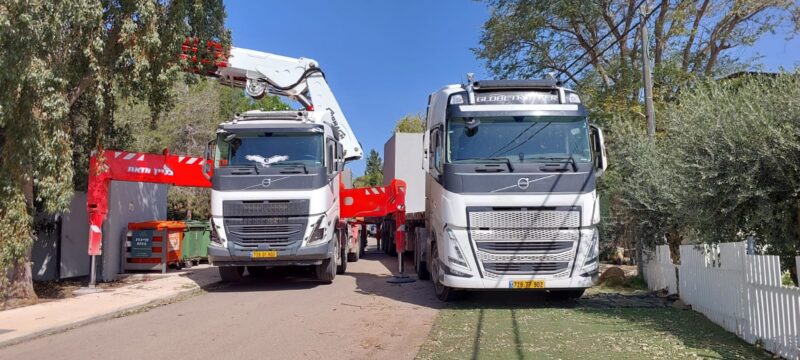
courtesy/JNF-USA
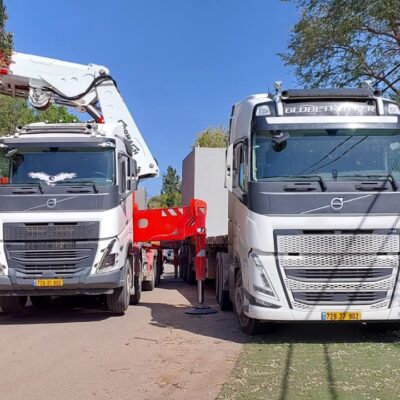
A mobile bomb shelter is installed in northern Israel with funding from the Jewish National Fund-USA.




 Add EJP on Google
In the nearly four weeks since the U.S. and Israel launched military strikes against Iran, Jewish National Fund-USA has raised $10 million to meet urgent and long-term needs in Israel, providing bomb shelters, fire trucks, resilience centers and civilian security equipment, the organization’s CEO, Russell Robinson, told eJewishPhilanthropy.
Every few days since Feb. 28, the organization has held emergency briefings on Zoom featuring Israeli politicians, community leaders, civil society officials and high schoolers. Sessions have drawn increasingly large numbers, peaking at Tuesday’s event, which had 1,400 attendees. According to Robinson, the community is motivated to help and ready to mobilize. “All of our people activated, calling on their friends and getting them together,” he said.
The funds were raised from over 2,500 individual commitments — some big, some smaller. “Did we have a million-dollar gift? Yes,” Robinson said. “But did we have a lot of $10,000 and $25,000 [gifts]? Yes. We had a lot of $1,000 and $500 [gifts] as well.”
In addition to the $10 million, JNF-USA received a $4 million gift from a donor in Atlanta earmarked for the JNF’s World Zionist Village in Beersheva, which will include a second campus for the JNF’s Alexander Muss High School, facilities for college and gap-year students and a conference center; a $1.5 million gift from a donor in Phoenix to build one of 15 Emergency Response Centers, bringing together volunteers in security, fire and rescue; and two $500,000 commitments from donors in Philadelphia and New York — one for building the Galilee Culinary Institute by JNF in Kibbutz Gonen in northern Israel, which opens in January 2027, where students “get to learn about 82 different nationalities of cooking called Israel,” according to Robinson, and another to establish an endowment for scholarships to the institute.
The $10 million is being spread across the “ecosystem” of “affiliates on the ground” in Israel, Robinson said, including Makom, HaShomer HaChadash and Adam V’Adama. The funds are being used to purchase bomb shelters, supplies for first responders and protective vests and helmets for park rangers. JNF is backing mentoring support for 1,120 children and adults with disabilities whose programs were closed because of the war, and JNF has ordered 55,000 packages from 162 small businesses in Israel’s North and South that are being delivered to lone and injured soldiers, supporting both the soldiers and the local businesses.
“When crises arise, we don’t have to scramble, because we are already there,” Deb Lust Zaluda, JNF-USA’s president, said on Tuesday’s webinar about the organization’s ability to rush into action.
Since the Oct. 7 massacres, JNF-USA has raised $500 million to support communities in Israel’s North and South. Currently, the JNF-USA has 674,000 donors, with the goal of reaching 1 million “voices for Israel” over the next 10 years, Robinson said. “We love million and multimillion-dollar gifts, but we want to make sure that we’re all still growing our donor base. Our fastest-growing part of our donor demographic is our 22- to 40-year-old [cohort].”
With Passover beginning next week, many families in Israel don’t know if they will be spending the holiday together because of the war. Countless schools have been shuttered since the fighting began, and children — and parents — haven’t had full nights of sleep due to rocket fire triggering sirens causing them to rush into shelters. The Eshkol region, which borders Gaza and has suffered thousands of rocket attacks from the strip over the past two decades and was one of the hardest-hit regions during the Oct. 7 massacres, is now being used as a refuge for residents from the North.
“How crazy can it be that suddenly we are becoming [a] safe haven,” Michal Uziyahu, mayor of the Gaza-adjacent Eshkol Regional Council, said during Tuesday’s webinar. “But relative to other places in Israel, this is a good place to be in right now.”
Even amid the chaos, “one of the greatest things that keeps [Jews] going is that we believe in hope,” Robinson said. “Our national anthem is one of hope. We talk about tomorrow. We’re going to celebrate Passover, and it’s always about the better day tomorrow.”
Related News

MAJOR GIFTS
Center for Jewish History celebrates 25 years with a $25M matching grant
CLOSING WORDS
In AZM address, Cosgrove links communal ‘orthodoxy’ on Israel to rising anti-Zionism among young Jews
ADVANCING A VISION
N.Y. federation donates $1M toward building shared-society center named for peace activist killed on 10/7
EXIT INTERVIEW
Elizabeth Sokolsky, longtime EVP of Birthright Israel, to retire next year
EXCLUSIVE
Detroit-based philanthropists Nancy, James Grosfeld donate $8M to renovate JDC’s Israel campus