WHAT YOU SHOULD KNOW
Jewish People reach ‘inflection point’ as Gaza war ends, new normal begins
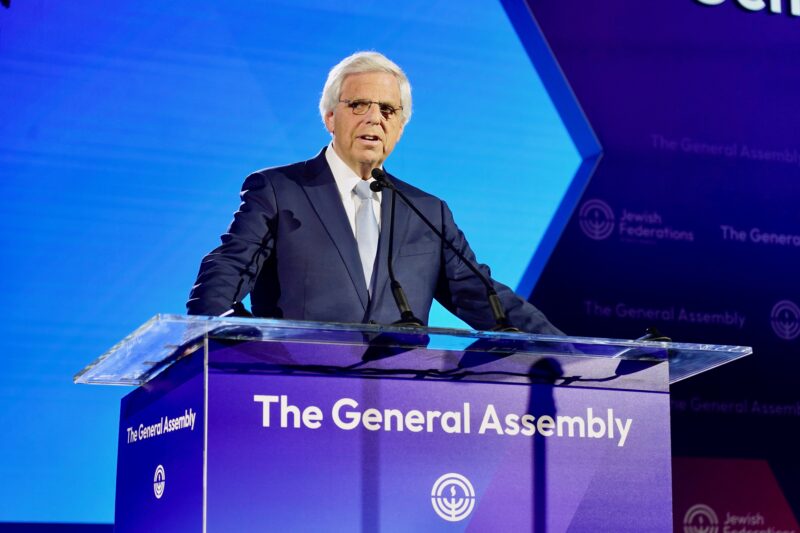
courtesy/JFNA
Gary Torgow, board chair of the Jewish Federations of North America, addresses the group's General Assembly in Washington on Nov. 16, 2025.




 Add EJP on Google
Just over one month into a ceasefire agreement between Israel and Hamas — with all of the living and all but three of the slain hostages returned — the Jewish Federations of North America is marking an “inflection point,” as it pivots from crisis funding to a new kind of normality, at its General Assembly, which opened on Sunday in Washington.
“Today, in this room and across the Jewish People, we stand united at an inflection point,” JFNA’s board chair, Gary Torgow, announced at the opening plenary on Sunday evening.
This includes an end to the organization’s Israel Emergency Campaign, which raised $907.5 million and distributed more than $839.6 million to Israeli causes following the Oct. 7 terror attacks, in favor of a new “Rebuild Israel” initiative. “Our federations mounted the largest emergency campaign in Jewish history. We supported more than 500 NGOs throughout Israel. We advocated in city councils and state legislators, in the halls of Congress, and we protected our people from thousands of threats through LiveSecure and now our frontline effort, led by our terrific leader and my dear friend, Julie Platt, who is here today,” Torgow said, referring to his predecessor, who has continued to oversee the LiveSecure initiative that she helped create.
Nearly a year into a new, Republican administration, JFNA is also prioritizing Jewish day schools, buoyed by a new federal tax credit for private religious schools that was included in the latest budget bill.
“Formal Jewish education has now been lifted to be one of the Jewish Federation of North America’s highest priorities,” said Torgow, who has long supported Jewish day schools in his hometown of Detroit. “We understand its success. We understand [that] its success or — God forbid — failure will be the legacy of this generation, and we will and must do our part. Jewish Federations of North America’s public affairs committee, led by Jason Wuliger, has urged every state to opt into the new federal education tax credit, a step that can transform Jewish education accessibility nationwide, and we will strengthen and support with every effort we can muster civic engagement to work with our political leadership on every level of government, to protect and strengthen and encourage Jewish life.”
While Jewish day schools may now be designated as a top priority for the group, JFNA has been involved in the field for some time, albeit primarily focused on funding, not advocacy. Following last year’s General Assembly, JFNA convened a meeting of roughly 100 donors to discuss the topic.
This year’s GA agenda is so far lacking some of the marquee speakers that it boasted in recent years. There are currently no Trump administration officials listed on the agenda — a change from last year, when Biden administration Homeland Security Secretary Alejandro Mayorkas spoke. Initially, no national politicians were scheduled to speak, but Sen. John Fetterman (D-PA) and Sen. Ted Cruz (R-TX) were added to the lineup.
There are no Israeli officials speaking at this week’s gathering, unlike last year when Israeli President Isaac Herzog addressed the gathering.
While the focus of this year’s General Assembly is on this pivot to a new set of circumstances and priorities, JFNA also invited four freed hostages — Noa Argamani, Avinatan Or, Evyatar David and Guy Gilboa-Dalal — to the event to share their experiences, reminding those in attendance of how we got here.
The program then pivoted to a distinctly North American lens, with a panel featuring CNN contributor Scott Jennings and longtime Democratic operative and diplomat Rahm Emanuel, which was moderated by Fox News host Jessica Tarlov. The discussion centered on antisemitism across the political spectrum. Jennings argued that the post-war period could present significant diplomatic opportunities, while Emanuel cautioned that rising anti-Israel sentiment among younger Americans may pose long-term challenges for the U.S.–Israel relationship.
“I think you know what we’re seeing on the left and the right, not only about Israel, but now fully openly about Jews and who they are, sits on the precipice. It can go either way,” he said. “I think people of good purpose and good clarity have a responsibility, and I think that it’s to be honest, because of where it is right now, it’s a conflict. I’m not ready to say it’s going to land heads, we win.”
The opening plenary closed out with a panel consisting of former White House speechwriter and author Sarah Hurwitz, Israeli thought leader Micah Goodman, and vice president of Canada’s Centre for Israel and Jewish Affairs Richard Marceau, who analyzed the impact of the last two years in America, Israel and Canada, respectively.
Addressing increasing anti-Zionism among young North American Jews, Hurwitz urged a renewed emphasis on deep Jewish education.
“It’s becoming increasingly clear that the kind of content-less ‘bagel and lox Jewish mother joke’ identity that many American Jews have just doesn’t cut it anymore,” said Hurwitz. “When your Jewish identity is a big empty void with a few ethnic jokes rattling around in it, it will be filled by what is around you,” she said.