GETTING BETTER
JCC Global’s ‘Good to Great’ offers international lifeline to Ukrainian communities under fire
Initiative connects JCCs in Ukraine with 'sisters' in the United States and elsewhere, allowing for joint programs — and fundraising

Courtesy/JCC Global
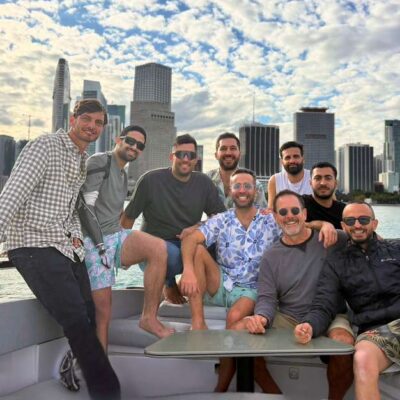
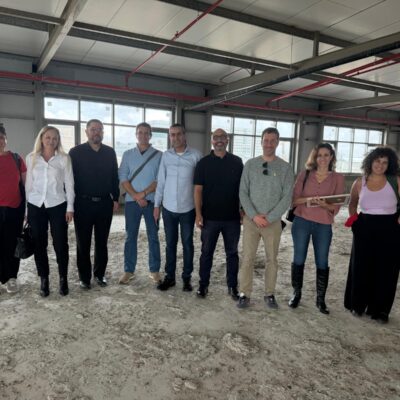
Several of the young European Jewish community leaders at the JCC Global conference in Budapest, Hungary, in December 2024.




 Add EJP on Google
Despite power shortages, lack of heating and destroyed infrastructure, Ukrainian participants in the JCC Global’s “Good to Great” program continue to show up for their regular monthly Zoom calls with their international partners, wrapped in blankets but eager to connect with other Jewish communities as the war in Ukraine has entered its fourth year.
Launched in late 2024 in response to the continuing hostilities, the Good to Great program connects JCCs from Ukraine with counterparts in North America, Israel, Europe and Latin America, supported by the Jewish Federations of North America. Thousands of people have benefited from the program so far, according to its creators.
“One of the most unexpected experiences was how deeply our international partners empathized with our reality,” said Inessa Nosenko, director of Mazal Tov JCC, and Kseniia Nikishyna, project coordinator of Mazal Tov JCC in Zaporizhia, Ukraine, in a written response to questions from eJewishPhilanthropy. “We did not expect them to feel our pain and challenges so personally, nor to engage with such sensitivity and care. This level of emotional involvement went far beyond formal cooperation.”
The program has become a vital place of connection with other Jewish communities, serving as a crucial lifeline for Ukrainian JCCs and their members by offering support and a sense of Jewish community and unity through the cooperative projects they developed, the women said.
“At the same time, we were surprised by how much the communication with partners helped our women and participants emotionally. Through dialogue and shared experiences, many of them were able to momentarily step out of daily stress and difficulties, feel supported, and regain emotional strength,” they added. The mutual empathy became one of the most valuable outcomes of the project, they said. “It showed us that global connections are not only about learning and exchange, but also about healing, solidarity, and the ability to support one another even across great distances.”
The program, designed to develop global partnerships and bolster the sustainability of JCCs and support the Ukrainian Jewish community, has surpassed expectations, fostering collaboration and support even amidst the ongoing war, noted Smadar Bar-Akiva, JCC Global executive director.
The program partners 11 Ukrainian JCCs with 10 JCCs in North America, six in Israel, three in Europe and two in Latin America. The December 2024 meeting in Budapest brought together the JCC leaders, where they formed partnerships and brainstormed ideas for projects for each group, which were put into motion over the past year.
The projects range from online tutoring, family history projects and producing a movie from interviews with Holocaust survivors to sharing culinary traditions, women and teen Jewish empowerment projects and photography workshops. The cooperative nature of the projects helps build the global partnerships, provide support, and ensure the resilience and sustainability of Jewish life in Ukraine during this period of intense crisis, Bar-Akiva said.
In addition, the mentorship component of the program has proven invaluable, she said. Through peer learning and expert guidance, JCC leaders have shared knowledge on fundraising, program development, and Jewish education, strengthening the sustainability of the JCCs.
The general idea for the program, which was developed into concrete intiatives at the Budapst gathering, was first proposed some three years ago, with the goal of helping rejuvenate the Ukrainian Jewish community after the war. No one could have imagined then that the war would still be raging four years later, said Bar-Akiva.
“It became really like an existential need for them to connect with other communities,” she said. “It’s four years into the war. In the last few weeks and months, we’ve seen a terrible situation in Ukraine. They have electricity [only] a few hours a day. Sometimes they don’t have water, sometimes they don’t have heating, so the situation deteriorated. This program has become their connection to the outside world, which at times feels like it has forgotten them.”
In addition to the one-on-one connections that Good to Great has created, more than $200,000 has gone directly to JCCs in Ukraine as a result of the program, Bar-Akiva said. The program has also inspired concrete acts of support, such as the Brooklyn Edith and Carl Marks Jewish Community House of Bensonhurst community sending winter clothing to their sister JCC in Dnipro, Ukraine, she said.
JCC Global program coordinator Shanie Barenboim noted that creating such a sense of Jewish peoplehood can’t be taken for granted and needs to be prioritized.
“In the beginning, many JCCs were a bit suspicious, and they didn’t understand exactly what it means to have Jewish peoplehood in your JCC,” said Barenboim. “But after getting to know each other in Budapest and later having those monthly conversations together, you could see that something changed in their perspectives, that they took it with them, this understanding of having a sister community or a sister JCC with people who are eager to know each other, to know other communities, other traditions. Because in the end, we’re all one Jewish people, and we care for each other. This ability to have a connection with a significant person in other JCCs in another country, in another community, it connects us more and it bonds [us] together.”
The Good to Great program is nearing its planned end, but efforts are underway to secure continued support, she said, acknowledging that without the support system provided by JCC Global the program will be unable to continue. A JCC Global world conference is scheduled for Nov. 16-19, 2026, in Jerusalem, Bar-Akiva said, with the initial 24 hours dedicated specifically to fellows from the “Good to Great” program.
“With the suffering, with growing antisemitism [worldwide] the need to connect is something more than just social,” said JCC Global program director Noa Tal. “[Good to Great] provides a response to something that is beyond practical. It is survival. It answers this real need so hopefully it will last.”
Witnessing life in Ukraine during wartime firsthand, including power outages and infrastructure disruptions, gave the participants from Bensonhurst a “profound and lasting understanding of resilience, vulnerability and responsibility,” said Alex Budnitsky, executive director of the Marks JCH of Bensonhurst, in a written response to eJP.
It has continuously inspired them to do more, he said, and helped them build a true partnership rather than just a transactional relationship, enabling them to respond quickly to emerging needs above and beyond the tutoring project. Over the last year, in addition to the community winter coat drive for 150 children, the organization was also able to provide Dnipro with laptops and tablets for the tutees who did not have access to technology, he said. The JCC is also in the midst of raising funds to purchase power hubs to respond to the electricity outages due to daily Russian attacks.
“This experience reinforces that Jewish peoplehood is not abstract; it is lived through responsiveness, trust and sustained commitment,” he said.
The program’s success has also pointed to the need for connection with other Jewish communities, not only by the Ukrainian Jewish community. Participants like Yani, 42, a member of the Buenos Aires Macabi JCC who asked not to use her last name, expressed the need to “build real connections, to feel accompanied and to strengthen this sense of shared identity and responsibility.”
“We are facing different challenges,” she said, “but we are clearly part of the same story.”
Related News

MAJOR GIFTS
Center for Jewish History celebrates 25 years with a $25M matching grant
PRESIDENTIAL REBUKE
Israel’s Herzog: Mamdani ‘makes no effort’ to hide disdain for Israel, Jews must fight back

MAGICAL EXPERIENCE
Shefa launches psychedelics retreat for Jewish professionals suffering burnout

EXCLUSIVE
Detroit-based philanthropists Nancy, James Grosfeld donate $8M to renovate JDC’s Israel campus
ADVANCING A VISION
N.Y. federation donates $1M toward building shared-society center named for peace activist killed on 10/7