Opinion
KEEP CALM
How the law will protect Jewish New Yorkers, even under a Mamdani administration




 Add EJP on Google
In Short
The law is on our side, we know how to use it and we have built an infrastructure to match the moment
Last week Mayor-elect Zohran Mamdani failed the first test of his promise to protect all New Yorkers. After an antisemitic mob gathered outside Park East Synagogue in Manhattan and attempted to block Jews from attending a Nefesh B’Nefesh event about making aliyah, Mamdani condemned the synagogue’s choice of programming.
That reaction tells us everything we need to know about the worries surrounding the incoming administration. These legitimate concerns have nothing to do with Mamdani’s race, religion, age or any personal characteristic. They are rooted entirely in what he has said, done and run on. But fear is not the appropriate response, because the Jewish community has endured far worse than a grandstanding demagogue — and because the law, when used correctly, remains a very strong safeguard.
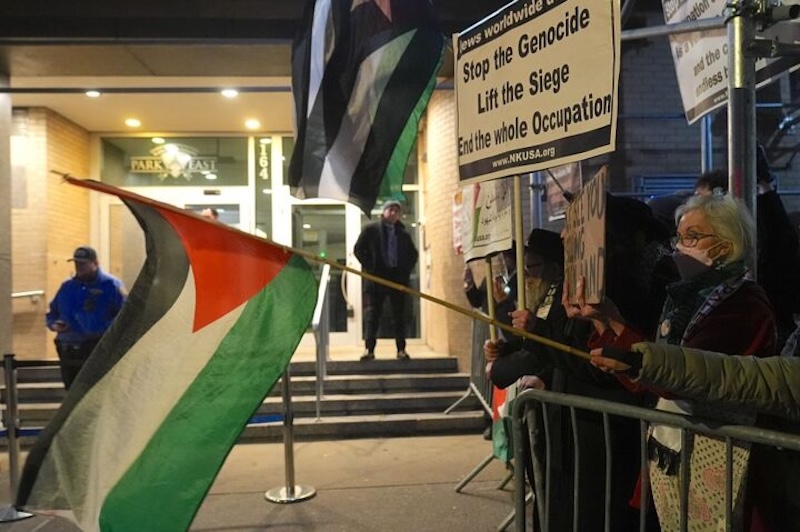
Selçuk Acar/Anadolu via Getty Images
Anti-Israel demonstrators gather at 'No Settlers on Stolen Land' protest against a Nefesh b'Nefesh event at the Park East Synagogue in Manhattan
At the National Jewish Advocacy Center, we have spent the last two years building and refining a comprehensive civil-rights strategy to protect Jews across the country. Our message is simple: We are going to be fine. The law is on our side, and we know how to use it. The Park East incident provides a real-time example of how those protections can work, and how they will continue to work even under a hostile administration.
To begin, the Freedom of Access to Clinic Entrances (FACE) Act is widely known for its protection of reproductive-health clinics, but it also contains another provision prohibiting the use of force, threats or physical obstruction aimed at interfering with “the First Amendment right of religious freedom at a place of religious worship.” FACE was deliberately drafted to provide federal and private backstop remedies when local government cannot — or will not — protect targeted communities from coordinated intimidation. Content-neutral and ideology-blind, it applies equally no matter the perpetrator’s motivation; all that matters is their conduct.
Federal law recognizes religious exercise broadly: attending prayer services, Torah study sessions, religious lifecycle events and educational or organizational events tied to religious commandments or observance — including those related to mitzvot such as aliyah — all fall squarely within FACE’s protection. The first such aliyah case was brought by NJAC with our partners at Holtzman Vogel after the Adas Torah riot in Los Angeles in 2024. The Department of Justice filed a statement of interest in support of our position, and since then has explicitly included aliyah events as protected acts of religious worship.
If the protesters return and the mayor won’t step in, we are fully prepared to FACE them.
What about the administration? The initial response by the New York Police Department was inadequate, but Mayor Eric Adams and Commissioner Jessica Tisch immediately acknowledged that failure — Tisch even went to the synagogue to apologize personally. Mamdani’s response, by contrast, signaled something far more troubling: Under his leadership, the NYPD might not only fail to protect Jewish New Yorkers, but might even blame them for being targeted. So what happens if the next Park East unfolds under a Mamdani administration? The answer is straightforward: Section 1983.
Enacted as part of the Civil Rights Act of 1871, Section 1983 remains one of the most powerful civil-rights enforcement tools in American law. Designed to stop local officials from looking the other way as minorities were attacked after the Civil War, it still serves as a lifeline when the government itself becomes the source of discrimination. Section 1983 does not create new rights; rather, it provides the mechanism for private citizens to sue state or local officials who, acting “under color of law,” violate rights guaranteed by the Constitution or federal statutes. “Under color of law” simply means using authority derived from a government position — a category that includes mayors, agency heads, police officers and even private entities performing government functions.
In the context of antisemitism, the constitutional rights at issue may include equal protection (Fourteenth Amendment), free exercise and free speech (First Amendment) or due process violations (Fifth Amendment). So, for example, if an administration made discriminatory statements and engaged in selective enforcement when a mob descended on a synagogue (unequal protection), in part because it disfavored their protected speech (viewpoint discrimination), and the police at the scene engaged in conduct that was deliberatively indifferent (a substantive due process violation), that would engender a Section 1983 lawsuit based on all three of those rights.
Another critical tool is Section 1981 of the Civil Rights Act of 1866, a Reconstruction-era statute guaranteeing that all persons in the United States, regardless of race or ethnicity, have the same right “to make and enforce contracts, to sue, be parties, give evidence, and to the full and equal benefit of all laws and proceedings for the security of persons and property” as white citizens. Although most often used in contract disputes, that final, rarely invoked clause applies directly to bias-motivated attacks and unequal treatment that interfere with a person’s physical security.
This became crucial in Sumrall v. Ali, a case we brought in Washington, D.C., last summer after a Jewish woman was assaulted for wearing an Israeli flag. The defendant claimed her conduct was merely “anti-Israel,” not antisemitic. The federal court rejected that argument outright, noting that she had no reason to believe our client represented the Israeli government and that the attack plainly targeted a Jewish woman displaying a universally recognized symbol of Jewish identity.
That ruling is especially important in New York, where Mamdani claims that anti-Zionism is not antisemitism. A mayor cannot rewrite state hate-crime law, but he can influence whether antisemitic attacks are treated as such — by shaping the police response, the data collection, and the public-messaging apparatus that determines which cases “count.” A mayor can defund, redirect, or deprioritize hate-crime investigations simply by adjusting the Office for the Prevention of Hate Crimes’ budget.
At least one act of violence occurred at the Park East protest. Authorities are still investigating, but for illustration let’s assume the victim was targeted for expressing their Zionism. If an administration later tries to downplay or relabel such conduct, federal law provides the remedy: We can and will file Section 1981 claims, as we have in D.C. and elsewhere, to ensure such attacks are properly recognized as antisemitic under federal civil-rights standards.
Many other laws also come into play. Mamdani may soon discover that government officials can be sued for defamation when they act outside the scope of their official duties. A mayor, for example, could be sued for falsely branding a person or organization a war criminal — exactly the issue in the case we filed against Francesca Albanese. These doctrines also interact: defamation alone is not a constitutional violation, but when defamatory statements are paired with the deprivation of a protected right, they become a federal civil-rights claim. So if a hypothetical mayor falsely labels a Jewish organization “criminal,” and city agencies then refuse permits, block funding, or withhold police protection, Section 1983 offers a direct path to court and accountability; and if the city also denies leases or contracts to Jewish groups while approving them for similarly situated others, we would add a Section 1981 claim as well.
It is also worth noting that our work is not reactive; we have built an infrastructure to match the moment. In 2024, NJAC created the Institute for Litigation Coordination, a first-of-its-kind national system tracking antisemitism-related cases across the country on behalf of dozens of partner organizations. It helps ensure that no case falls through the cracks and that our community deploys its legal resources strategically and systematically. We also launched the nation’s first-ever Antisemitism Law Clinic at Touro Law School, where we are training a new generation of Jewish civil-rights attorneys.
It is true that New York’s mayor elect has praised convicted Hamas funders, pledged to dismantle critical NYPD units and vowed to strip nonprofits of tax-exempt status for supporting Israel. That is concerning — but concern is not the same as fear. The Jewish community has weathered far worse with far fewer tools. Today we have the FACE Act to stop mob intimidation at synagogues, Section 1983 to hold government discrimination accountable, Section 1981 to ensure antisemitic attacks are recognized and remedied under federal law, defamation doctrines that prevent officials from smearing Jewish groups with impunity, a national litigation-coordination network to deploy these protections strategically and a new generation of civil-rights advocates trained through the country’s first Antisemitism Law Clinic. These tools demonstratively work, and we are prepared to use every one of them.
So take a deep breath: We are going to be fine. The law is on our side, and we know how to use it.
Rabbi Mark Goldfeder is the founder and director of National Jewish Advocacy Center and a professor at Touro Law School.