WHAT YOU SHOULD KNOW
Australian antisemitism inquiry highlights crucial difference between safety and feelings of safety
George Chan/Getty Images
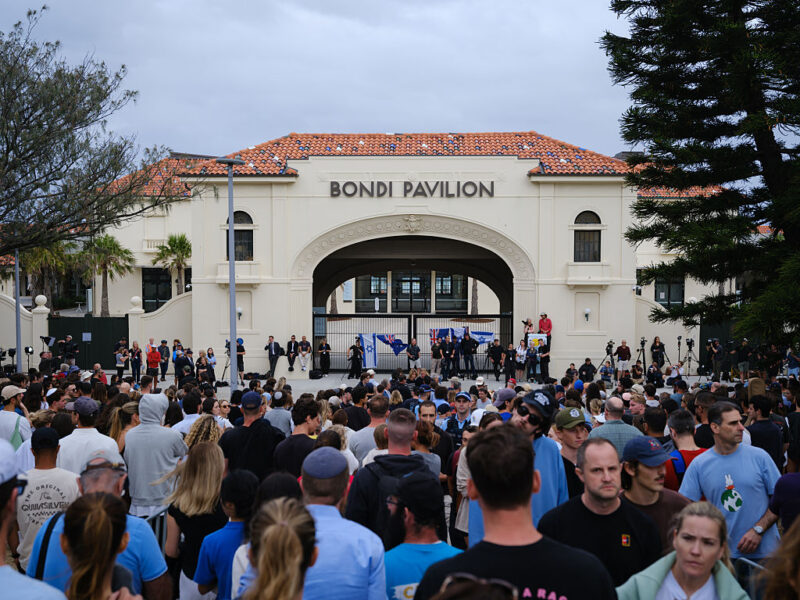
Members of the public lay flowers at a memorial at Bondi Pavilion in the wake of a mass shooting at Bondi Beach yesterday, on December 15, 2025 in Sydney, Australia. Police say at least 16 people, including one suspected gunman, were killed and more than 40 others injured when two attackers opened fire near a Hanukkah celebration at the world-famous Bondi Beach, in what authorities have declared a terrorist incident.




 Add EJP on Google
A glaring disparity — between safety and perceptions of safety — can be found in the interim report released yesterday by Australia’s Royal Commission on Antisemitism and Social Cohesion, the inquiry launched in response to December’s deadly terror attack at a Hanukkah event at Sydney’s Bondi Beach.
This distinction, seen in the gap between the Jewish community’s warnings ahead of the event and local law enforcement’s assessments of those warnings, has far-reaching implications outside of Australia’s borders, both for state security services and Jewish communal groups.
As violent antisemitism rises around the world — seen most apparently in this week’s stabbing attack in a heavily Jewish suburb of London and in last month’s attempted terror attack at Temple Israel outside Detroit — recognizing the difference between feelings of safety and actual safety becomes critical. The increasing isolation, exclusion and discomfort that many Diaspora Jews have reported feeling over the past 2 ½ years are serious concerns for the long-term health of the community. But conflating those social and psychological issues with physical safety concerns runs the risk of having those security threats be dismissed or discounted.
The interim report, parts of which are redacted, examines the circumstances around the attack, from the country’s legal frameworks, intelligence gathering, preparations for the event and the emergency response to the terror shooting. Roughly a quarter of the way through the 159-page document, the report examines the coordination between the local Jewish security organization, Community Security Group New South Wales (CSG NSW), and the local police.
The commission, led by Judge Virginia Bell, noted that CSG NSW had communicated with police ahead of the event and warned them that the “National Terrorism Threat Level was ‘probable’” and that the Jewish community was on “heightened alert” ahead of the event.
“CSG NSW passed on its threat assessment to NSW Police on 8 December 2025, characterising its threat rating as ‘high’, and stating ‘a terrorist attack against the NSW Jewish community is likely [emphasis theirs] and there is a high level of antisemitic vilification,’” the report said.
Yet despite the warning of a high likelihood of an attack, the police dispatched just three officers and a supervisor to the event — and just for part of it. “No need to stay the entire duration, but your presence will ensure the community feel safe,” an email to the officers read.
While it is easy to say with the benefit of hindsight, the Jews gathered at Bondi Beach did not need to “feel safe,” they needed to be safe, and they weren’t. Armed with rifles and handguns, two gunmen killed 15 people at the candlelighting event, including a Holocaust survivor and a 10-year-old girl, and wounded dozens more.
The report also noted that CSG NSW volunteers were not permitted to carry firearms at the event, despite requests to do so, as police said the event was too public. (CSG NSW members can be permitted to carry firearms at private events.) Had they been armed, the Jewish security personnel on the scene likely would have more quickly shot the gunmen, ending the attack and saving lives.
Though this was not explored in-depth in the interim report, the New South Wales Police evidently failed to take the Jewish security organization’s threat warning seriously, seeing Jewish communal concerns as being a matter of perception and feeling, instead of physical safety.
Jeremy Liebler, president of the Zionist Federation of Australia and a longtime local Jewish leader, told eJewishPhilathropy that while the police were wrong in that assessment, it was understandable why — to at least a certain extent — given the unprecedented nature of the attack, one of the deadliest in Australian history.
Liebler, who has been a vocal critic of the current government’s response to antisemitism in Australia, said that while he had repeatedly warned that greater violence was to come following multiple cases of vandalism and a terrorist arson attack, even he did not expect the kind of carnage seen at Bondi Beach. “If you had asked me if something like this was going to happen, I would have said no way,” Liebler told eJP.
“It’s not how Australians see Australia, even if Australia has changed,” he said.
Lieber, whose law firm Arnold Bloch Leibler is representing Australian Jewish communal organizations in the commission proceedings, said that despite the growing number of violent antisemitic attacks in Australia that preceded the Bondi Beach massacre, the community itself — not just police — was primarily concerned with the “psychological” elements of Jew hatred, the social exclusion and isolation.
“There was a gap between actual physical safety and psychological safety,” he said. “There was a gap, until suddenly the two met.”
Lieber praised Australian Prime Minister Anthony Albanese for adopting the independent commission’s 14 interim recommendations (five of which are classified). This includes providing greater security for Jewish events and a gun buyback program.
Lieber noted the limited scope of the interim report, saying that the commission’s full inquiry is only beginning now, with testimonies due to be heard in the coming weeks.
Yet Lieber said that the commission has already started to improve security conditions for Jewish Australians, citing police assistance in facilitating the post-attack visit by Israeli President Isaac Herzog. He added that universities, which Jewish groups have long demanded take a harsher stand against antisemitism, are also now adopting measures to do so.
“The universities are doing it because they know that they are going to be hauled before the commission and torn apart,” he said.