CULTURAL REVOLUTION
As Arab Israelis struggle with high murder rate, arts institutions see major influx of state funds
Culture Ministry official leading the $107 million five-year plan tells eJP that such Arab cultural programs are particularly needed post-Oct. 7 to mend divisions
COURTESY/Jon Elkins
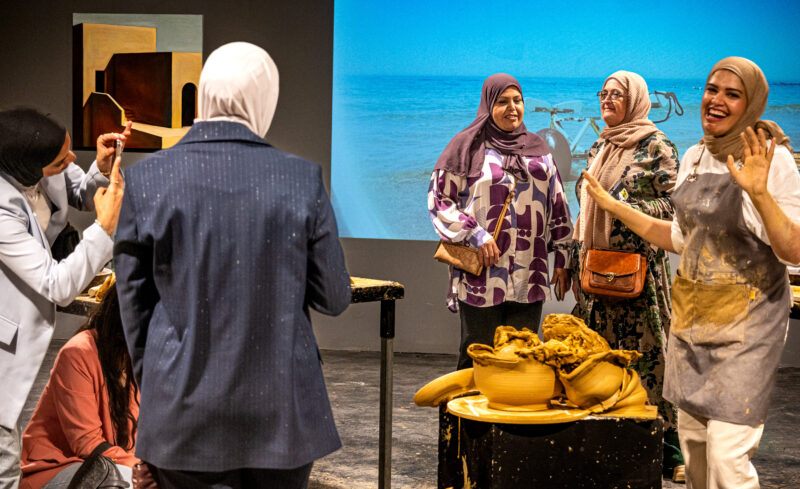
People attend the opening of a new art space, 'The Mill,' in south Tel Aviv-Jaffa, on Oct. 24, 2025.




 Add EJP on Google
For Israel’s Muslim and Arabic-speaking populations, the past four years have been among the most consequential in their history.
First, in 2021, the Islamic Ra’am party joined the so-called “change” government, marking the first time that an Arab-majority party served in an Israeli coalition. The following year, they were voted out, with the government replaced by one of the most right-wing coalitions in the country’s history. That change in government has coincided with an unprecedented rise in homicides in the Arab Israeli community. Dozens of Muslim Israelis, mainly from the southern Bedouin community, were killed in the Oct. 7 terror attacks and in the following two years of war, which have further challenged the community as it grapples with its connection to the State of Israel and its concerns for its coreligionists in the Gaza Strip.
But alongside all of these obvious, high-level political and social developments, a quieter cultural revolution has slowly been taking hold in Arab Israeli society as more than $107 million in government funding has flown into the community’s arts institutions, establishing new galleries, theaters, museums and schools throughout the country.
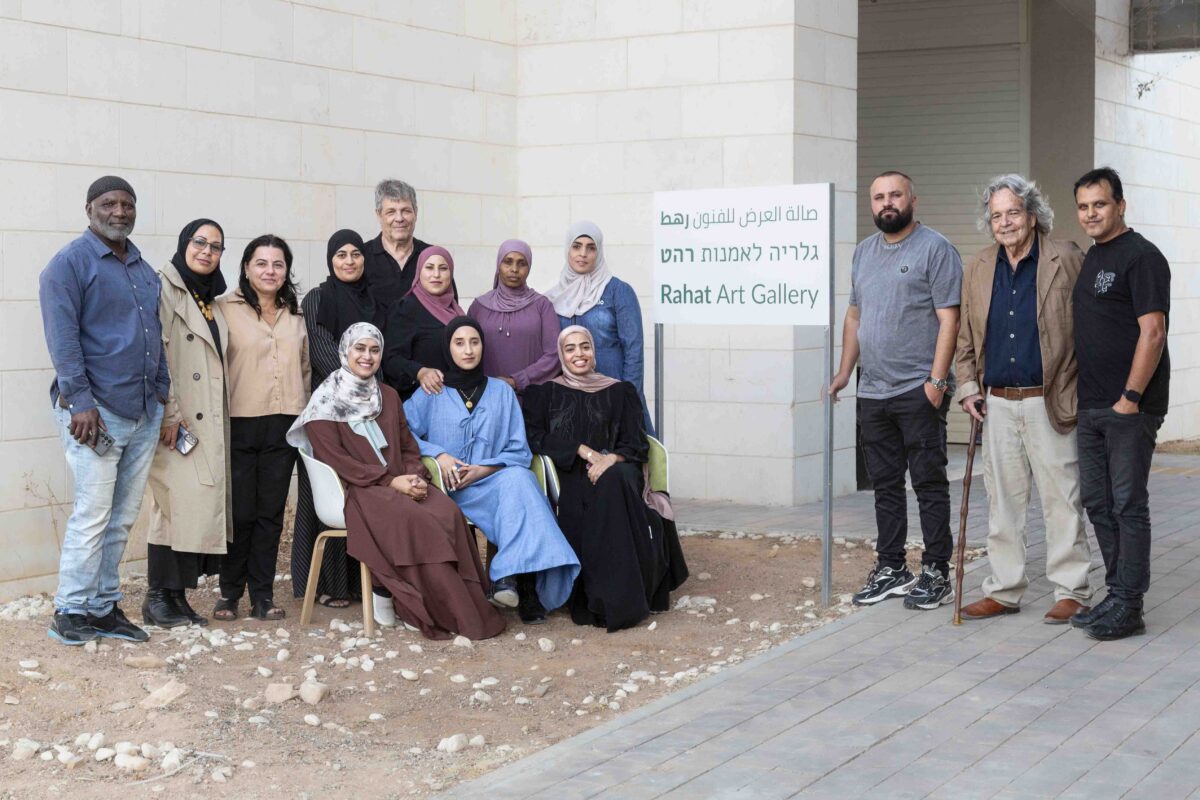
“We can now say: Rahat has an art gallery!” declared Talal al-Krenawi, the mayor of the Bedouin-majority city, northwest of Beersheva, at the opening of the municipality’s first such institution on Sunday.
Alongside the excitement, al-Krenawi lamented the unprecedented wave of violence that has been sweeping through Arab Israeli society. “Every morning we read the news — another murdered, another wounded,” he said.
“We must strengthen informal [educational] activities,” al-Krenawi added. “If we don’t deal with violence together, through education, through culture, through enforcement — it will reach everyone. The murder reached Tel Aviv yesterday. No one should think they’re immune.”
In 2024, 230 Arab Israelis were murdered, according to the Abraham Initiatives, a nonprofit that tracks violence in Arab society. The previous year saw an even worse record: 244 murders in 2023, more than double the 116 killed in 2022.
The escalation is dramatic. Arab citizens comprise roughly 21% of Israel’s population but accounted for 74% of murder victims in 2023 and 2024. According to the Taub Center for Social Policy Studies, the Arab-to-Jewish homicide ratio, which stood at 4-to-1 until 2015, has skyrocketed to 14-to-1 in 2024. Less than a fifth of murder cases are solved, and critics argue that government neglect has allowed the crisis to worsen.
Rahat, the largest Arab and only Bedouin city in Israel, also paid a heavy price in the Oct. 7 attacks: 21 Bedouins from Rahat were killed in the Hamas attack and subsequent rocket fire, and six were taken hostage. Youssef Ziyadne, 53, a father of 19, and his son Hamza, 22, were taken hostage while working at the cowshed of Kibbutz Holit, where Youssef had worked for nearly two decades.
Yesterday’s celebration of the gallery opening was part of an extensive government investment in the Arab sector, a seemingly incongruous phenomenon in the current political atmosphere.
In 2021, Israel’s “change government” under Naftali Bennett, then head of the New Right party, and Yair Lapid, of the centrist Yesh Atid party, included support for culture in a five-year strategic plan for Israel’s Arab population as part of the coalition agreement with the Ra’am party.
In 2022, Israel’s Ministry of Social Equality and Ministry of Culture and Sport announced $107 million in cultural funding as part of a broader allocation to promote Arab employment and close economic gaps.
The cultural program includes establishing art galleries in Rahat, Jaffa and Nazareth, a first-of-its-kind art museum in Umm al-Fahm, a theater school in Rahat where the first cohort recently began studying, a cinema in Nazareth and a cultural heritage center. Ten cultural managers have been appointed in ten local authorities through the “Cultural Leadership in Arab Local Authorities” program. Existing cultural institutions also received $10 million for renovations with an emphasis on accessibility, and historical sites are being officially designated and made accessible.
The plan was stalled several times, when the current government resisted and ultimately approved it, and again following the Oct. 7 attacks and the war.
Ayat Rahal, a Ministry of Culture and Sport official, has been leading this five-year program, along with Husni Shehade, who also serves as a senior lecturer at the Bezalel Academy. “My goal is that the Arab public won’t need to travel far to enjoy culture, watch a movie, or see an art exhibition. Therefore, I try to look at the unique needs of Arab society. This is a long-term strategic plan,” Rahal told eJewishPhilanthropy.
“Specifically now, in these times of division and the period after Oct. 7, we know how much culture has a significant role in strengthening community resilience and social resilience… and also in creating dialogue in Israeli society between our communities,” she said.
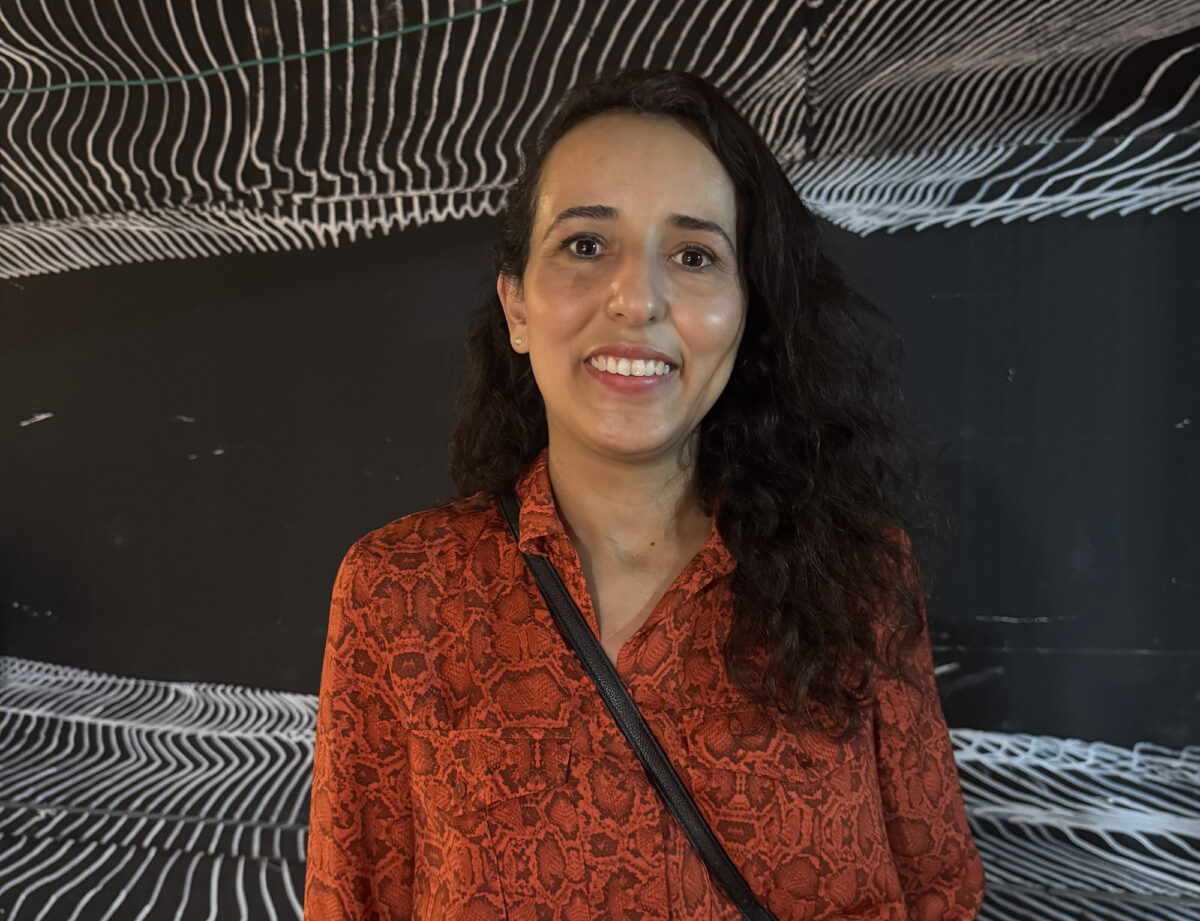
The Rahat Gallery opening in Rahat was held in a courtyard flanked by the Bedouin Heritage Center, the Rahat Public Library and the Rahat Cultural Center. Long tables filled with handmade ma’amul (date-filled pastries), za’atar-coated pita breads, fruits, and pots of hot tea and coffee greeted the local guests and municipal officials, as well as those who had come from the faraway center of Israel, including MK Waleed Alhawashla from Ra’am, Culture Ministry officials and Israeli curators and artists.
Inside the gallery, local Rahat women, all Bedouin and wearing traditional garb, presented their installations, as part of the exhibition titled, “The Beginning of memory,” and curated by Adi Yekutieli, an artist and curator.
Rahat’s gallery is part of a broader cultural transformation for the city. Guiding this transformation is Daniel Alter, former CEO of the Khan Theater in Jerusalem, who now serves as strategic advisor for culture and arts to the city of Rahat. Alter, who moved to Rahat after the Oct. 7 attacks, hopes to turn the city into a blossoming cultural metropolis.
On Oct. 24, as part of Tel Aviv municipality’s Love Art, Make Art weekend, Al-Mathaneh gallery opened on Salame Street, an industrial location on the seam where Tel Aviv meets Jaffa. With the relief of the ceasefire still palpable, hundreds of locals gathered to celebrate the momentous occasion of Tel Aviv-Jaffa’s first Arab art gallery.
The speakers, including representatives from the Culture Ministry and the Tel Aviv municipality, addressed the excited crowd in Arabic, conveying the sheer possibility and awakening the gallery had promised.
The 2022 tender required experienced curators. “Considering that there are few Arab curators here, we were lucky to have this approval,” said Rula Khoury, chief curator of Al-Mathaneh, who won the tender for the central region along with the Saraya Theater, directed by Mahmoud Abu Arisha.
The tender also required locating and renovating a historic building. “We toured several old stone houses and heritage sites in Jaffa, but eventually decided on this industrial space on Salame Street,” said Khoury. “The site carries rich symbolism.”
Al-Mathaneh, Arabic for “The Flour Mill,” occupies a space built as a mill in the early 1920s. In 1930, it was purchased by Shahadi Attallah, a member of a Jerusalem family, and became one of Jaffa’s main flour production centers until 1948. “In ’48, it was very heated in that area. There was a fight, and the millhouse was burned,” Khoury said. After the war, it was taken over by a Jewish-owned company that continued to store and produce flour there.
Khoury noted the lack of Arab galleries and cultural centers in the center of the country. “We have some galleries in Tamra, in the Galilee. A small one in Nazareth, Sakhnein. But as a fully funded five-year program, this is completely new,” she said. The gallery will include a lab where artists can experiment, create and receive support, with space for artist studios and residency programs.
The gallery space also initiates cultural projects open to the public in Jaffa. “The concept of this gallery is a full Palestinian Arabic gallery,” Khoury said. “Our programs will include lectures about the history of Palestinian art, workshops with artists to get to know more and to introduce the artists to the community.”
The Tel Aviv-Jaffa municipality has supported the effort, helping with the space and additional budgets. Everything is translated into three languages: Arabic, Hebrew and English. “We are open, very open, to welcome everybody,” Khoury said.
Khoury invited artists with personal connections to the historical city to engage with the mill’s architecture and history in various media. “It was very important for me to work with artists from Jaffa,” she said.
Yekutieli hopes that the Rahat gallery will be a meeting place for local artists and artists from all over the country. “I hope that it will be a place that creates dialogue and creativity as well as mutual human vulnerability that will show what is possible in our togetherness, especially now in our current reality.”
“We will see the fruits of this, just as we see and are excited today, for many years ahead,” Rahal said of the government program’s expected impact on Arab cultural life in Israel.”
As one of the artists from Rahat said: “If a person is holding a musical instrument, he can’t hold a gun.”
.
Related News
HIGHER EDUCATION
As Jewish donors reconsider academia, Jan Koum doubles down, endowing Israel studies at Stanford
EXCLUSIVE
Detroit-based philanthropists Nancy, James Grosfeld donate $8M to renovate JDC’s Israel campus
MAGICAL EXPERIENCE
Shefa launches psychedelics retreat for Jewish professionals suffering burnout

MAJOR GIFTS
Center for Jewish History celebrates 25 years with a $25M matching grant
CLOSING WORDS
In AZM address, Cosgrove links communal ‘orthodoxy’ on Israel to rising anti-Zionism among young Jews