ON THE SCENE
Amid lull in Iranian attacks, Israeli nonprofit leader shares wartime experiences with NYC funders
Leah Hershkovitz, the manager of the Israel Tennis and Education Centers’ Arad branch, discussed the missile attack on her community last month at the ITEC Foundation's women's luncheon

NIRA DAYANIM/EJEWISHPHILANTHROPY
Leah Hershkovitz, the manager of the Israel Tennis and Education Centers’ Arad branch, speaks at ITEC Foundation's women's luncheon in Manhattan on April 14, 2026.




 Add EJP on Google
It’s a long way from the sun-baked tennis courts of the southern Israeli town of Arad to the sleek event space atop a Park Avenue building with a wall of windows looking out over the Midtown Manhattan skyline.
But with the fighting between Israel and Iran on hiatus as the United States negotiates a ceasefire with the Islamic Republic, Leah Hershkovitz, the manager of the Israel Tennis and Education Centers’ Arad branch, attempted to bridge the gap yesterday between her community, which was hit by an Iranian ballistic missile during the war, and the upmarket crowd that had gathered for the ITEC Foundation’s annual women’s luncheon.
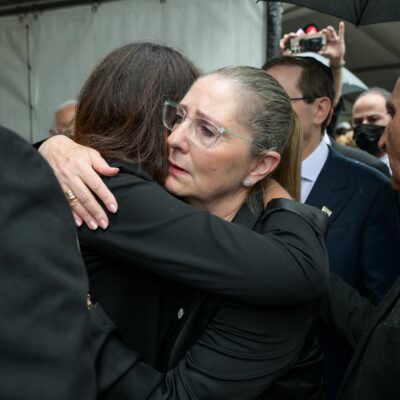
Speaking at The Diagrid Club, Hershkovitz not only offered a window into the wartime experiences of her organization and broader community, but also of her own family, whose longtime home was destroyed in the March 21 attack, which injured 71 people.
Hershkovitz’s parents, in their 90s, made it down the stairs to a bomb shelter before the missile struck, which she said was “a miracle,” since they hadn’t for the five other sirens that sounded that Shabbat. Last week, said Hershkovitz, when her sister took her father to see what remained of the house, where Hershkovitz’s parents had lived for 42 years after immigrating from Ethiopia, “he cried and said Kaddish.” The ballistic missile attack also damaged 20 surrounding buildings.
“All my life was there,” Hershkovitz told eJewishPhilanthropy at the event. “We had stories in my house. Stories, pictures, memories, a lot of memories for my children.”
After the missile struck Arad, Hershkovitz said, some children took a break from attending the tennis center that she manages, but many other parents and children reached out to her to see if there was anything they could do to help. “The tennis center is like a family,” she said.
Much of ITEC’s programming caters to children from disadvantaged backgrounds, a disproportionate number of whom are among the 56% of Israelis without access to private bomb shelters, Sophie Katz-Sulam, vice president of ITECF’s global relations, told eJP. “You see a lot of kids that don’t have shelters that are really, really impacted,” she said.
Both her own children and children at the centers often bounce back quickly, moving onto the next activity quickly after the sirens pass, Katz-Sulam said. She expects the impact of the war to be felt later on.
“Since the centers have been open, I’ve been to the office a few times when there are sirens. The kids straight away go into the shelter. They play on their phones, and then as soon as they’re over, they’re going back to their life. So I think Israeli kids are really resilient,” Katz-Sulam continued, “But I think the [post-traumatic stress disorder] is going to be very real soon. It’s almost like, they don’t realize it’s happening at the time.”
Israeli journalist Tamar Ish Shalom also spoke at the event, discussing her work as a news anchor after the Oct. 7 attacks and her subsequent temporary move to the United States. Asked what gives her optimism about the current situation in Israel, Ish Shalom praised Israeli civil society.
“When you look at the political scene around the world, actually, it’s not only Israel. It’s in West Europe, it’s in Eastern Europe, it’s in America. It’s in Israel, there’s a lot of polarization, and it’s volatile. But then you look at civil society in Israel, not only the NGOs organizations, amazing organizations like ITEC, but Israelis… When we didn’t see the state after Oct. 7, we did see people. We saw Israelis, and they shone with all of their glory. And it’s continuing right now. So if there’s something that brings me hope. It’s the people,” she said.
Related News
ADVANCING A VISION
N.Y. federation donates $1M toward building shared-society center named for peace activist killed on 10/7
EXIT INTERVIEW
Elizabeth Sokolsky, longtime EVP of Birthright Israel, to retire next year
HIGHER EDUCATION
As Jewish donors reconsider academia, Jan Koum doubles down, endowing Israel studies at Stanford

PRESIDENTIAL REBUKE
Israel’s Herzog: Mamdani ‘makes no effort’ to hide disdain for Israel, Jews must fight back

MAJOR GIFTS
Center for Jewish History celebrates 25 years with a $25M matching grant