Opinion
A FOOT IN BOTH WORLDS
Living the war, seeing the impact: A federation leader’s view from Israel




 Add EJP on Google
I landed back in Israel two days before the latest war with Iran began, knowing full well that a confrontation was coming. But I did not return to Israel only as a resident. I also came back as a senior lay leader of the Jewish Federations of North America — and that not only shaped how I experience this war, but also how I understand its impact on Israeli society.
Israelis abroad go to extraordinary lengths to get home during wartime. It is not just emotional or symbolic; it is rooted in a sense of shared responsibility and in a belief that being present matters. It is easier to be here, despite everything that comes with it, than to watch from across the ocean.
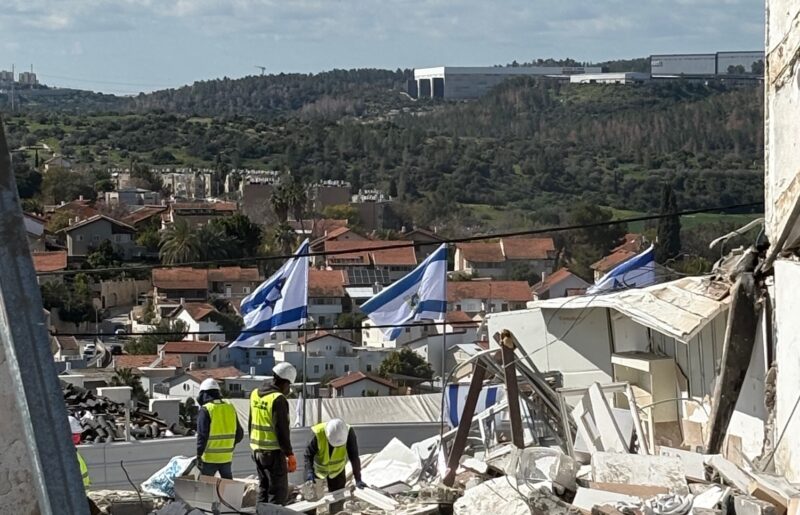
Sanford Antignas
A view of destruction, resilience and hope from Beit Shemesh, Israel, March 2026.
Being here has allowed me to see, up close and in real time, the impact federations have had since Oct. 7, 2023, in helping Israelis meet their urgent and longer-term needs — the impact of a system I have helped steward, built precisely for moments like this.
Upon my return to my Tel Aviv neighborhood, I quickly got used to the sound of the Home Front Command’s special alert on my phone, giving us five to seven minutes to reach shelter. I move like everyone else — quickly, instinctively. If a missile is expected nearby, we have 90 seconds to get to the shelter. My neighbors and I gather in a shared shelter next door, waiting out the danger together, listening to the thuds of the interceptors hitting their targets. It is a deeply Israeli experience.
It’s surreal how quickly this begins to feel normal. In a way, it becomes routine: people try to live their daily lives, pausing for alerts and finding shelter wherever they happen to be. If an alert catches you driving—as it did for me on the main highway from Tel Aviv to Jerusalem, on my way to a meeting in Modi’in—you pull over, park, climb over the guardrail, and shelter in a drainage ditch or open space with strangers until the all-clear. If it happens while you’re eating lunch at the mall, you leave your food on the table, follow everyone down to the underground parking garage, and then come back to the same meal, waiting for you, as if nothing happened.
In those moments, it is the broader infrastructure that surrounds us, protects us; the governmental and societal systems, institutions, and partnerships make resilience possible.
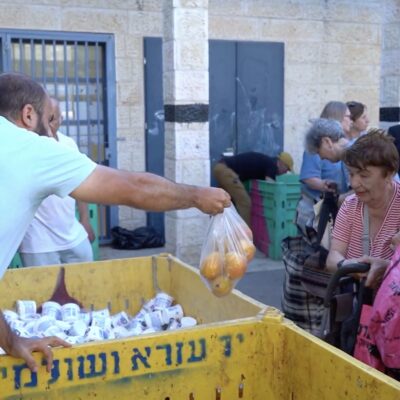
For decades, Jewish Federations have invested in Israel not only in times of crisis, but in the everyday fabric of society. Schools, community centers, social services, Jewish life, economic development, shared society, emergency networks—much of what allows Israel to function under pressure and rebuild have been quietly built over generations with support from global Jewish philanthropy.
In wartime and its aftermath, that infrastructure becomes visible and vital.
I saw it most starkly in Beit Shemesh, where a missile strike devastated a building whose basement shelter was being used as a synagogue. The destruction was immense. But within hours, a nearby community center, part of a national social infrastructure built with Federation support, was activated as an emergency hub to support those in need.
This is not by accident. It’s the result of long-term investments.
The same is true at the national level. Through core partnerships with the The Jewish Agency for Israel and the American Jewish Joint Distribution Committee, as well as other organizations, Jewish Federations have built a system that can respond immediately when crisis strikes. Emergency funds are not created from scratch; they are deployed through trusted channels that already exist.
The Jewish Agency’s Roaring Lion Fund for Victims of Terror is providing direct financial support to families who have lost loved ones, to those injured, and to people whose homes have been destroyed. The JDC is working with municipalities to deliver humanitarian relief in locations hardest hit by missile strikes, ensuring that local leaders have the resources they need to respond in real time and look to the future. Other organizations funded by Federations are also doing their part to meet the moment.
As a lay leader, I have sat in meetings discussing these mechanisms in the abstract. But standing in a bombed-out neighborhood, watching those systems activate within hours, is something else entirely. It transforms theory into reality.
It underscores a critical point: the power of Federations lies not only in what we raise during emergencies, but in what we sustain every year.
Unrestricted annual funding—often less visible—is what enables this speed and effectiveness. It allows partners to be present before a crisis, so they can act immediately when one occurs and be there for the day after. Without that foundation, response would be slower, less coordinated, and far less impactful.
That same principle is being applied to one of the most significant challenges since 10/7: mental health. The cumulative toll of constant alerts, disrupted sleep, and prolonged uncertainty is profound, particularly in the northern communities. Here, too, Federations are not starting from zero. They are expanding existing networks of trauma care, investing in services that will be needed long after the sirens stop. It is easy to focus on the immediacy of each alert, each attack. But through federations I have a wider lens. I see not only the danger, but the response. Not only the vulnerability, but the capacity to meet the urgent and longer-term needs.
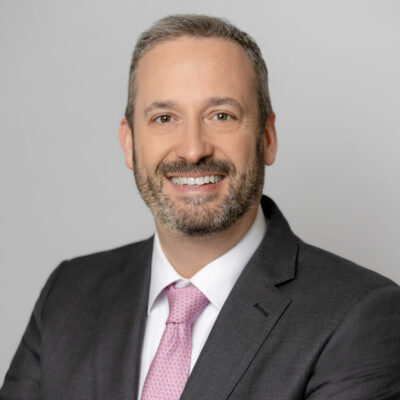
Sanford Antignas is chair of the board of United Israel Appeal, a member of the boards of the Jewish Federations of North America, the American Jewish Joint Distribution Committee and the Jewish Agency for Israel, and a former board member of UJA-Federation of New York.