Opinion
YOM HASHOAH 5786
When war returns, it does not return for everyone in the same way




 Add EJP on Google
In Short
For some, war has not just returned to their lives — it never ended.
Israel once again finds itself under fire, and much of the public conversation is rightly focused on children, families and young soldiers. They are our future, and in times of crisis it is both natural and necessary to direct attention and resources toward protecting tomorrow.
But there is a population living through the same war that remains largely unseen: Holocaust survivors and older adults. For those working in Jewish philanthropy and community leadership, this raises a practical question: Who do we prioritize in times of crisis?
Amcha
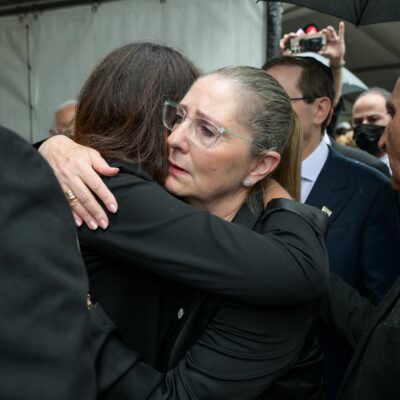
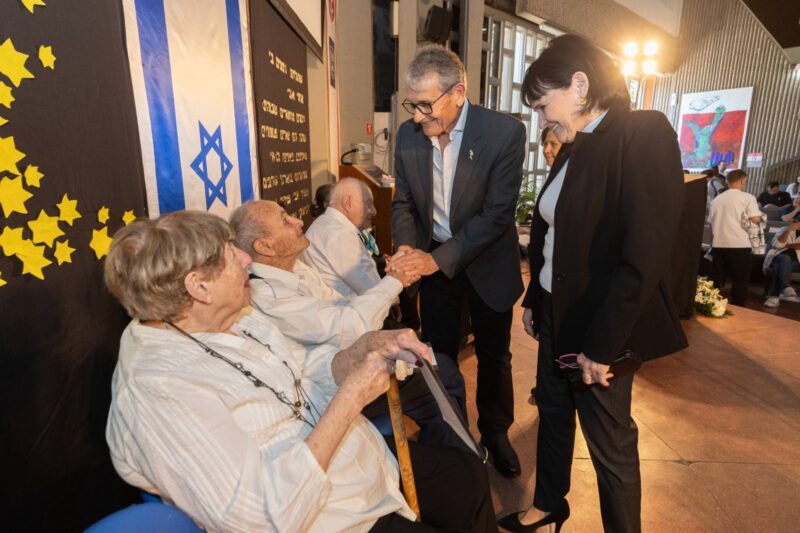
Amcha CEO Col. (res.) Orly Gal (left) and Chairman Zvi Levin greet Holocaust survivors at a Yom HaShoah ceremony in Ashkelon on April 13, 2026.
For many older adults, the sirens, explosions and sudden need to evacuate are not simply present-day events. They are direct triggers of deeply embedded traumatic memories. What is happening now connects with what has already been lived. The past does not remain in the past, and it returns with an intensity that is difficult to articulate and even harder to contain.
During the evacuation of civilians following a missile strike, one of our therapists at Amcha noticed an elderly man sitting alone in the corner of a hotel. Upon inquiry, the man was described as someone in his own world, unaware of what was happening; there was no point in approaching him, the therapist was told. Nevertheless, the therapist chose to sit beside him. The man began to cry.
“No one wants to sit next to me. No one talks to me,” he said quietly.
In that moment, what emerged was not confusion but a deep sense of loneliness. Not a clinical condition, but a human experience of being unseen and disconnected. Through a single act of presence, through attention and genuine listening, that sense of isolation began to shift.
In another case, a 105-year-old Holocaust survivor from the south said to her therapist, “What’s the point of continuing?” The war, the constant sirens, and the loss of independence brought back a deep sense of helplessness. She no longer felt like someone who can act, contribute or still has a place.
Through the therapeutic process, we worked with her to reconnect to earlier moments in her life, moments of agency, purpose and contribution. From there, a small but meaningful action emerged. She began collecting clothes for people affected by the war. By the following session, there was a visible change. She was no longer asking about the point of continuing; she was engaged in continuing.
Even in ordinary times, aging is accompanied by increased vulnerability, including loneliness, loss and dependence. In times of war, these vulnerabilities intensify. Many older adults are unable to reach protected spaces in time, while others are physically or socially isolated, disconnected from family or community. For Holocaust survivors in particular, earlier trauma is often reactivated, without access to the support needed to process it.
For nearly four decades, Amcha has worked with trauma-affected populations, with a focus on Holocaust survivors and older adults. Across the country, a team of over 600 professionals supports thousands of individuals each year, drawing on decades of experience showing how deeply past and present trauma can intertwine, especially in times of renewed crisis.
Yet older adults are rarely at the center of emergency response efforts, including within well-intentioned philanthropic and communal responses. In moments of crisis, we make implicit decisions about where attention and resources should go. We prioritize those we see as representing the future. While this instinct is understandable, it creates a hierarchy in which those who have already lived much of their lives are more easily overlooked.
Experience on the ground suggests that this distinction between present and future is not as clear as it may seem.
In evacuated kibbutzim, the older generation often serves as the emotional and social anchor of the community. They carry its memory, identity and sense of continuity. When they do not feel safe returning, or when they are not supported in doing so, others often hesitate as well. Rebuilding a community is not only about restoring infrastructure. It is about restoring a shared sense of home. In many cases, that sense is closely tied to the presence and well-being of its older members.
Supporting older adults, in this context, is not separate from rebuilding the future. It is part of what makes rebuilding possible.
At the same time, even from a practical perspective, the implications are significant. Periods of prolonged stress, displacement and isolation can accelerate physical and cognitive decline, including the worsening of dementia, depression and chronic illness. When these conditions are not addressed early, they often lead to increased hospitalizations, greater dependence on already strained health and social systems and growing burdens on families and caregivers.
Providing timely psychosocial support, maintaining continuity of care and ensuring human connection are therefore not only acts of compassion. They are also essential for preserving functioning and reducing longer-term strain on the system.
And yet, even this does not fully capture what is at stake. The question is not only what role older adults play in the recovery of society, nor only what the cost of neglecting them might be. It is whether their lives and their suffering are recognized as deserving of attention in their own right.
Decades of experience working with Holocaust survivors and trauma-affected populations have shown that the need for connection, dignity and meaning does not diminish with age. In times of instability, when past and present trauma converge, that need often becomes more acute.
The current reality is creating a new wave of emotional distress among individuals who have already carried trauma across a lifetime. Without deliberate attention and targeted support, many will remain invisible within the broader response.
This Yom HaShoah, we encourage you to broaden the lens through which need is defined and recognize that alongside the urgency of investing in the future, there is an equally pressing responsibility to care for those who have carried the past into the present.
This requires intentional inclusion of older adults in emergency response efforts, dedicated funding for home-based care for those with limited mobility, community-based social frameworks that reduce isolation and trauma-informed interventions tailored specifically to older populations.
At a moment when the world once again feels unstable, the question before us is what we prioritize and whom we choose to see. A society is measured not only by how it invests in its future, but by how it cares for those who have carried its past.
Col. (res.) Orly Gal is CEO of Amcha.