COME TOGETHER
After relaunch, PJ Library’s Get Together microgrant program sees spike in interest
A limited version of the program launched a decade ago, but a national version is seeing a wave of interest, particularly in small cities and rural areas
courtesy/Harold Grinspoon Foundation
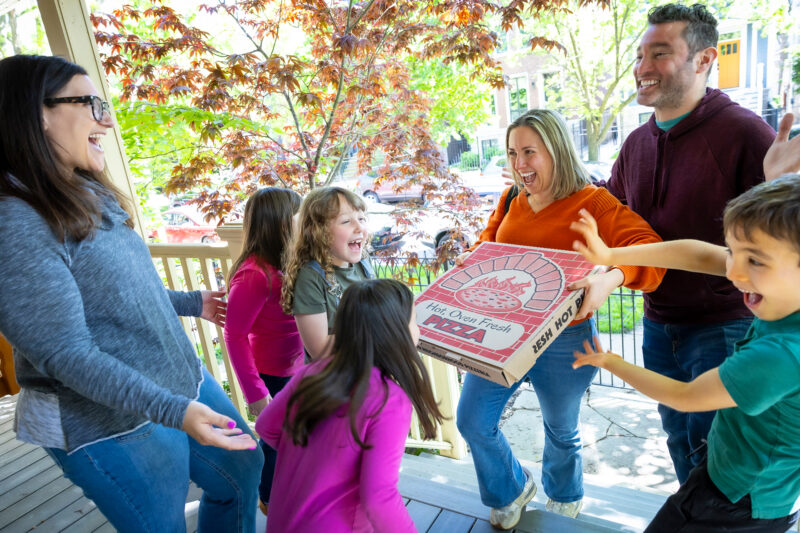
Jewish families have a pizza party with funding from a PJ Library 'Get Together' microgrant.




 Add EJP on Google
In the midst of a snowstorm in Washington, D.C., shortly after federal layoffs rocked the city, a group of Jewish families teamed up to dig their neighbors out of the snow. When the job was done, they gathered for a hot chocolate party — funded by the Harold Grinspoon Foundation.
The costs of the “it takes a village” snow-shoveling and the hot chocolate party, and thousands of other small Jewish gatherings, were covered by a PJ Library program providing subscriber families with $100 micro-grants to cover hosting expenses for small Jewish-themed gatherings. The Get Together microgrant program has seen a steep spike in interest this year, particularly in smaller cities and rural areas, Jessica McCormick, PJ Library’s director of family experience, told eJewishPhilanthropy.
Over six months, the Get Together microgrant program has distributed over $1 million in grants. Between September and December 2025 alone, 8,000 households held Jewish gatherings enabled by the micro-grants, 2,500 of which used the grants for the first time, according to McCormick. “It’s moved at a sort of breathtaking speed,” she said.
The program was launched in 2016, but was only available in 10 locations across North America. In 2024, the grants were expanded to all PJ Library subscribers, relaunching in fall 2025 with a more streamlined submission process and a bigger team to review submissions and dispense grants. For 2026, the project’s target was to engage approximately 4% of PJ Library’s over 230,000 subscribers throughout the United States and Canada. So far, more than 2,000 grants have been issued. If things continue as they are, said McCormick, they are likely to reach 8% by the end of the year.
The microgrants have been highly successful in large hubs of Jewish life, like New York City and Los Angeles, but also in smaller markets like Minneapolis and Winnipeg, Canada.
But “by far,” said McCormick, the majority of “get-togethers” sponsored by the grants happen in what PJ Library describes as “all-access communities” — more rural areas where the population is not served by a JCC or Jewish federation.
“We’re sending these funds into areas where people might be reaching out to the only other Jews in the area, or maybe they didn’t know other Jews, but the micro-grant has encouraged them to go out and meet families and find community,” she told eJP.
Some 23% of grants have been used for activities tied to the High Holiday season, 31% were used for Shabbat or Havdalah, and 26% were used for Hanukkah celebrations. Other uses of the grants have ranged from the snow?shoveling support, to indoor stroller?walking events that sparked weekly bagel meet?ups.
“Everybody has micro-communities on their mind,” said McCormick. “And we’re very proud to be able to say, ‘Let your people use our money. Let them know they should use our micro-grants to host their gatherings.’”
Related News
PRESIDENTIAL REBUKE
Israel’s Herzog: Mamdani ‘makes no effort’ to hide disdain for Israel, Jews must fight back
EXCLUSIVE
Detroit-based philanthropists Nancy, James Grosfeld donate $8M to renovate JDC’s Israel campus
HIGHER EDUCATION
As Jewish donors reconsider academia, Jan Koum doubles down, endowing Israel studies at Stanford
CLOSING WORDS
In AZM address, Cosgrove links communal ‘orthodoxy’ on Israel to rising anti-Zionism among young Jews

MAJOR GIFTS
Center for Jewish History celebrates 25 years with a $25M matching grant