WHAT YOU SHOULD KNOW
After landmark elections in Israel and U.S., 2,500 leaders flock to JFNA General Assembly in D.C.
courtesy/JFNA
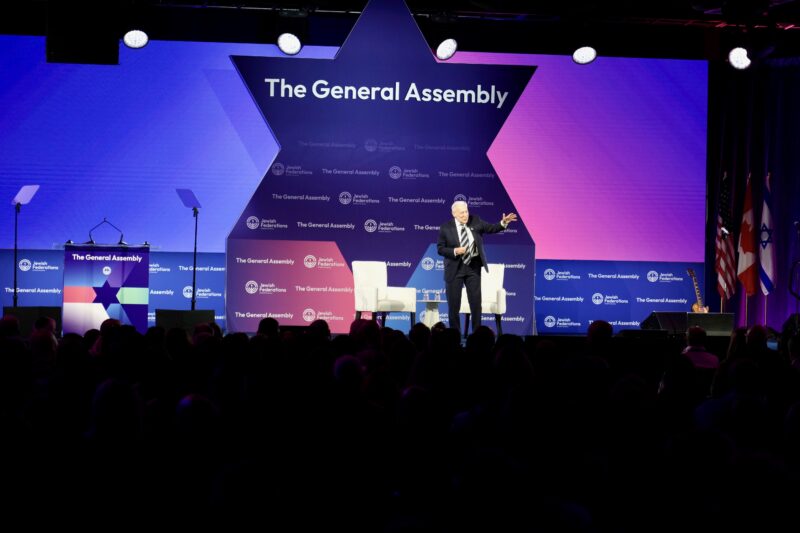
Eric Fingerthut, president and CEO of the Jewish Federations of North America General Assembly in Washington on Nov. 18, 2025.


 Add EJP on Google
From across North America, Israel and even Australia, nearly 2,500 people will flock to Washington for this year’s Jewish Federations of North America annual General Assembly, hoping to network with fellow Jewish professionals, drum up interest in their initiatives and influence the agenda of the Jewish federation system for the coming year.
The annual event, which kicks off on Sunday, takes place at a time when JFNA sees the Jewish community as standing at “an inflection point,” according to the event organizers. It’s a common theme from past years’ gatherings, which were also held during periods of crisis and change for the Jewish world: from the COVID-19 pandemic to the 2023 GA that was held in the shadow of the judicial overhaul protests and, for the past three years, wars in Israel and rising antisemitism around the world. This year’s gathering comes days after the midterm elections in the United States, and less than two weeks after Israel’s parliamentary elections.
“There is an energy at the General Assembly that is hard to express in words when 2,500 leaders come together who are committed to the work of strengthening Jewish life day in, day out,” Shira Hutt, executive vice president at JFNA, told eJewishPhilanthropy. “There’s a chance for people to be inspired, to be connected, and it’s also strengthening to be together as a community.”
The convention will focus on three main topics: securing Jewish communities, inspiring Jewish engagement and rebuilding Israel.
The conference will have three main-stage plenaries and 38 sessions taking place between Sunday and Tuesday. The events come after a year of debate raging through the Jewish community about where money should be invested: fighting antisemitism or funding Jewish education and identity-building, or — as JFNA advocates — both simultaneously.
The sessions reflect both sides of the debate: with numerous panels focusing on antisemitism in the media, politics and law, but also panels focused on welcoming Jews who continue to “surge” into Jewish life after the Oct. 7 terror attacks in Israel and wars in Gaza, Lebanon and Iran. This trend of increased engagement slowed slightly last year but is again on an upswing.
One topic that hasn’t been a subject of debate is the need for security at Jewish institutions, and multiple panels focus on the topic, some from the angle of securing the community and some from the angle of political advocacy for security resources and funding. Although a recent Anti-Defamation League study found that antisemitic incidents declined by one-third over the past year, antisemitic assaults have increased and, in some cases, been deadly.
The conference is dotted with multiple gatherings for JFNA’s new antisemitism-fighting Frontline initiative workers, with 35 of the employees hired under the grants meeting for the first time at the GA, alongside 50 other community relations professionals. Several sessions and gatherings will be held just for Frontline workers and community relations workers along with an open session, “Bridge Building That Counts,” that includes Jewish, Latino, Catholic and evangelical speakers.
Speakers at the conference include: Juju Chang, co-anchor of ABC News’ “Nightline”; Melissa Lantsman, member of Canadian parliament; and former Secretaries of State Tony Blinken and Mike Pompeo.
After raising $908 million through its Israel Emergency Campaign in the aftermath of Oct. 7, 2023, JFNA last year entered a new phase of supporting Israel, with an initiative titled “Rebuild Israel.” Discussions of next steps will be held throughout this year’s program.
“There was Oct. 7, and then there was a couple of years after that of just chaos and no kind of normalcy, and we’re slowly getting into the rehabilitation and the rebuilding and looking forward,” T’helah Ben-Dan, the North American deputy director of Talma, an English education nonprofit serving underprivileged Israelis, told eJP. It will be her first time attending the GA.
At first, the rehabilitation in Israel focused on meeting citizens’ “basic needs,” Ido Mahatzri, CEO and executive director of Talma, who flew in from Israel to attend for the first time, told eJP. “Part of our understanding is [that] for a real rehabilitation of the country, education is something that is one of the most important things.”
Being at the GA offers Ben-Dan and Mahatzri the opportunity to meet with federations that the nonprofit already has relationships with, but also to create new connections with federations and other Jewish professionals doing similar work.
It is also coexistence leader Mohammad Darawshe’s first time attending the GA. The trip to the GA would have typically been a schlep for Darawshe, who lives in Israel, but he is currently a visiting scholar at American University in Washington for the semester.
Darawshe, who is the director of strategy for the Center for Shared Society at Givat Haviva, will be presenting a lunch session on Monday titled, “Building a Shared Society: A Conversation with Mohammad Darawshe.”
“Shared society [is] a topic that is not very much [discussed] in the mainstream American Jewish community, and one of my main efforts is to try to mainstream this work as much as possible, exactly as we try to do in Israel,” Darawshe told eJP. He sees the visit as a chance to thank the federations that have supported Givat Haviva, including ones in New York, Boston, Washington, Cleveland, Chicago, Houston, San Francisco, Los Angeles and St. Louis. He also hopes to invite other federations to join in the cause.
“The work in Jewish-Arab relations has been damaged severely in the last four years under this government, and in the last three years after Oct. 7, there’s a lot of damage, a lot of mistrust, a lot of fear,” Darawshe said. But Arab Israelis make up one-quarter of Israel’s doctors, nurses and dentists and half of the country’s pharmacists. They are the majority of bus drivers. He hopes attendees can look to the entire Israeli population, not only the roughly 80% who are Jewish.
“This is the future of Israel,” Darawshe said, and people can help by supporting “collaboration and cooperation.” This too is part of mending Israel, he said. “A lot of healing work needs to be done in Jewish-Arab relations, and the [interest in helping] I hope will triple in 2027.”
A delegation from Australia will also make the journey, including Alain Hason, the CEO of the Jewish Council of Australia, an organization that serves a similar role as JFNA in the country. Its presence at the GAThey come to America comes in response to JFNA CEO’s Eric Fingerhut’s solidarity mission leading a delegation of leaders to Australia in May, a visit that followed. Fingerhut went to Australia to show solidarity after the December 2025 Bondi shooting that saw terrorists murder 15.
The GAevent takes placecomes after monumental elections in both America and Israel, and there will be sessions on unpacking both the Israeli parliamentary elections and the American midterms.
There will also be sessions on artificial intelligence and ways to take advantage of the $1,700 tax rebate Americans can access in January that will reduce private school tuition costs. In September, JFNA partnered with Prizmah: Center for Jewish Day Schools and the Orthodox Union and its day school-focused Teach Coalition to create The Opportunity Fund for Jewish Education, a national scholarship-granting organization to make the tax break easier to access for Americans.
Sunday night’s programming The first night will concludecap with a performance by Orthodox comedian Modi, and Monday will feature the Tzomet game — tzomet (being the Hebrew word for “crossroads”) — in which participants are given four 2050 futures written by author Dara Horn and have to work their way back to the present to see the choices that would happen to make them come into reality. “Part of coming together is also having a little bit of fun together,” Hutt said.
After the event, JFNA is bringing 100 leaders from across the country to Capitol Hill to lobby for issues including the Jewish American Security Act and the Nonprofit Security Grant Program, amongalong with others issues.