WHAT YOU SHOULD KNOW
A miraculous near miss in Michigan; a direct hit in Zarzir
Michael Giladi/Flash90
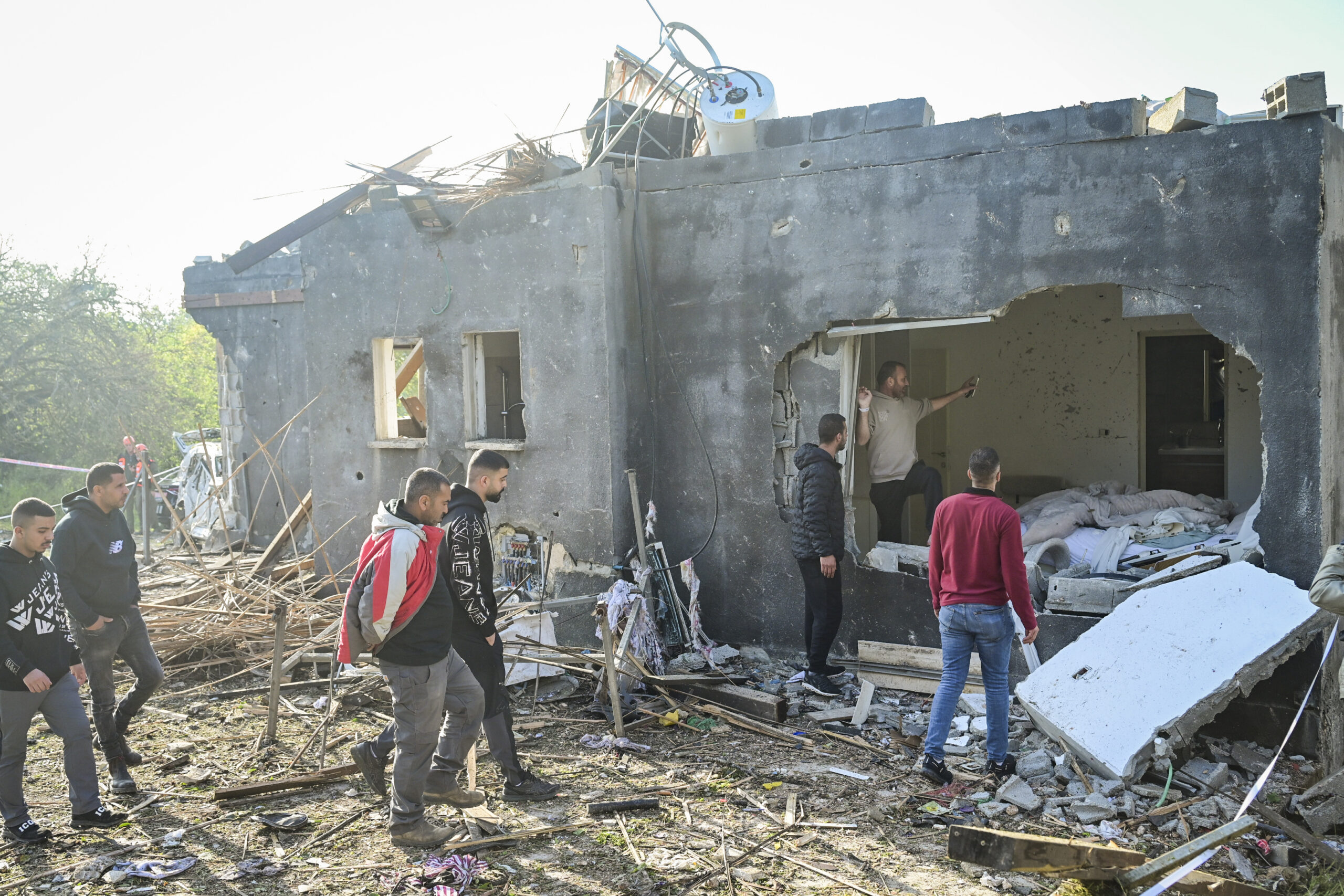
People look at the damage after a missile fired toward Israel overnight struck Zarzir, in northern Israel, on March 13, 2026.




 Add EJP on Google
On opposite sides of the globe and in different — but not too different — contexts, yesterday saw a troubling near-miss and a devastating direct hit.
In a miraculous mix of staff preparation, proper implementation of security protocols and a healthy dose of good fortune, the only person killed in yesterday’s car ramming and active shooter situation at a Michigan synagogue was the assailant. The only other injury reported in yesterday’s attack was a security guard who was knocked unconscious when the assailant drove his car through the synagogue’s doors. He is expected to make a full recovery.
“Everything that was supposed to happen happened,” Oakland County Sheriff Michael Bouchard told reporters.
Just a few hours later, an Iranian missile evaded Israeli air defenses, directly hitting the northern Bedouin-majority town of Zarzir. The missile struck outside a horse stable, causing a massive crater and sending out destructive shockwaves, which collapsed concrete walls and shattered windows. Several cars nearby also burst into flames. Dozens of people were injured by broken glass and debris, including one woman who sustained significant injuries to her back from a blown-out window shutter. Miraculously, the only fatality in the missile strike was a foal, police said.
A glance at the Israeli government’s official map of bomb shelters throughout the country shows that — as in many Arab and Druze villages in Israel — there are none in Zarzir. In comparison, the adjacent town of Givat Ella, whose Jewish population is roughly a fifth of Zarzir, has 23 public bomb shelters. The Israeli shared society group Abraham Initiative recently noted that of the 11,776 public bomb shelters in Israel, just 37 are located in predominantly Arab municipalities, despite Arab Israelis making up roughly 20% of the population.
Unlike in West Bloomfield Township, Mich., in the suburbs of Detroit, practically nothing in Zarzir that was supposed to happen happened.
Ilan Amit, the co-director of the Bedouin-Jewish organization AJEEC-NISPED, told eJewishPhilanthropy on Friday that the lack of bomb shelters in Arab communities make residents less likely to take precautionary measures during sirens. With no shelter to run to, Arab Israelis think, “What’s the point?” said Amit, who recently wrote a Time of Israel opinion piece on the subject. “They couldn’t care less.”
Amit said his group is working on getting the government to take the issue of fortification shortages in Arab communities seriously, hoping that this will make Arab Israelis take security measures seriously as well. He noted that there have been improvements on the issue since the Oct. 7 terror attacks, with his organization working directly with the Israeli military’s Home Front Command to improve and tailor messaging for Arab Israelis.
Yet Amit expressed exasperation at the fact that this remains an issue, considering how exceedingly well documented it is, with multiple governmental reports highlighting the vast disparity in the number of shelters in Arab communities versus Jewish ones. “It’s unbelievable that we’re still having this discussion after so many years,” he said.
“We are trying to raise money to lobby and to bring public awareness to the issue,” Amit said, adding that it was not about “not just another article in a newspaper about the gap in shelters.” Instead, he said, a major goal was to insert the issue of emergency preparedness into the government’s next five-year plan for the Arab community.
Temple Israel, one of the country’s largest Reform congregations, has a massive campus that houses a preschool, a JCC and a museum. It is a community hub for the 3,000 families who belong to it. And because of the synagogue’s size and offerings, it can provide multiple layers of security — all of which worked as intended yesterday.
Six weeks ago, the FBI’s Detroit office also held an active-shooter drill with the clergy and staff of Temple Israel. It’s clear that such training sessions and paid security guards and infrastructure save lives. But for many Jewish communities around the country, the barrier for entry is too high, too complicated or too expensive.
Last year, Jewish Federations of North America estimated the security costs for Jewish institutions — sometimes referred to as a “Jew tax” — at $765 million annually. Jewish institutions are lobbying Congress — so far unsuccessfully — to ramp up funding for the federal Nonprofit Security Grant Program to help alleviate some of these costs.
What these two events share in common is that they demonstrate both the murderous intentions of the perpetrators and the considerable investment that is needed to thwart them. Jewish Insider’s Melissa Weiss contributed to this report.