Your Daily Phil: The Jewish future as America turns 250: Peril and possibility




 Add EJP on Google
Good Wednesday morning.
In today’s edition of Your Daily Phil, we cover the Reut USA and Rabbi Sacks Legacy conference in New York envisioning the future of American Jewry as the U.S. marks its 250th year. We report on the upcoming JCC Maccabi Games in the wake of the postponement of this summer’s Maccabiah in Israel, and interview Jonathan Greenblatt about the National Education Association board’s rejection of a resolution to boycott the Anti-Defamation League. We feature an opinion piece by Ben Vorspan with lessons for donor stewardship from an unexpected source. Also in this issue: Judah Touro, Jack Wertheimer and Shelley Kedar.
What We’re Watching
White House Middle East envoy Steve Witkoff heads to Rome today ahead of a meeting on Thursday with Israeli and Qatari negotiators to discuss ceasefire and hostage-release efforts.
Anti-Defamation League CEO Jonathan Greenblatt will join Reps. Josh Gottheimer (D-NJ) and Don Bacon (R-NE) on Capitol Hill today to announce bipartisan legislation to combat antisemitism and disinformation on social media platforms.
What You Should Know
Making Jewish education more accessible is the key to many of the challenges facing American Jews today, several Jewish leaders said on Monday at a conference on the future of American Jewry, held at the UJA-Federation of New York headquarters in Manhattan, Jewish Insider’s Haley Cohen reports for eJewishPhilanthropy from the event.
Drawing inspiration from the teachings of the late Rabbi Lord Jonathan Sacks, some 100 rabbis, lay leaders, entrepreneurs and CEOs of Jewish organizations debated how to expand Jewish education — as well as a number of other issues facing American Jewry — at the daylong conference organized by Reut USA and The Rabbi Sacks Legacy.
Elan Carr, CEO of the Israeli-American Council and former U.S. special envoy for monitoring and combating antisemitism in the first Trump administration, called for a greater connection to Jewish text, citing a Rabbi Sacks framework: “To defend a country, you need an army. But to defend an identity, you need a school. Judaism is the religion of the book, not the sword,” the former British chief rabbi famously said.
The conference, titled “The Great Diaspora: Visioning American Jewry at America’s 250th,” was held as preparations are underway for the country’s 250th anniversary celebration next summer and American Jews are reflecting on the condition and direction of Jewish life in America for the coming generations.
The anniversary comes as American Jewry faces antisemitism at levels not seen in decades, record-high intermarriage and a volatile relationship with the State of Israel. While Jewish leaders largely agree that the solution is more Jewish education, some at the conference were divided over best approaches to make education accessible — ranging from tuition-free day schools to establishing more inclusive communities.
“We need to give our kids a Jewish education,” Carr said. “And we are pricing ourselves out of existence. This has to be fixed.” But Ellen Finkelstein, CEO of Hadassah Women’s Zionist Organization of America, argued that finances are not “at the root of why every Jewish student in America does not have a Jewish education.”
“The reason that Jews in America don’t all put their children in Jewish day schools is because they don’t feel welcomed. I think for many Jews, it’s frightening to put their child in a day school where they may be judged based on their own level of religiosity or engagement. It’s a problem that we as a society need to address,” Finkelstein said.
Several of the conference’s panels referred to “Oct. 8 Jews,” a term used to describe Jews who reconnected with their Jewish roots in the aftermath of the Oct. 7 terrorist attacks in Israel. Studies commissioned by Jewish Federations of North America have documented “the Surge” — an uptick in engagement among previously unaffiliated Jews who are increasingly donating to Israeli and Jewish causes, joining synagogues, attending rallies and gathering regularly for Shabbat. In April, the uptick in Jewish engagement appeared to plateau — with a follow-up study finding that about a third of the respondents (31%) saying that they are engaging more with the Jewish community than they did in the past, compared to 42% who said so the year prior.
But speakers debated whether this trend will endure, as well as the unique challenges it poses to philanthropy and whether money is being spent in the right places.
“American Jewish philanthropy isn’t just larger in scale than previous diasporas. It’s different in kind. We don’t just support institutions, we create movements,” said Maimonides Fund President Mark Charendoff. “We don’t just respond to crises, we shape the future… acting as full partners in American society.”
But such large-scale philanthropy is sometimes “taken way too far,” argued Zoya Raynes, chair of the Jewish Funders Network, which has mapped out the ecosystem of organizations focused on antisemitism in the U.S.
According to Raynes, there are over 160 nonprofits in the U.S. that are solely focused on combating antisemitism, which she argued is an indication of disorganization. “No one can look at the result and say we are doing a good job, nor can anyone look at this model and say it’s OK,” said Raynes, who is also a managing director at Bank of America. “If this is the moment of ‘what did you do when,’ someone will look back at this model and ask how we allowed it to exist.”
Jonathan Sarna, a prominent historian and retiring professor of American Jewry at Brandeis University, said “Oct. 8 Jews” are both unique to today and have also existed in every generation of American Jewry.
The future of American Jewry, Sarna said, largely depends on the group of influential young Jewish leaders on college campuses, many of whom did not expect to hold Jewish leadership roles but were thrust into them by the increase of antisemitism on campuses in the aftermath of Oct. 7. “We need to look at them as our Henrietta Szolds and Cyrus Adlers,” continued Sarna, referring to the founder of Hadassah and leader of Conservative Judaism, respectively. “We have a great opportunity in many ways. Our job is to empower those young Jewish leaders on campuses. They’re the future leadership. They’re the hope of the future of American Jewish unity.”
GAME ON!
After Iran war forces Maccabiah cancelation, JCC Maccabi Games welcome teen athletes from U.S. delegation
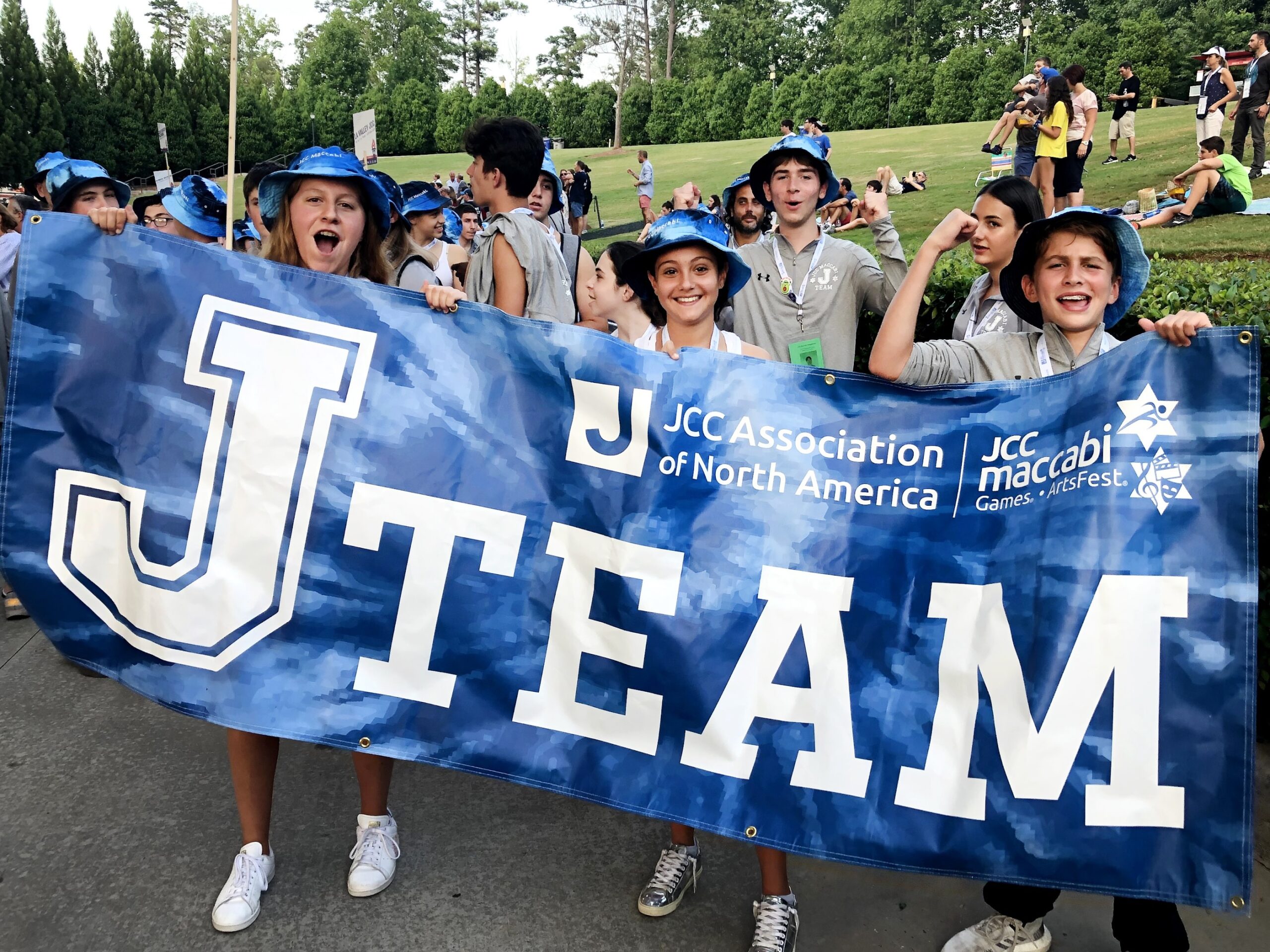
Cooper Lee, a 14-year-old swimmer from San Francisco, was set to be one of the more than 500 Jewish American athletes to compete in the 22nd Maccabiah Games this month in Israel. Then, just weeks before the international competition was to kick off, the war in Iran began. “We were kind of expecting it,” he told eJewishPhilanthropy’s Jay Deitcher of the eventual postponement of the Maccabiah Games until next year. “Which is unfortunate.” It was going to be Lee’s first time in Israel, and he’d crowdfunded almost $10,000 for a nearly monthlong trip. Though disappointed, he knew where to turn: the JCC Maccabi Games, which kick off next week.
As positive as possible: The Maccabi Games will be held this year in two cities: Tucson, Ariz. (July 27-Aug. 1) and Pittsburgh (Aug. 3-8). This year’s games were in a unique position to add participants because of a partnership with the University of Pittsburgh, allowing competitors and their families to stay and eat in the campus’ dormitories and dining halls. Another change to the games will be the presence of the Access program, which will allow Jewish teens and young adults with cognitive and developmental disabilities to compete; the former pilot program is now a permanent feature of the Maccabi Games. “We were very sad about the [postponement of the international] games, but the team felt that it was our mission to get as many kids as possible to have a positive Jewish sports experience this summer, so we did what we could,” Samantha Cohen, the JCC Association of North America’s senior vice president of JCC Maccabi, told eJP.



UNION DUES
Jonathan Greenblatt ‘pleased’ with NEA reversal but says ADL is ‘still in this fight’

Days after the National Education Association walked back a decision by its members to cut ties with the Anti-Defamation League, ADL CEO Jonathan Greenblatt praised the move but cautioned that the union still has a “long way to go” toward making clear that it respects the Jewish community, he told Gabby Deutch for eJewishPhilanthropy’s sister publication Jewish Insider. “I am glad that they recognize what’s wrong about calling out the most consequential organization fighting antisemitism at a time of rising antisemitism,” Greenblatt said. “Yet at the same time, there are elements of even the statement that lead me to believe that we’re still in this fight. We’ve got a long way to go to make sure that the ADL and our community is respected for who we are.”
Free speech?: While the board of directors of the NEA — the largest teachers union in the country — condemned antisemitism in the statement released last week, the board also stated that the organization’s rejection of the anti-ADL measure was “in no way an endorsement of the ADL’s full body of work,” which it said chilled free speech. That rhetoric surprised Greenblatt, which he viewed as a swipe at the ADL. “The idea that the ADL — which, of course, all of our work is predicated on protecting the First Amendment — that we are ‘not supporting the free speech of all students and educators?’ Give me a break. Find the evidence to even support this assertion,” Greenblatt said. “We have a problem with those people who use that speech to slander Jews or other minorities.”
Read the full report here and sign up for Jewish Insider’s Daily Kickoff here.
FROM THE CHEAP SEATS
What Cirque du Soleil taught me about donor stewardship

“On a recent trip to Las Vegas, my wife and I decided to see ‘Michael Jackson ONE,’ a Cirque du Soleil show that promised iconic music, dazzling visuals and gravity-defying acrobatics,” writes Ben Vorspan, author of The Nonprofit Imagineers and a member of The Lapin Group, in an opinion piece for eJewishPhilanthropy. “We were in ‘the cheap seats,’ third row from the back, and as we settled in we gave each other the universal reassurance of budget-conscious theatergoers: ‘These seats aren’t so bad…’ But then the show began.
Convey value at all levels: “The nonprofit imagineer in me noted that someone at Cirque du Soleil must have asked a bold question: How can we make this as thrilling for the people in the back row as it is for the people in the front row? That same question should guide our approach to donor engagement… This isn’t a call to equalize the donor experience. Your $50,000 donor and your $50 donor don’t need the same thank-you gift or recognition package, nor should you abandon the system that you’ve built for major donor stewardship. But, they do both deserve to feel seen, appreciated and respected… Cirque du Soleil kept the cheap seats affordable but made the experience unforgettable — not by moving us closer to the stage, but by expanding the stage to meet us where we were. That’s the charge for Jewish nonprofits today: Expand your stage. Create awe and belonging at every level of giving. Make the $18 donor feel like they’re an integral part of something extraordinary, because they are.”
Worthy Reads
Stuck in a Bubble: In Jewish Insider, Editor-in-Chief Josh Kraushaar notes the flaws and exaggerations in a recent op-ed on Jewish communal rifts. “Ezra Klein’s New York Times column this week, headlined ‘Why American Jews No Longer Understand Each Other,’ is a worthwhile example of how even the best-intentioned columnists can struggle to understand the world outside their own social and informational bubble. The column portrays a vocal minority of anti-Zionist sentiment within the Jewish community as much larger than it actually is. The characterization of a roughly even divide within the Jewish community between Zionists and anti-Israel Jews is at odds with numerous reputable polls tracking Jewish public opinion. … A fall 2024 poll of Jewish voters commissioned by the conservative Manhattan Institute found 86% of Jews considering themselves ‘a supporter of Israel.’ … This doesn’t paint the portrait of a community that is meaningfully divided over Israel — even amid the wave of negative, if not hostile, coverage towards the Jewish state in recent months.” [JewishInsider]
Losing Their Religion: In The Atlantic, Elizabeth Bruenig warns that the recent IRS rule change allowing endorsement of political candidates from the pulpit without risking an institution’s nonprofit status will make church a vehicle for sowing division rather than the development of good Christian middot, or moral attributes. “Providing political endorsements makes churches susceptible to powerful campaign tactics: PACs, for example, will have incentives to fund churches that reflect their agendas, meaning that pastors’ livelihoods could come to depend on contorting their religious beliefs to suit political interests. Politically active congregants will also have good reason to lobby their pastors for certain endorsements, another source of pressure for church leaders to say that supporting a particular candidate is the will of God. And the practice of offering endorsements prioritizes accepting specific instructions from church leaders over cultivating Christian values and methods of reasoning that allow the faithful to determine which candidates to support for themselves.” [TheAtlantic]
Step by Step: In a blog post for Aish, Rabbi Menachem Levine spotlights the story of philanthropist Judah Touro, a namesake for Jewish institutions for hundreds of years, and the role of a rabbi named Gershom Kursheedt in bringing Touro closer to Judaism. “[U]ntil he was almost 70, [Touro] had little connection to Judaism or to the Jewish community. He had inherited traditions from his parents, but the connection was so weak that his charity was overwhelmingly directed to non-Jewish and even Christian causes… In 1840, Gershom Kursheedt arrived in New Orleans from New York… Young Gershom was known for his passion for Jewish learning and Jewish causes. He was a student of Rabbi Isaac Lesser, one of the most renowned Jewish leaders in colonial America. Kursheedt had moved to New Orleans to work in his uncle’s retail business. He was horrified at the lack of Jewish observance by Jews there. Intent on changing things, he managed to persuade Touro to fund a new synagogue that would be built on the Torah values of Touro’s parents. Touro agreed to purchase a building, which was then renovated into a synagogue that could seat 470 people. Step by step, Touro became more invested in the synagogue and, as a result, more invested in his own Judaism.” [Aish]
Dual Roles: In The Wall Street Journal, Leslie Lenkowsky reviews Jewish Giving: Philanthropy and the Shaping of American Jewish Life by Jack Wertheimer. “Despite a reputation for concentrating on inward-looking causes, Jewish philanthropists have long given a large proportion of their resources to secular concerns. In fact, by the 2010s, Mr. Wertheimer notes, ‘larger proportions of American Jews gave to nonsectarian causes than to Jewish ones.’ At the same time, he writes, Jewish donors sustain “a vast network of Jewish institutions and initiatives designed to enhance the lives of American Jews and provide aid for Jews in other lands.” Despite signs that Jews have become less attached to their religion, these ‘legacy institutions,’ Mr. Wertheimer reports, are receiving ‘renewed appreciation.’ His book explains why that is important.” [WSJ]
Word on the Street
Avera Mengistu, who was held in Gaza for a decade before his release earlier this year, was released from Tel Aviv’s Ichilov hospital after five months; the Ethiopian-Israeli man, who suffers from mental illness, will be moved into a special residential facility…
Republicans on the House Appropriations Committee’s National Security, Department of State and Related Programs subcommittee are backing a significant increase in funding for the office of the State Department’s special envoy to monitor and combat antisemitism, reports Jewish Insider’s Marc Rod…
In a Wall Street Journal opinion piece, Rabbi Avi Shafran examines the complex significance of the term “Zionist” for Haredi Jews…
Jews were the group most targeted by hate crimes in Canada last year, per a new report released yesterday by Statistics Canada…
The Chronicle of Philanthropy analyzes how nonprofits are impacted by a shifting relationship with the U.S. government, and a rollback of government funding for social welfare programs…
In its third exit from a United Nations agency, the U.S. government has withdrawn from UNESCO, citing anti-Israel bias…
As nonprofits face federal funding cuts and a surge in need, many law firms, accounting firms and philanthropic foundations are filling the void with pro bono work…
Increased access to affordable housing has been found to significantly reduce poverty levels in New York City, a Robin Hood report has found…
The Jewish Federation of Greater Pittsburgh is dispensing some $7.5 million in grants to the Jewish community and Israel…
A new documentary about comedian Joan Rivers is in the works by Passion Pictures and the Mediapro Studio…
Josh Kraft has officially left the New England Patriots organization to focus on his campaign for mayor of Boston…
Major Gifts
The Leona M. and Harry B. Helmsley Charitable Trust has donated $1.5 million to expand plastic removal efforts on Hawaii’s coastlines…
Transitions
Shelley Kedar has been appointed the new chief impact officer at the Jewish Agency for Israel; Kedar has been serving as head of the organization’s Connecting the Jewish People Unit…
The Orthodox Union Advocacy Center has hired Elie Buechler, the former director of JLIC at Columbia University and Barnard College, as its director of programs and associate director for interfaith engagement…
Kathryn Gonnerman was named the next president and CEO of the Jewish Community Foundation of Greater Hartford…
Rabbi Natan Levy was appointed campus rabbi for Syracuse University Hillel…
ETTA, the nonprofit that runs the Bhatia Family Village, a housing community for neurodiverse adults in the heavily Jewish Pico-Robertson neighborhood of Los Angeles, has hired Scott Saliman to serve as its next executive director; Michael Held, the founder and outgoing executive director, is being appointed the inaugural CEO of the organization…
Pic of the Day

The Latin American Jewish Congress and the Delegación de Asociaciones Israelitas, Argentina’s umbrella organization of Argentine Jewry, holds a conference with Argentina’s national security ministry on Friday, focused on protecting the Jewish community. The event was held on the 31st anniversary of the bombing of the AMIA community building in Buenos Aires.
Birthdays
Executive director and chief creative officer at the Milken Center for Advancing the American Dream, Rachel Eva Goslins…
Banker who distributed $60 million to his 400 employees when he sold City National Bank of Florida in 2008, Leonard L. Abess… Former U.S. ambassador to the Netherlands, she was the chair of the Harry and Jeanette Weinberg Foundation until 2023, Fay Hartog-Levin… Retired after serving for 32 years on the U.S. Court of Appeals for the 9th Circuit, Judge Alex Kozinski… Businessman and real estate investor who made his fortune in the trade and manufacture of fertilizer in the former Soviet Union, Alexander Rovt… Senior rabbi of the Great Neck Synagogue for over 30 years, he served as president of the Rabbinical Council of America, Rabbi Dale Polakoff… President of the Marcus Foundation, founded by the late Bernie Marcus of Home Depot, Jay Kaiman… Proprietor of Oy Vey Jewish Bakery and Delicatessen in Terre Haute, Ind., Chavah Stair… Freelance journalist, she is the widow of Daniel Pearl and wrote a book about his kidnapping and murder in Pakistan in 2002, Mariane Pearl… Director, producer and actor in movies and television, Shawn Adam Levy… Dov M. Katz… Freelance television writer and author of two books, Joel Stein… Psychologist in private practice in both Manhattan and Great Neck, Long Island, Lynn Glasman, Ph.D…. Activist and fashion designer, Monica Lewinsky… Israeli film actress best known for her performances as a Jedi Master in the “Star Wars” prequel trilogy, Orli Shoshan… Music producer and songwriter, Jonathan Reuven “J.R.” Rotem… Professor at Georgetown University Law Center, Itai Grinberg… Singer, he represented Israel in the 2001 Eurovision Song Contest, Tal Sondak… Radio disc jockey, television show host and professional wrestling personality, Peter Elliot Rosenberg… Mayor of Minneapolis since 2018, Jacob Lawrence Frey… Sports studio host and play-by-play announcer for Westwood One, Sirius XM and ESPN, Jason M. Horowitz… Comedian and actor, Rick Glassman… Starting right fielder for Team Israel at the 2017 World Baseball Classic, Zach Borenstein… Reporter for The Washington Post, Perry Stein… Joseph Stern…