Your Daily Phil: Long-simmering Western Wall prayer dispute heats up




 Add EJP on Google
Good Monday morning!
In today’s edition of Your Daily Phil, we examine recent developments in the long-simmering dispute around egalitarian prayer at the Western Wall and cover Jewish Federations of North America’s efforts over the weekend to convince Democratic governors to opt into a federal tax credit that would help subsidize Jewish day school tuition. In the latest installment of eJP’s exclusive opinion column, “The 501(C) Suite,” Mark Charendoff, president of Maimonides Fund, on the slow but unmistakable integration of Haredim into Israeli society. We also feature an opinion piece by Abbey Frank on the misunderstood role of interim leaders. Also in this issue: Mijal Bitton, Shira Banki and Jack Hughes.
Shabbat shalom!
What We’re Watching
We’re monitoring how the winter storm hitting the East Coast today is disrupting nearly everything up and down the Northeast corridor. To our readers from Washington to Boston: Stay warm and safe!
Despite the snow, AIPAC’s annual Congressional Summit is continuing this week in Washington, after kicking off yesterday.
We’re also keeping an eye on developments in the Middle East, with President Donald Trump still considering a military strike on Iran.
What You Should Know
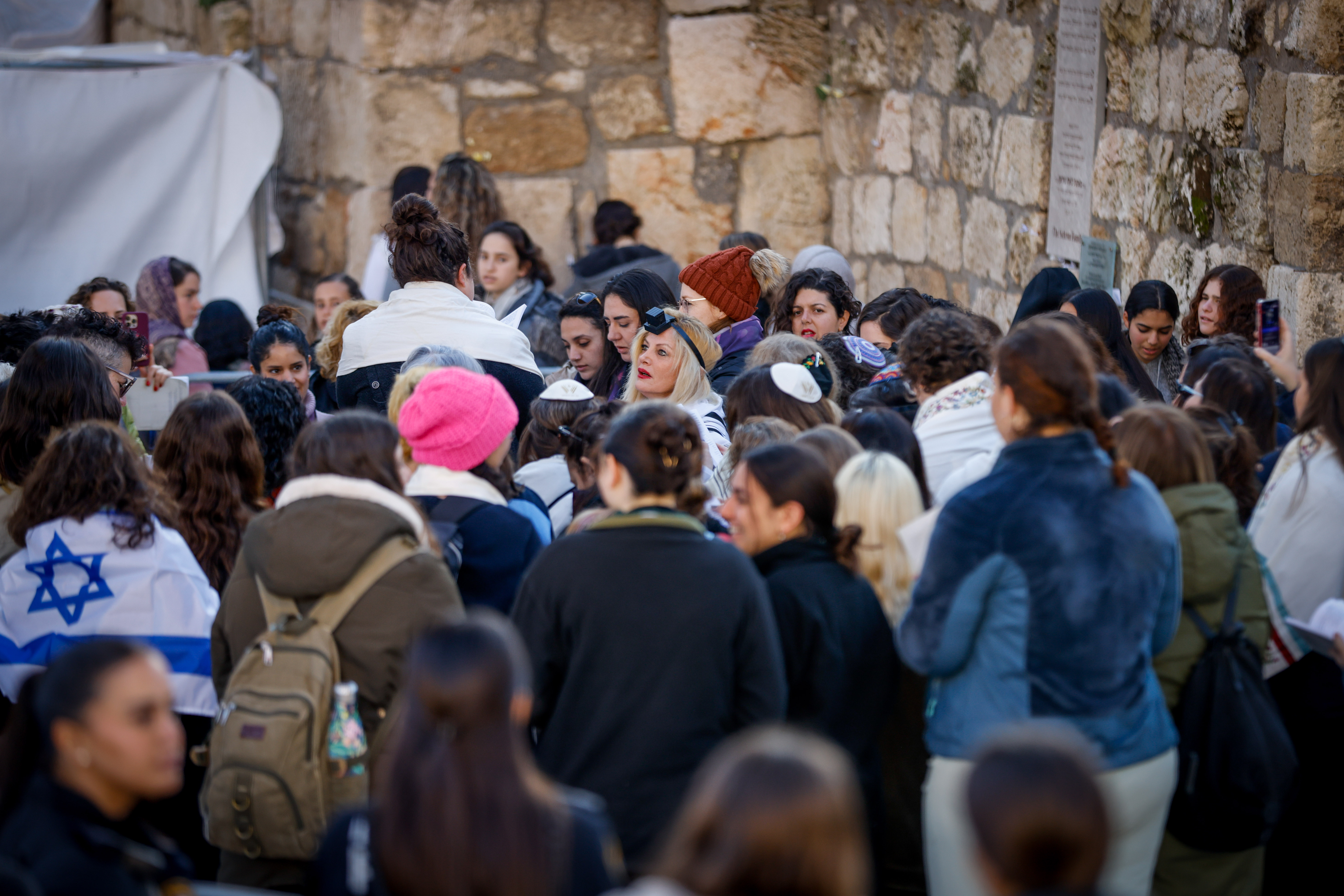
For the past 10 years, few issues have exemplified the strains between the State of Israel and Diaspora Jewry more than the dispute over what type of prayer is permitted at the Western Wall. The disagreement — which at times even turns violent — centers around two main issues: one, mixed, egalitarian prayer at the site; and two, what women are and aren’t allowed to do at the Western Wall, particularly as it relates to reading from the Torah.
This simmering situation came to a head over the past week, following a hearing in a long-running case in Israel’s High Court of Justice, focused not on the implementation of the Western Wall Compromise — an agreement between Haredi leaders and the Reform, Conservative and progressive Orthodox movements — but on the long-stalled renovations of the “egalitarian plaza,” a section south of the main plaza.
After the hearing, the justices ruled that the government must proceed with those renovations. However, the High Court win for the progressive religious movements may prove to be a Pyrrhic victory.
In response to the ruling, Knesset Member Avi Maoz, the leader of the far-right religious Noam party, submitted a bill that would assert full Rabbinate control over the entire Western Wall area, including the egalitarian section, and would make the “desecration” of a holy site — activities that are in violation of the Rabbinate’s rulings, including egalitarian prayer and female Torah reading — a criminal offense, punishable by up to seven years in prison. (Possibly unintentionally, the bill could also prevent Jews from visiting the Temple Mount, as this too is officially banned by the Chief Rabbinate.)
According to Yizhar Hess, vice chair of the World Zionist Organization and former head of the Israeli Masorti Movement, Maoz’s bill could spell the end of both the Western Wall Compromise and the legal case in the High Court of Justice. This is true even if the bill is not signed into law and only passes an initial reading. Were the government to go to the High Court of Justice and say that the issue is being resolved through legislation — and thus shouldn’t be arbitrated through the courts — “that would be a strong argument,” Hess told eJewishPhilanthropy.
Israeli Prime Minister Benjamin Netanyahu does not appear to personally favor the bill and ordered the cancellation of a ministerial meeting in which the legislation would have been discussed. However, this does not prevent the bill from going forward. As the head of his party, Maoz can put the bill up for a vote in the Knesset on his own, and The Times of Israel reports that the Likud whip has given party members free rein to vote as they see fit.
TAXING TALK
JFNA presses Democratic governors to embrace federal tax credit that could benefit Jewish day schools

As governors from across the country convened in Washington over the weekend for the annual National Governors Association summit, representatives from the Jewish Federations of North America held dozens of sideline meetings with Democratic officials to lobby them on a new education tax initiative, Josh Nason, JFNA’s senior director of political affairs, told Haley Cohen for eJewishPhilanthropy’s sister publication Jewish Insider. Their goal was to educate those governors, some of whom were skeptical of the credit, and urge them to participate in the first-of-its-kind supplemental federal funding that could help pay for Jewish day school and yeshiva education.
Window of opportunity: Starting in the 2027 tax year, the federal Education Freedom Tax Credit, part of President Donald Trump’s One Big, Beautiful Bill Act, provides a dollar-for-dollar tax credit — up to $1,700 annually — for donations to approved Scholarship Granting Organizations. These SGOs offer scholarships for a variety of K-12 public and private education expenses, including private school tuition, transportation and tutoring. If states don’t opt in, taxpayers can still donate, but residents of that state won’t have the ability to be beneficiaries. “For Jewish day schools, it’s a huge opportunity,” Nason told JI following his meetings with governors — the first time JFNA had a presence at NGA.
Read the full report here and sign up for Jewish Insider’s Daily Kickoff here.



THE 501(C) SUITE
Israel and the Haredi conundrum

“I was in Israel recently for the first time since Ran Gvili’s body was returned and the first time when no Israelis remained captive in Gaza. … There was a lightness I hadn’t felt since before the judicial reform crisis. While the Iranian threat hovered in the background, the conversation this time was almost entirely domestic: the future of military service for the Haredi community,” writes Mark Charendoff, president of Maimonides Fund, in the latest installment of eJewishPhilanthropy’s exclusive opinion column, “The 501(C) Suite.” “A society cannot sustain a defense burden carried by only part of its population — especially when headlines forecast that by 2050, roughly a quarter of Israelis will be Haredi. … But if we frame this as ‘good guys versus bad guys,’ we will miss the story.”
‘Possibility of change’: “While in Israel, I spent a morning on an IDF base where tanks are built and repaired. It looked like what we now expect from the Start-Up Nation: robotic welders, computer-guided cutters, and metalwork done with extraordinary precision. And the soldiers running the operation? Haredim. Not dropouts. Not marginal cases. Committed young Haredi men who, after the Oct. 7 attacks, feel a responsibility to be part of the serving nation. … The Haredi conundrum is real. The math is real. The inequity is real. But so is the possibility of change — change already happening on IDF bases, in new brigades and in the quiet courage of young men who want a seat at the table of shared responsibility.”
LESSONS IN LEADERSHIP
Keeper of the Cup: What a Hillel interim director and the steward of the Stanley Cup have in common

“The Stanley Cup is iconic and recognized worldwide, but less well-known is the role of the ‘Keeper of the Cup,’ the person whose full-time responsibility is to safeguard and escort the trophy from place to place; to maintain it — protecting, cleaning and repairing it to ensure it is always looking its best; and to preserve its tradition, sharing stories and knowledge about the history of hockey and the significance of the Cup. This also describes the role of an interim executive director,” writes Abbey Frank, principal and co-founder of Frank Strategies, who until recently served as the interim executive director of GW Hillel, in an opinion piece for eJewishPhilanthropy.
Better than you found it: “A successful interim director understands that this role of stewardship is not about maintaining the status quo. In hockey, the Keeper of the Cup does not merely guard and accompany the Stanley Cup. Between winners, they protect it, polish it, identify and fix dents or scratches, all to ensure the Cup is ready for the next team — the next generation of leaders — to lift proudly.”
Worthy Reads
Market Mindset: In her Substack “Committed,” Mijal Bitton reflects on Parshat Terumah, which was read on Saturday, and the blueprint it offers for building Jewish life. “For a long time, we American Jews didn’t just underinvest in Jewish life — we structured it in ways that made it shallow. We trained Jews to experience Judaism as optional and low-stakes. We should not have been surprised that something structured as optional became, for too many, easy to walk away from. This was a philosophical mistake. We absorbed the logic of the market and applied it to our covenant. Markets reward preference. Covenant demands responsibility. If we are serious about Jewish renewal — not new branding, but generational renewal — then we must be serious about structure.” [Committed]
Where is the Love?: In The New York Times, Rabbi Shai Held reflects on the biblical commandment to love the ger, those who live in our land without being part of our people, which some have started translating as “immigrant.” “Those of us who follow the Bible as a moral guide can conclude that demonizing, mocking or dehumanizing immigrants — let alone violently pursuing them — is, religiously speaking, an abomination, a direct affront to a biblical vision of what a good and holy society ought to look like. Xenophobia is, then, spiritually speaking, an illness, a failure to see people as God does, to treat them as God demands they be treated. … The immigrant was protected by the law but was also obligated to observe much of it. The Bible commands the people to love and protect the stranger, but it also expects at least some degree of assimilation on the immigrant’s part.” [NYTimes]
Land, Language, Culture: In the Jewish Journal, Benji Davis, Rabbi Michael Unterberg and Rabbi Alan Goldman advocate for a three-dimensional model of Jewish education. “We believe Jewish education can be a force for impact and change, but current approaches often fall short by overemphasizing Judaism as merely a religion. We offer a framework that addresses this weakness by focusing on three dimensions that make Jews a people: our land (Israel), language (Hebrew), and culture (Judaism). … Students who’ve explored what Jewish collective identity means — learned the history, connected to the land, engaged with the language, experienced the culture — and freely chosen this identity as meaningful will develop their own reasons to advocate however feels right. Some will become activists. Others will build communities, dedicate themselves to Israel or a life of Torah or express connection through scholarship, art or raising Jewish families. All strengthen the Jewish people. But none can be imposed — they must emerge from genuine, informed choice.” [JewishJournal]
Word on the Street
Several dozen diplomats, senior Trump administration officials and Jewish communal leaders gathered at the Donald J. Trump Institute of Peace on Friday night for a Shabbat dinner hosted by Rabbi Yehuda Kaploun, the U.S. antisemitism special envoy, according to a source who attended the dinner, Jewish Insider’s Gabby Deutch reports…
Israel’s National Olympic Committee disqualified its four-man bobsled team after one of the team’s members lied about a medical injury in order to allow the team’s alternate a chance to compete; captain AJ Edelman said in a statement that “[g]iven that our placement going into the final run was all but predetermined, it was more important to us that our alternate could have the opportunity to compete in the Olympics”…
The Washington Post looks at how Israelis are preparing for the possibility of a renewed war with Iran, less than a year after the 12-day war between the countries…
The Jerusalem municipality announced yesterday that it will honor Shira Banki, a teenager murdered at the city’s Gay Pride Parade in 2015, by naming a street after her…
Ohio gubernatorial candidate Vivek Ramaswamy attended last night’s opening and ribbon-cutting at The Ohio State University’s Schottenstein Chabad Student Center…
The “Today” Show interviews Shira Kupperman Boehler, wife of Adam Boehler, the Trump administration’s special envoy for hostage response, about her early-stage diagnosis, at age 44, of lung cancer last year and subsequent treatment…
The New York Times’ “Vows” section spotlights the Los Angeles nuptials of influencer Caroline Goldfarb and shofar player Michael Gropper, the latter of whom is the Western states development director of American Friends of Bar-Ilan University…
Philadelphia artist Isaiah Zagar, who designed dreamscape mosaics around his hometown, died at 86…
Transitions
Former Deputy Israeli Foreign Minister Idan Roll is joining the Jerusalem Institute for Strategy and Security as an expert on a range of issues including national security and public diplomacy…
Pic of the Day
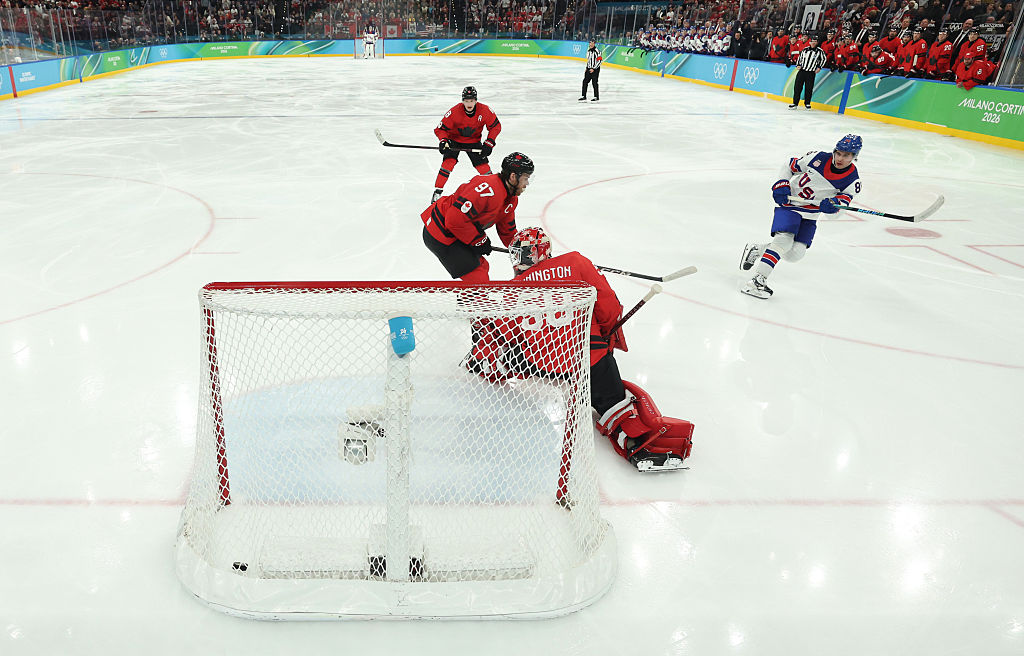
American Jewish hockey player Jack Hughes of Team United States scores the game-winning goal against Canada yesterday in overtime during the men’s gold medal game on the last day of the Milano Cortina 2026 Winter Olympic games in Milan.
Birthdays

Founder and CEO of Dell Technologies, he is the 10th richest person in the world according to Bloomberg, Michael Dell turns 61…
Retired senior counsel in the Baltimore office of DLA Piper, he served as president of the Harry and Jeanette Weinberg Foundation, Shale D. Stiller turns 91… EVP emeritus of the Orthodox Union and editor-in-chief of the Koren Talmud Bavli, Rabbi Tzvi Hersh Weinreb turns 86… Bethesda, Md., resident, Lois Copeland… Dean of a yeshiva high school in Israel, in 1967 he co-founded a popular band called The Rabbis’ Sons, Rabbi Baruch “Burry” Chait turns 80… Philosopher, novelist and public intellectual, she was a winner of a MacArthur Genius Fellowship in 1996, Rebecca Newberger Goldstein turns 76… Chairman of Agudath Israel of America and CEO of the OuterStuff sportswear line, Sol Werdiger turns 75… Film director, writer and producer, he is the president emeritus of the Producers Guild of America, Marshall Schreiber Herskovitz turns 74… 25-year veteran of USAID’s Foreign Service, she was the mission director for USAID in the West Bank and Gaza, Monica Stein-Olson turns 69… Strategic communications consultant, he was previously director of communications and PR for the Jewish Federations of North America, Joe Berkofsky… Political consultant and pollster, he is the founder of Luntz Global, Frank Luntz turns 64… Best-selling author of young adult novels, Nova Ren Suma turns 51… CEO of film production firm Benaroya Pictures, Michael Benaroya turns 45… Grammy Award-winning actor, comedian and singer, Josh Gad turns 45… Founder of Tahrir Scarf, Johnathan Morpurgo… COO and director of research at The Lawfare Project, Benjamin Ryberg… Member of the Knesset for the Likud party, Dan Illouz turns 40… Former chief of staff at USAID, now a senior advisor at RF Catalytic Capital, Rebecca Chalif… Reporter at Bloomberg covering residential real estate with a focus on NYC’s housing market, Jennifer Epstein turns 40… Founder of an eponymous real estate brokerage in Tel Aviv, Barak Daon… AIPAC alum, now an engineering manager at Business Insider, Reuben A. Ingber… Senior strategy officer at Walton Enterprises, Mary Ann Weiss… Until recently, the national politics breaking news reporter at The Washington Post, Patrick Svitek… Director of policy and business development at Polymateria, Gidon Feen…