Your Daily Phil: IsraAid CEO opens up about group’s Gaza relief efforts, warns of crisis




 Add EJP on Google
Good Monday morning.
In today’s edition of Your Daily Phil, we interview Yotam Polizer, CEO of IsraAid, about his organization’s work in Gaza, which had not been publicly disclosed until recently, and we report on the American Jewish Committee’s concerns about Israel’s plans to expand its war against Hamas in the Strip. We feature an opinion piece by Rona Sheramy and Graham Wright highlighting ways Jewish organizations on campus can do more to include and support students navigating financial insecurity, and one by Robert Lichtman cautioning against a tikkun olam takeover of Judaism. Also in this issue: Shani Mink, Shir Siegel and Loel Weil Samuel.
What We’re Watching
This week, eJewishPhilanthropy Managing Editor Judah Ari Gross is in Tulsa, Okla., speaking about Jewish philanthropy and Israel-Diaspora ties at events organized by the city’s Jewish federation as its Elson Israel fellow.
In honor of this past weekend’s Tu B’Av — Judaism’s “Holiday of Love” — Aish, CoronaCrush and Partners in Torah are hosting a speed-dating initiative tomorrow.
What You Should Know
A QUICK WORD WITH EJP’S JUDAH ARI GROSS
For over a year and a half, the Israeli humanitarian relief group IsraAid has been quietly providing assistance to Palestinians in the Gaza Strip, first by serving as an adviser and go-between, helping international aid organizations coordinate with the Israeli government and military. In recent months, this has increased to more direct assistance by creating a logistics hub for partners on the ground.
Until now, IsraAid has not publicized its work in Gaza — though its partners there, its supporters around the world and the Israeli communities it has been helping since the Oct. 7 terror attacks have been aware of its involvement. But as the debate around the humanitarian crisis in Gaza has grown increasingly “toxic” and as the situation there has grown increasingly dire, IsraAid CEO Yotam Polizer told eJewishPhilanthropy’s Judah Ari Gross that he felt it was time to open up.
Polizer sat down with eJP last week for an extended interview to discuss his organization’s efforts in Gaza, the indications that this is a true humanitarian crisis and how the Jewish world is increasingly getting involved in the Strip.
The interview has been lightly edited for clarity.
JAG: So let’s start from the beginning. How did IsraAid start getting involved with providing humanitarian aid to Palestinians in Gaza?
YP: On Oct. 8, we launched our massive response — our largest response to date, a $20 million operation in sixteen communities in Israel in the south — and that’s been our focus. And when we were watching the situation in Gaza unfolding, honestly, I didn’t think that we could get involved for obvious reasons, right? We’re called IsraAid. It’s pretty clear where we’re from. We don’t want to put anyone at risk from our team or anyone from our partners who will be able to work with us…
But a couple of months later, I think in February-March 2024, we were starting to receive calls from many of our humanitarian partners, organizations that worked with us in Afghanistan, in Ukraine and elsewhere. And they were really struggling to bring in aid into Gaza. And they told us, “Guys, you’re in the middle of it. You’re Israeli, so you know the Israeli system, you know the Israeli authorities, you know how Israel works, you know how to navigate the Israeli system, but you’re also humanitarian, so you understand how the humanitarian system works. So you guys basically have a very unique positioning that no one else has in this crisis.”
I think what people don’t understand, when they think about Gaza, they don’t understand how different it is from anywhere else in the world. … What makes Gaza so different? The fact that the civilian population and the active fighting are actually happening in the same place, in the same condensed area. In the case of Ukraine, for example, you have the war zone, the active fighting, which is mostly in the eastern border, but most of the population has fled. They went to Poland, they went to Western Ukraine, they fled for safety. … In the case of Gaza, people can’t leave… and that’s what makes it so difficult to balance between Israel’s security concerns and the humanitarian needs. … And there’s no magic solution to this balance.
JAG: And how has your work in Gaza changed over time?
YP: After a few months of doing this very quiet coordination and facilitation and helping both sides understand each other and speak to each other, we realized that we needed to do more because we were watching how the humanitarian situation was deteriorating. We decided to establish a logistics hub and support vetted and trusted partners…
At some point, we also realized that we should work on a higher level, too. During the ceasefire [in January and February], Israel agreed to allow 600 trucks into Gaza each day. And I remember, we worked in close coordination with the IDF to make that happen together with the U.N. and the many other aid organizations. … And by the way, that was important for two reasons. One is to address the needs in Gaza, but the other one is to make sure that Israel complies with the deal, and we will see our hostages. Our office is across the street from Hostages Square, literally across the street. And I remember every week, when the hostages were released, I could actually hear it. I could hear the relief, people were able to breathe for the first time when we saw our hostages released. So I felt our mission had a double meaning and double impact, both to the people of Gaza and to the families of the hostages.
JAG: What is the situation like in Gaza today?
YP: I’m not getting into the scientific terms of this or that [about what constitutes starvation or famine]. These are scientific terms. If we are at this level of starvation or famine, I’m not getting into it. But what we do know is that the situation is quite extreme. … That’s why right now we’re focused on getting as much essential aid as we can — food, medical support, hygiene supplies — to people in need, as urgently as we can.
At the moment, we really believe that the only way forward is if we get everyone involved, and I mean everyone, I mean the Israeli government, the IDF, the U.N., the [Gaza Humanitarian Foundation], the NGOs, the Gulf countries — I think the UAE is actually playing a very important role in aiding Gaza and they want to play an even bigger role. … In the absence of a hostage deal now, it’s very, very important to see that the aid is consistent and that we can avoid a bigger catastrophe from a humanitarian perspective.
JAG: As you said, there’s a certain toxicity around the topic of humanitarian aid. There have been patently bad practices in the media of using misleading photographs, but then on the flipside, there is outright denial that there is a humanitarian crisis in Gaza. Since you have not been able to go in personally, from your partners on the ground, what are some of the specific indicators that are showing that this is a real, true humanitarian crisis?
YP: The reason we know that this is real is because we’re hearing that from a lot of partners whom you can’t accuse of being pro-Hamas or being affiliated with Hamas, whether it’s vetted partners and organizations, whether it’s Palestinians who have been involved in protests against Hamas, or whether it’s a Hebrew University professor who has been researching for a long time the ups and downs in the prices of flour in Gaza. When it reaches $2,000 per 25 kilograms (55 pounds) of flour, you know the crisis is real, and you know the scarcity is real.
FRIENDLY CONCERN
American Jewish Committee expresses ‘deep apprehension’ over Gaza City takeover plan
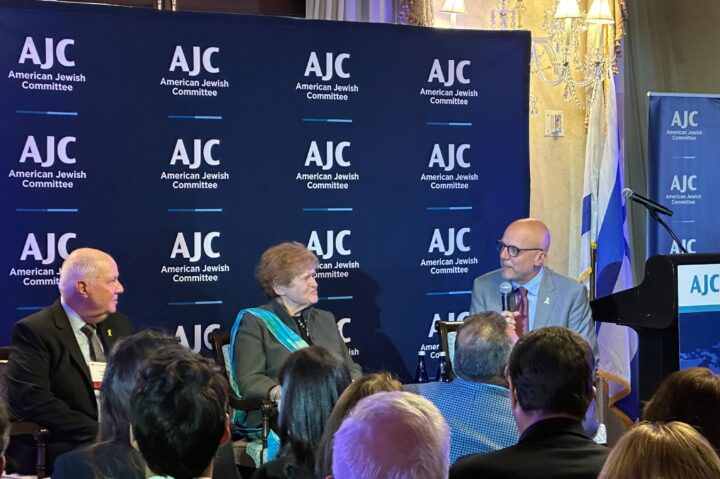
The American Jewish Committee, one of the leading global Jewish and pro-Israel advocacy organizations, expressed its “deep apprehension” over the Israeli Security Cabinet’s vote to move forward with a military takeover of Gaza City, in a statement released by the organization on Friday, reports Danielle Cohen-Kanik for eJewishPhilanthropy’s sister publication Jewish Insider.
Hostages and casualties: AJC acknowledged the “extraordinary challenges” Israel faces due to Hamas’ “intransigence” in negotiations and the “failure of the international community to impose sufficient pressure on the terrorist organization.” Still, the group said, “the profound risks posed by a full military takeover of Gaza City cannot be overlooked.” It highlighted concerns over “endanger[ing] the lives of the remaining hostages” and the possibility of “substantial casualties among both Israeli soldiers and Palestinian civilians,” in particular.
Read the full report here and sign up for Jewish Insider’s Daily Kickoff here.



CAMPUS SCENE
Piercing the solitude of the financially insecure Jewish college student

“In July, the Cohen Center for Modern Jewish Studies, in collaboration with the Jewish Foundation for Education of Women, released a report that shines a light on the ways that financial insecurity impacts the college experience of Jewish young adults in the U.S.,” write Rona Sheramy, executive director of the Jewish Foundation for Education of Women, and Graham Wright, a co-author of the report, in an opinion piece for eJewishPhilanthropy.
Outside looking in: “Jewish students with financial need can feel isolated or invisible on campuses, even those with sizable Jewish populations. For some of these students, the need to earn money while in school and a lack of shared experiences prior to college (such as summer camps and travel experiences) can make them feel estranged from their peers as well as campus Jewish organizations intended to make them feel more at home.”
READER RESPONSE
Let’s not trip and fall pursuing social justice

“Our tradition teaches that there were many more prophets than we know of today, and they traded in many more ideas than we are aware of today, but the words of the prophets that were chosen to be canonized — to carry us through thousands of years of Jewish history — were those words that would be relevant throughout that journey,” writes longtime Jewish communal professional Robert Lichtman in an opinion piece for eJewishPhilanthropy. “I have no doubt that if those biblical prophets walked our streets today they would be aghast at the injustices that still pervade every level of society. I also have no doubt that the recent announcement by the United Synagogue of Conservative Judaism that it is focusing new energies on social justice comes from such a place — not the pursuit of ‘relevance’ or competition for market share, but a tradition of balancing its investments in Torah, avodah (prayer) and gemilut chasadim (acts of loving kindness), the three pillars upon which the world stands.”
A note of caution: “While social justice can be pursued for the most noble and holy reasons, I’m deeply concerned. I’m concerned because for the past many decades, we have seen how the Reform movement raised the banner of tikkun olam (repairing the world), giving it such prominence that it obscured the other banners that we carry as a people… Some in the Reform movement have expressed misgivings, acknowledging that infusing so much capital into one goal, no matter how noble, has imbalanced its theological, sociological and philosophical essence. Rabbi Rick Jacobs, president of the Union for Reform Judaism, said as much during his keynote address at the URJ Biennial in 2015: ‘Social justice not grounded in text and ritual is ephemeral and unsustainable. Like a bouquet of fresh flowers, it is destined to dry up and wither.’”
Worthy Reads
Home Away From Home: In Haaretz, Naama Grynbaum spotlights “The Place,” a retreat in southwest India that was founded by Israeli social workers Hezi Shochat and Tamar Friedman to provide care to Israeli backpackers struggling with post-traumatic stress disorder. “After spending several months in Dharamshala in northern India, home of the Dalai Lama and a particular attraction for Israeli travelers, Shochat and Friedman came to a conclusion: The war was leaving mental scars on Israelis and many of them needed help, while on the road abroad. … So they decided to do something. They established a nonprofit, raised funds, found a building in Arambol and within two weeks transformed it last year into a calm, welcoming haven that works on a seasonal basis. … As for an agenda? There is none. This is just a place. Anyone is welcome. People sit, talk, make music. There’s yoga, meditation, improvisation. Whatever happens, happens.” [Haaretz]
Time (For Others) to Shine: In The Chronicle of Philanthropy, nonprofit executives share how, done right, taking sabbaticals can be beneficial for both leaders and their organizations. “Daniel McPhee, executive director of the Urban Design Forum, returned from a three-month sabbatical in July. He says he saw his break as a chance for his team to shine this year. ‘I really wanted to make sure that the organization was strong outside of my influence,’ McPhee says. … He divided his tasks between Urban Design Forum’s director of programs, Guillermo Gómez, and its managing director, Katherine Sacco. The trio spent six months scenario planning to cover every conceivable possibility: ‘What happens if a project falls apart? What happens if a board member passes away?’… Showing trust in your team has capacity-building benefits as well. Giving senior staff valuable experience at the helm while you take time to recharge sets up your organization for a healthy future, McPhee says.‘They were ready to rise in their leadership,’ McPhee says, ‘and this really did afford them the opportunity to do so.’” [ChronicleofPhilanthropy]
Word on the Street
Police in Montreal are investigating an attack on a Jewish man in the city’s Villeray–Saint-Michel–Parc-Extension neighborhood; Canadian Prime Minister Mark Carney called the incident “an appalling act of violence”…
In a feisty, wide-ranging interview with The New York Times, Anti-Defamation League CEO Jonathan Greenblatt explains why he considers much of anti-Zionism to be antisemitism in practice, saying, “Let me tell you what anti-Zionism doesn’t mean to me but what it results in: It’s a lunatic trying to burn down the governor’s mansion with his family sleeping in it because of his, quote, position on Palestine. It is, again, firebombing elderly people because you want to “end all Zionists”…
A man spray-painted “There is a Holocaust in Gaza” on the Western Wall overnight, after doing the same on a wall of Jerusalem’s Great Synagogue earlier. The suspect, reportedly a Haredi man with American citizenship, has been apprehended by police; his family says that he has been dealing with “severe mental health issues”…
The Canadian Jewish News interviews Shani Mink, the co-founder and executive director of the Jewish Farmer Network, about how agriculture reconnected her to Judaism…
Yarden Bibas and Dana Silberman-Sitton, respectively the husband and sister of Shiri Bibas, cut the ribbon to open the Bibas Family Playroom at Schneider Children’s Hospital in Petah Tikva, Israel, which was created by the nonprofit Toys for Hospitalized Children. Read eJewishPhilanthropy’s coverage of the efforts to build the center here…
The co-leaders of the British Progressive Judaism movement, Rabbis Charley Baginsky and Josh Levy, were booed off the stage yesterday at a London rally for the hostages in Gaza after declaring their support for the potential creation of a Palestinian state; the rabbis later released a statement saying they would not “retreat from cross-communal spaces”…
Al Jazeera said five of its staffers were killed in an Israeli strike in Gaza City; Israel said Anas Al-Sharif, who was killed in the strike, was a Hamas cell leader…
Shir Siegel, the daughter of former American-Israeli hostages Keith and Aviva Siegel, married Yuval Bar-On on Thursday, after having postponed their wedding until after both of her parents were freed from captivity…
The New York Times looks at the conversations and meetings that led British, French and German leaders to take more critical approaches to Israel…
A Holocaust survivor who was injured in an Iranian ballistic missile strike in June died on Saturday at her home in Rehovot…
The Jewish Telegraphic Agency spotlights an effort to launch a new Jewish day school within the city of Chicago — as opposed to its suburbs, which already have several…
The National Alliance for Caregiving and AARP conducted a new study, which found that 63 million Americans say that they are caring for aging parents, spouses with chronic conditions, or adult children with disabilities and serious illnesses, a 45% increase over the past 10 years…
Congregation Beth El Chabad, a historic synagogue and Jewish community center in Rutherford, N.J., was destroyed in a fire over the weekend, including the Torah scrolls; the congregation’s rabbi and his family, who were staying in an apartment in the building, escaped unharmed. There is no indication so far that the fire was caused by arson…
Elon Musk’s Starlink internet service launched its services to the general public in Israel…
Michael Seltzer, a leading figure in LGBTQ philanthropy, died last week at 78…
Major Gifts
The Pearlman Foundation is donating its entire art collection, including works by Edouard Manet and Vincent van Gogh, to three institutions: the Brooklyn Museum, the Los Angeles County Museum of Art and MoMA…
The Arthur M. Blank Family Foundation is awarding five grants totaling $2.7 million to food banks in Georgia and Montana…
The Mid Island Y JCC in Plainview, N.Y., received a $950,000 grant through the American Rescue Plan Act…
Transitions
Jewish Children’s Regional Service, which supports Jewish youth and families across Texas, Alabama, Arkansas, Louisiana, Mississippi, Oklahoma and Tennessee, has named Loel Weil Samuel as the next president of its board of managers…
Deborah Anstandig is joining Pardes Institute of Jewish Studies as educational director of engagement…
Tal Shalev is now an Israel correspondent for CNN…
Pic of the Day

Lindsay Chetkof (center) celebrates her bat mitzvah at the Western Wall last week while in Israel for the summer with the Birthright Israel Excel Fellowship.
Chetkof, who grew up in a secular Jewish home, never marked her bat mitzvah. “It felt like more than just my personal celebration. It felt like a celebration of my Jewishness—of being part of the Jewish people,” she said, according to Birthright Israel.
Birthdays

Co-founder of The Carlyle Group, in 2024 he became the principal owner of MLB’s Baltimore Orioles, David Rubenstein…
Longtime Democratic Party activist in N.Y.’s Orange and Rockland Counties, Doris Feder… Architect best known for the Holocaust Memorial in Berlin and the State Farm Stadium in Glendale, Ariz., Peter David Eisenman… Former member of the House of Representatives, she also served as Brooklyn district attorney and New York City comptroller, Elizabeth Holtzman… Principal of Investors Research Group based in Los Angeles, Jacob S. Segal… Former senior vice president for international affairs at the Jewish Federation Los Angeles, Lois Weinsaft… U.S. trade representative during the Clinton administration, she retired in 2021 as the chair of the international trade group at WilmerHale, Ambassador Charlene Barshefsky… Senior counsel for benefits and employment at the Wagner Law Group, Linda E. Rosenzweig… Lenore Solomon… Artistic director and choreographer of an eponymous dance company based in Union, N.J., Carolyn Dorfman… CEO, chairman and major shareholder of the Russian gas company Novatek, Leonid Mikhelson… Board member emeritus of AIPAC, Jeffrey Snyder… Former member of the Massachusetts Senate, he is the founder of Cape Air (an airline started on Cape Cod but that now has 37 domestic and international destinations), Daniel A. “Dan” Wolf… Publisher of Yated Ne’eman, Rabbi Pinchos Lipschutz… Member of Knesset since 2015 for the Likud party, he serves as minister of regional cooperation, David “Dudi” Amsalem… Co-founder and partner of MizMaa Ventures and wine columnist for Jewish Insider, Isaac “Yitz” Applbaum… Chairman at Duty Free Americas, he owns Israel’s Psagot Winery, Simon Falic… Former chief of the Shin Bet, Nadav Argaman… Political, cultural and social science commentator for The New York Times, David Brooks… Senior advisor for communications and engagement at The Aspen Institute, Ilana Marcus Drimmer… Clarinetist who performs internationally as a soloist, Sharon Kam… MLB pitcher for seven teams, he has also been the pitching coach for Team Israel, Andrew Lorraine… NFL offensive lineman for four seasons, he is now the managing partner of Oakland-based North Venture Partners, Alex Bernstein… Co-founder and CEO of Israeli interactive video firm Eko, Yoni Bloch… Chief investment officer and CEO of Toronto-based investment firm Murchinson, Marc Bistricer… NFL punter for seven seasons with the Jaguars and Bears, he was then a broker in the Jacksonville office of Merrill Lynch, Adam Podlesh… Reporter for Mishpacha Magazine, known as Jake Turx, Avraham Yaakov Tarkieltaub… Ukrainian-born and San Francisco-raised journalist and copywriter, Yelena Shuster… Complex general surgical oncology fellow at the University of Texas MD Anderson Cancer Center, Sara Ginzberg, M.D…. Daniel Weitz…