MAKING SPACE
WZO, WJC launch ‘Zionist Salons’ to engage disillusioned young Jews on Israel and Zionism
The program trains participants to create spaces with peers where they can openly discuss their thoughts — and gripes — about Israel without fearing judgment
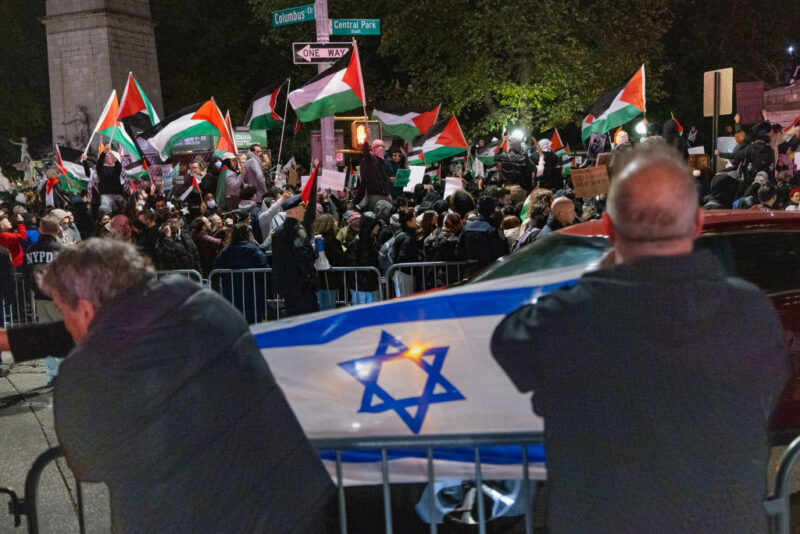
Michael Nigro/Pacific Press/LightRocket via Getty Images
Counter-protesters hold an Israeli flag across the street from a pro-Palestinian protest in New York City on Nov. 11, 2023.




 Add EJP on Google
Israel and Zionism have long been fraught issues within the Jewish community, particularly among young Jews, evoking deep emotions and sparking fierce debates. Such disputes are often short on understanding and grace and even basic agreed-upon facts — all the more so in the wake of the Oct. 7 terror attacks and the launch of Israel’s war against Hamas in Gaza.
Aiming to address the disconnect that some young Jews feel toward the Jewish state, last month, the World Zionist Organization in North America and the WZO’s Department for Zionist Enterprises partnered with the World Jewish Congress to train young Jewish leaders to initiate dialogue with their peers about Israel and Zionism through “salons.”
The inaugural “Zionist Salons Training initiative” brought select participants from the WJC’s NextGen leadership program to Denver from communities across the United States, Canada and Mexico. Michal Slawny Cababia, the North American representative of the WZO, told eJP that the aim of the program is to train participants to create spaces within their own peer networks where young adults can openly discuss their thoughts — and gripes — about Israel without fearing judgement, “even when their questions or perspectives feel complicated or controversial.”
According to Slawny Cababia, the program was developed in response to disillusionment felt by young Jews towards Israel after the Oct. 7 terror attacks and the launch of Israel’s war against Hamas in Gaza. “This came about from the need to build a program to deal with the challenge of young American Jews who are distancing themselves from Israel post-Oct. 7 and feel like they don’t have a safe space to talk about Israel,” Slawny Cababia said.
Even though the program was already in development at the time, Slawny Cababia said, the need for it was expressed in a speech by Rabbi Elliot Cosgrove in December at the American Zionist Movement’s biennial national assembly. Cosgrove, who leads New York’s Park Avenue Synagogue, warned that communal “orthodoxy” and unwillingness to accept criticism and debate would alienate young Jews from Israel and Zionism.
She noted that while the program was conceived independently of Cosgrove’s speech, it reflects similar ideas.
“The [program] wasn’t inspired by him and his book, but it’s exactly what he says,” said Slawny Cababia, referring to the rabbi’s 2024 book, For Such a Time as This: On Being Jewish Today. “Today’s kids, and I mean, I see it with my own kids too, they need that nuance. They’re not going to come to a conversation if it’s not able to hold two truths. They’re not going to go for it without that balance. Because it’s complicated.”
The nature of the program, she added, means that those conversations — both in terms of the attendees and topic — vary based on the organic social network of each facilitator.
“We’re not trying to educate people to be supporters of Israel,” she said. “Some people will take it to the place where they’re talking with their friends who may be less knowledgeable about Israel and Zionism… Some people may bring in their friends who distanced themselves from Israel since Oct. 7, to have a dinner conversation. Just ‘what do you think about Israel?’ And through that, to bring them in” she said.
Tia Sacks, a political research analyst at the Canadian Centre for Israel and Jewish Affairs who participated in the seminar in January, envisions facilitating conversations both with her non-Jewish friends and her family.
“It just sort of heightened my sense of curiosity and how people’s connection to Zionism may vary, and what it looks like to them, and whether that be, yeah, with Jewish people, with my family and friends, or with people who don’t even know what Zionism is. Creating this sense of openness and willingness to just talk freely,” she said.
Shortly before Oct. 7, 2023, Sacks had started a master’s program in journalism at a university in Canada. Conversations about the conflict became inescapable, she said — and exhausting.
“It was kind of an everyday battle of feeling at the edge of your seat just waiting for the topic to be brought up, and feeling like you were the only one who could sort of defend yourself and your people. The way that I thought about Zionism and the way that I thought about being Jewish, was very much on the defense at all times, which was sort of the exhausting thing and a sad thing for someone who’s had quite a strong Jewish identity,” she told eJP.
Sacks was drawn to participate in the program because she was hoping to learn to facilitate more productive conversations, she said.
“I realized that it doesn’t have to be so intense. There doesn’t have to be a strong outcome. You can just start the dialogue and let things sort of go from there,” she said.
Related News
EXIT INTERVIEW
Elizabeth Sokolsky, longtime EVP of Birthright Israel, to retire next year
CLOSING WORDS
In AZM address, Cosgrove links communal ‘orthodoxy’ on Israel to rising anti-Zionism among young Jews

MAJOR GIFTS
Center for Jewish History celebrates 25 years with a $25M matching grant
ADVANCING A VISION
N.Y. federation donates $1M toward building shared-society center named for peace activist killed on 10/7

MAGICAL EXPERIENCE
Shefa launches psychedelics retreat for Jewish professionals suffering burnout