HELP ON THE WAY
With Israelis displaced and stuck in bomb shelters, Social Delivery brings aid where it’s needed
The small logistics nonprofit serves as a bridge between those who have things they don't need and those who need things they don't have
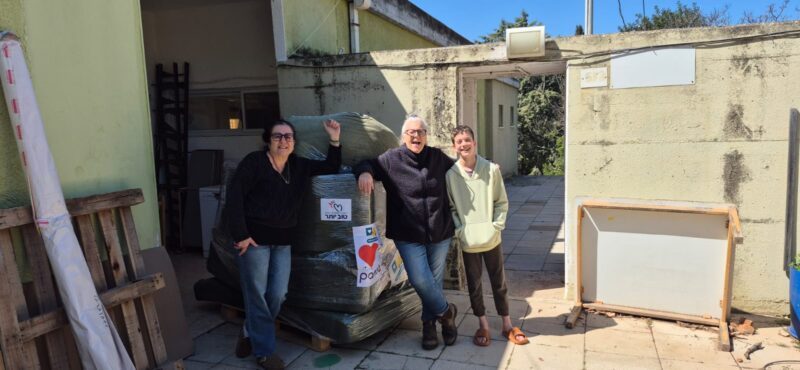
Courtesy/Social delivery
Residents of Kibbutz Eilon in northern Israel receive a shipment of goods from 'Social Delivery' in March 2026.




 Add EJP on Google
The idea is straightforward: Some people have things they don’t need; other people need things they don’t have.
The Israeli nonprofit Shinua Hevrati (Social Delivery) steps into the gap between the two, helping remove unwanted items — a clothing company with an unsellable surplus of merchandise; a relocating startup getting rid of its office furniture — and delivering them to people in need: families in poverty or a teen afterschool program.
As Israel enters its second week of missile and drone strikes across Israel, displacing hundreds of people and exacerbating financial struggles, Social Delivery is stepping in to fill those growing needs.
Families whose homes have been damaged by rocket fire or who have been forced to evacuate are receiving donations of clothing and toys, delivered to evacuees from Tel Aviv, Beit Shemesh, Beersheva and Tirat HaCarmel in the north, and to patients and displaced persons at Ichilov Hospital. On an even larger scale, as one-third of Israelis lack fortified rooms in their homes — many of whom are elderly or have special needs — they are spending long hours in public bomb shelters, often in the middle of the night, which cannot only be stressful but physically uncomfortable.
“When there are frequent sirens, people need to stay in the shelters. So we provide mattresses, bed sheets, pillows, blankets — things that make it easier for them to stay,” Medi Nachmias Baruch, Social Delivery’s manager of resource development and strategic development, told eJewishPhilanthropy. Even as Israeli children spent the Purim holiday in shelters last week, Social Delivery brought them special care packages to lift spirits. “To date, we have distributed thousands of items of clothing and hundreds of mattresses, pillows and blankets.”
“We identify the needs on the ground, whether it’s clothes, hygiene products, infant products. And one of our biggest advantages is that we have our own logistical infrastructure — our own trucks and drivers — so we can respond really rapidly, within 24 hours, with the products that might be needed,” Nachmias Baruch said.
Current delivery locations include Hatzor HaGlilit, Rishon LeZion, Akko, Haifa, Kiryat Shmona, Tzfat, Beit She’an, Tiberias, Kibbutz Manara, Maalot-Tarshiha, and the Arab cities of Majd al-Krum and Shefa-Amr — with more being added. So far, the organization has provided support to some 2,000 people evacuated from their homes.
“What moves me every time,” founder Tomer Shemesh said, “is the ability to fill the gap from the surplus that already exists. The circle closes.”
Yitzhak Katz, the community director of the Ron Arad school in Rehovot, sent a video thanking the assistance given to his school, which turned into a community response center for citizens 65+, in coordination with the Rehovot municipality. In the video, Katz thanks Social Delivery and the corporation for the distribution of pillows, mattresses and bedding, as well as warm clothing.
Tali Lidar, the Israel representative for the Jewish Federation of Greater Philadelphia, which supports Social Delivery, said the organization tends to fly under the radar. “Why doesn’t everyone know about Social Delivery? Because they’re busy doing the work — and not talking about it,” Lidar told eJP. (The organization did feature prominently in a recent episode of the popular Israeli economics podcast “Hayot Kis.”)
Social Delivery was founded in 2018 by Shemesh, a social and environmental entrepreneur whose instincts were shaped, in part, by growing up within the Noar Oved youth movement — Israel’s socialist Zionist youth movement. Before founding the organization, he served as a campaign manager at Leket Israel, the country’s largest food rescue organization. Watching Leket redirect surplus food from producers to people in need, Shemesh asked a simple question: Why couldn’t the same principle apply to everything else?
“He basically said: Leket does it for food — why can’t we do it for other products?” said Nachmias Baruch. “And from there it expanded.”
The group’s logistics platform matches supply to the specific need of the moment, wherever in the country that need exists. “They’ll respond to the need. So if they get computers, they’ll work with the places that need computers. If you have mattresses and you’re absorbing immigrants, they’ll get the mattresses,” said Lidar.
Social Delivery describes its model as win-win-win. For the corporate side, the organization provides a single address for in-kind donations — eliminating the legal and logistical burden of managing surplus — while offering a recognized tax deduction. Companies don’t have to pay to dump the goods; they can write off the donation and know that it went somewhere meaningful. For nonprofits and welfare agencies, the model eliminates what is otherwise a constant drain: time and budget spent sourcing equipment. For the environment, it diverts hundreds of tons of usable goods from the landfill annually.
The corporate partnerships range across sectors. The garment industry — Israeli brands including Delta and Golf — generates production overruns and excess inventory. The high-tech sector, where companies relocate or renovate offices every two to three years, contributes furniture, computers and equipment at scale. Microsoft, Wix and IBM are regular partners. When Wix moved its offices to Herzliya, the brand-new furniture in its previous location had nowhere to go. Social Delivery came in, packed everything out and redistributed it.
Among the most trust-intensive partnerships is the one with Fox, the Israeli retail chain. Social Delivery is the only organization with permission to use Fox’s surplus garments — the company will otherwise not allow its unsold inventory to be resold or reenter the market. According to Lidar, that kind of exclusivity reflects something Social Delivery has built carefully: the confidence of Israeli business that their surplus will be handled with integrity.
Operating out of three warehouses covering the north, center and south of the country, the organization employs dedicated staff for each geographic zone to manage requests from nonprofits and municipalities.
For many in the Jewish world, Social Delivery first came into view during the wave of Ukrainian Jewish immigration to Israel following Russia’s 2022 invasion. Working in partnership with the Jewish Agency, the organization created physical stores in municipalities across Israel that were absorbing large numbers of Ukrainian refugees, offering things like baby clothes and formula, diapers, mattresses, light fixtures, kitchen items.
“Instead of giving them handouts, they [refugees] could choose what they needed,” said Lidar. “So it was also keeping their dignity and their ability to choose, sustaining their resilience.”
This model of needs-based logistics is what positioned Social Delivery to respond so efficiently when Hamas attacked Israel on Oct. 7, 2023. Already stocked with emergency reserves, and experienced in disaster response, the organization was able to quickly support those civilians immediately impacted by the war.
The geographic reach was national, extending to the north, the south and the center of the country as well as multiple hospitals receiving evacuated patients.
The organization’s logistical center near the town of Pardes Hanna also features an added dimension that goes beyond mere logistics and focuses on community-building and environmental sustainability: a hands-on repair workshop for people recovering from trauma — including veterans dealing with PTSD — who need purposeful physical work as part of their rehabilitation. Donated items that arrive broken or worn are brought to the workshop: a cracked stove repaired and made functional again; old benches reupholstered and returned to donation-ready condition. The repaired goods go to yet another nonprofit for redistribution.
Social Delivery is funded mainly by North American Jewish philanthropy — the federations of Philadelphia, Los Angeles, New York, Miami, St. Louis, Atlanta, Chicago, San Diego and Cincinnati are among its partners, along with Jewish Federations of North America, which committed emergency funding post-Oct. 7 — as well as in-kind corporate support from leading Israeli corporations including the fashion label Fox, Panda Mattresses, Phoenix Insurance and Taavura Holding (transportation and logistics).
“They’re very lean,” said Lidar. “It’s a small organization that’s only growing and maximizing the work it’s doing and really reaching more and more people.”
And possibly most important to the current moment is the organization’s ability to be nimble and highly responsive, Lidar said. Social Delivery does not wait for funding before acting. Lidar connects this to Shemesh’s Noar Oved roots — a movement that instilled the idea that showing up to help is not a strategy or a brand exercise, but something closer to a reflex. “I think it’s imprinted on [Tomer Shemesh’s] soul. He needs to go out there and help.”
Related News

EXIT INTERVIEW
Elizabeth Sokolsky, longtime EVP of Birthright Israel, to retire next year

MAJOR GIFTS
Center for Jewish History celebrates 25 years with a $25M matching grant
CLOSING WORDS
In AZM address, Cosgrove links communal ‘orthodoxy’ on Israel to rising anti-Zionism among young Jews

MAGICAL EXPERIENCE
Shefa launches psychedelics retreat for Jewish professionals suffering burnout
HIGHER EDUCATION
As Jewish donors reconsider academia, Jan Koum doubles down, endowing Israel studies at Stanford