Opinion
BEHIND THE SCENES
Why humanity matters most: One Israeli foundation’s post-Oct. 7 experience




 Add EJP on Google
In Short
How to maintain human connection while managing hundreds of donors, thousands of donations and the pressure of national crises — and why, without it, everything falls apart.
People think that working with money is purely technical work: just numbers, accounts and bank transfers. The truth is that when you’re dealing with charitable donations, you’re dealing with something entirely different. When someone gives tzedakah, they’re giving of themselves; giving something they’ve deeply invested in. Naturally, there are tremendous emotions involved.
Especially during difficult times, much of the giving comes from people’s pain. Intense emotions surface; painful responses emerge. Yet the goal is to not lose the human connection, even when the workload becomes inhuman.
Courtesy
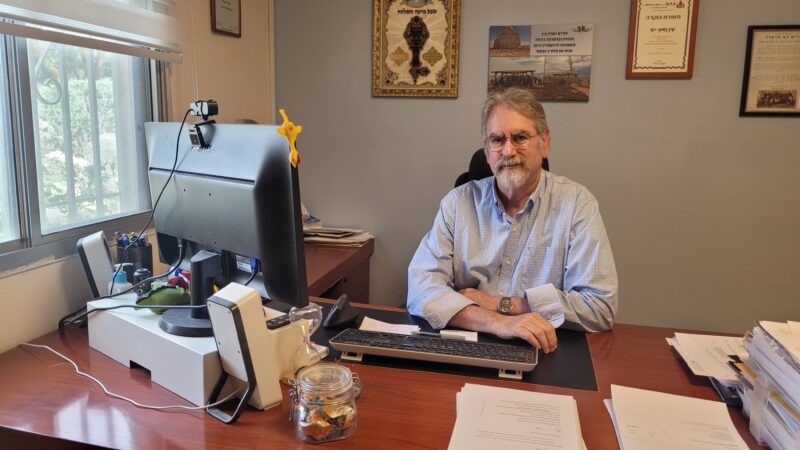
Chaim Katz, founder and CEO of Ne'eman Foundation, at his desk.
I want to share what it really looks like behind the scenes and what it takes to preserve the human element in work that deals with hundreds of donors and nonprofits every day.
The day after Oct. 7, 2023, everything was still in chaos. Everyone was in shock. Most men were called up to reserve duty. Suddenly we realized that the organization wasn’t stopping — it was growing explosively. New donors were searching for ways to help the people of Israel. Needs were emerging from the field, new campaigns were launching, and we, a small team, needed to respond to everyone.
We started working non-stop. Flooded with inquiries, urgent requests, donors who wanted to help now. And the question was: How do you do this right? How do you not collapse under the pressure, but also not lose what’s most important — the personal connection with each person?
After three weeks, we hit our limit; physically, emotionally, mentally. We understood we needed to do something different. So we sat down and decided to make a list of priorities. We can’t do everything. What are the most important things?
Receiving donations from people, especially from abroad.
Issuing receipts, so money doesn’t get lost.
Distributing the funds, so money reaches its destinations faster.
That’s it. Everything else will wait.
It was a difficult management decision, but the right one. And looking back, I think we succeeded in 90% of cases. We’re human; there was tremendous pressure, and there were mistakes. But people showed immense empathy and understood. And most importantly, we didn’t lose the personal connection.
So what does it really take to maintain humanity in this kind of work?
First, respond with courtesy. Always. Even under pressure, even with overwhelming workload. Always start an email with “Good morning, how are you? Thank you for reaching out to us.” Always end with “Have a great day” or “Good news” — anything that makes the person feel there’s a heart meeting a heart.
Second, never give up on a client. The agenda is to help, and to help as much as possible. And even if they think we made a mistake, say “I apologize for the frustration, let me help you. How can I extend a hand?” It sounds simple, but under daily pressure it doesn’t always happen automatically.
Third, develop what I call “written intonation.” Most of our work is through emails. And I always try to make the person on the other end feel my heart through the screen. I have clients who write to me very formally, but I respond warmly. And there are those who already write to me “Hey, how are you?” like friends. That means we’ve succeeded in creating a real connection.
And here’s the important point: people appreciate having someone who knows them. Someone who remembers the conversation from February of last year. Someone who understands their needs, sees their pain, truly notices them.
We have a signature at the bottom of all our forms: “Boutique Philanthropy.” It’s not just a nice slogan. It’s our commitment: to provide optimal service, so the person before us understands and feels that there’s someone here who truly wants to help them make a difference.
On the eve of Rosh Hashanah, the day before the holiday, during a very busy period, we received an email from a donor. “My heart is broken,” he wrote. “I promised a family here in Israel support for the holiday. And I didn’t know that the way I donated [the funds] would be delayed like this. I can’t enter this holiday without supporting this family.”
We clarified the details with him and discovered that the money was indeed on its way, but taking time. So we decided: We’ll donate it before the holiday ourselves, so the family receives the money. A few days later, the money came through, and the thank you he wrote was so heartwarming.
This is one story among many, and it illustrates something simple: This work isn’t just technical. It’s not just numbers and bank transfers. It’s work with people. People for people, people with people. This is human work.
It’s true that our work does require support and help from computers: we invest heavily in systems, automation, ways to streamline the work. But the human element — that must never be lost. Without it, all these systems are just an empty shell.
That’s why, even when the workload is heaviest, even when the pressure is most intense, we always remember: Behind every donation is a person. Behind every request is a story. Behind every email is a heart hoping for a warm, human response.
This is our mission — and I believe it’s the mission of everyone working in this field.
Chaim Katz is the founder and CEO of the Ne’eman Foundation.