Opinion
COMMUNAL LIFE
Where do I belong? Making space for adults without children in the Jewish community




 Add EJP on Google
From brit milah to bar mitzvah, wedding to family programming, much of Jewish institutional life is structured around the family structure and children’s growth and education. Jewish adults who travel a different path, one that doesn’t connect with these traditional touchstones of engagement, may find themselves marginalized and ignored by the Jewish communal establishment.
For Jewish adults post-college, there’s Moishe House and local offerings, such as Tribe 12 in Philadelphia or GatherDC in Washington. Family programming is addressed through a plethora of tot Shabbats, PJ Library offerings, religious and day schools, and Jewish summer camps. Adult programming in many institutions focuses on seniors and retirees. There’s an invisible cohort falling through the cracks: Jewish adults in their late 30s, 40s, and 50s without children.
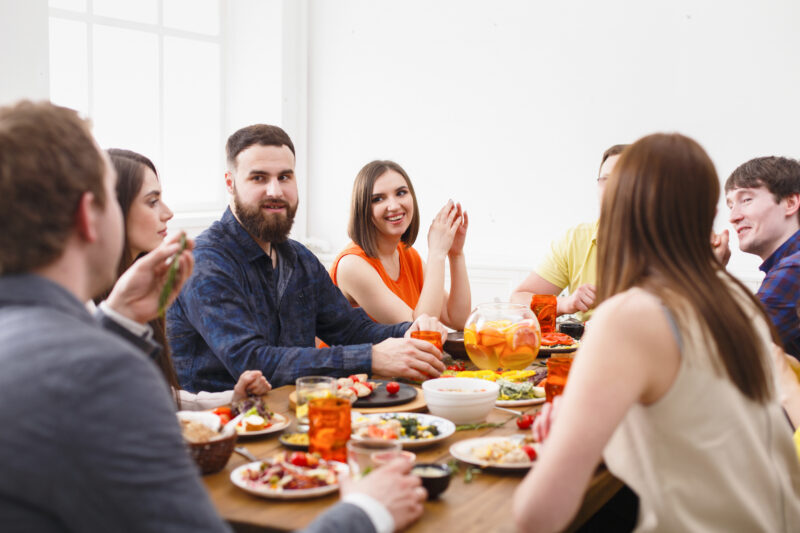
Adobe Stock
Illustrative.
Too old for the post-college programming, too non-parent for the family offerings and too young for the older-adult options, Jewish adults in their late 30s, 40s and 50s have distinct experiences of identity and belonging, and their needs in these areas warrant attention and support.
Social science researchers understand belonging as how one feels within one’s relationships and one’s environment, and the Need to Belong as a fundamental human drive. Belonging is whether an individual feels that they are an integral sense of a system or community, and how the individual understands their place within the community. A sense of belonging leads to an individual’s positive emotions, and a lack of belonging may lead to decreased emotional and physical health.
The family at the center of Jewish institutional life
Among synagogue professionals, a common adage about membership is that growth is measured by the number of baby strollers out front. Many synagogues label their membership units as “families.” Engagements and marriages are celebrated in synagogue life, with announcements, auf rufs, and rounds of singing od yishama or siman tov u’mazal tov. On a local level, the South Philadelphia Shtiebel, a much-talked-about modern Orthodox community of which I’ve been a part for over five years, had roughly two dozen babies born to community members in the last year, and babies and toddlers are passed between parents across the mechitza throughout services. We celebrate and venerate family life, fertility, and children in Judaism, recognizing both the commandments to be fruitful and multiply and to teach the Torah to our children, as well as the fact that our people’s continuation is contingent on that next generation.
The population of Jewish adults in their 30s, 40s, and 50s without children has grown in the last several decades, alongside a general shift in the United States in patterns of marriage and childbirth. In 1950, there were 37.1 million more married Americans than unmarried Americans, a gap that decreased to 4.3 million by 2023. There was a 14% decrease in total births in the US between 1990 and 2023, as well as an increase in the median age of mothers. Jewish women are less likely than American women overall to have children. Among women aged 40–59, 20% of Jewish women remain without children, compared with 10% of American women.
Jewish adults in their 30s, 40s, and 50s without children have a strong desire for community, a desire which is impacted by their degree of social connections and their alignment with organizational values. In researching the feelings of belonging of Jewish adults ages 35-40 in the Philadelphia Jewish community for my master’s thesis, I found that participants simultaneously felt “a part of” and “apart from” the community. Participants were very aware of their position relative to established groups, generational patterns and the centrality of parenting in Jewish institutional life. Some demonstrated confidence in seeking out what they needed; others spoke of the difficulty of entering already-formed circles. Several participants noted that they intentionally seek out environments where they could be known, recognized and valued — spaces where their contributions mattered and their identities were respected. Participants shared a foundational belief that community is essential for Jewish flourishing and that belonging is not a passive condition but something actively experienced, negotiated and cultivated.
Macro-level recommendations
Create and offer leadership training, and offer support for DIY initiatives: My research showed that leadership activation was key in fostering belonging and continued engagement. Support in this area will lead to individual growth and community vitality. I recommend three areas of support: first, formal leadership training for emerging lay leaders; second, the development of meaningful leadership roles across organizations, such as serving on a board or spearheading new programs; and third, support for grassroots, DIY initiatives, whether offering space for events, marketing, or funding for projects.
Offer events for adults in their 30s and 40s: Creating programming specifically for this age range would allow participants to meet peers experiencing similar life stages. This would support the development of peer networks, deepen a sense of belonging, and provide a clear point of entry for adults who feel caught between existing demographic categories.
Cultivate a culture of welcoming: Case study participants consistently identified welcoming behavior as the single most decisive factor shaping their sense of belonging. This welcoming behavior wasn’t only friendliness or a simple greeting, but was being recognized as an individual, with unique capacities, presence, and potential. This relational attentiveness fostered a sense of belonging and, in turn, created the conditions for sustained engagement.
Micro-level recommendations
For any membership-based institutions, such as synagogues and JCCs: How are you defining your membership units? Do you use the word “family” to describe a unit as a whole? Consider how othering this is to an individual who is, or may seek to be, a member in your organization. While utilitarian, the words “unit” and “household” describe the membership mechanism.
For synagogues and other organizations that acknowledge life-cycle events, whether via email blasts, social media posts, or announcements and honors at services: Consider the balance between family-focused acknowledgements, such as an engagement or a birth, and non-family-focused acknowledgements, such as completing a doctoral degree or beginning a new job. How might you incorporate acknowledgement of individual achievements in a way that honors them just as you honor family-focused events? Perhaps do one less round of od yishama for the newly engaged couple, or even a round of siman tov for the individual.
Take a step back and assess your institution as a whole through this lens. Do staff bios include family and marital status? Does your institution have a “director of congregational learning” that is a rebranded religious school director (and if so, does that mean that the youth are the only ones learning in your congregation?)? Do you send email blasts or mailers about summer camp to your entire mailing list? Does adult lap swim get cancelled so campers can use the pool? Is it possible to walk through your synagogue entrance on Shabbat morning, or is the access blocked by strollers? Do you offer child-free low-sensory spaces for adults? Do you offer affinity groups for families, children, teens, and seniors, but none for adults in their 30s-50s? How much programming, and air space about that programming, is for families versus non-family programming? Whom do you see sitting together at communal meals–is it families who know each other through tot Shabbat and religious school, or are there mixed groups? What does your membership application look like? Who is in the photos on your website–is it all or almost-all families?
These questions and observations are asking you to be intentional about the spaces you create, the programming you run, and the language you use. All of this sends a message about your organization, and whom you really want to be there.
Remember that your constituents matter just as they are, regardless of their family status. A community is made up of individuals, not families, and each individual is integral to the health of the whole.
When we work to create spaces that are welcoming to people of different age groups and family statuses, we are recognizing those who are already a part of the community. Adults without children crave community and recognition for their unique selves. There are simple shifts in design and language that can open up room for their experiences, and some changes that require financial investment. Jews of all backgrounds and paths make up klal yisrael; now let’s ensure that the communal infrastructure of klal yisrael reflects that.
Rebecca Van Wagner is a senior rabbinical student at the pluralistic Academy for Jewish Religion in Yonkers, N.Y. She serves as rabbinic intern at Goucher Hillel.