Opinion
FROM THE LAND DOWN UNDER
What the Australian response to Bondi reveals about Jewish institutional readiness




 Add EJP on Google
In the days immediately following the antisemitic attack at Bondi Beach, I flew to Sydney with Rabbi Avi Weiss to show up for the Jewish community in its aftermath. Only hours after arriving, we attended the funerals of Boris and Sofia Gurman z”l, who were killed while trying to fight off the attackers, visited shiva homes and hospitals and met with members of a Jewish community reeling from shock and loss.
That Friday night, at the Great Synagogue, political leaders gathered for a Chanukah event meant to signal solidarity.
Amitai Fraiman
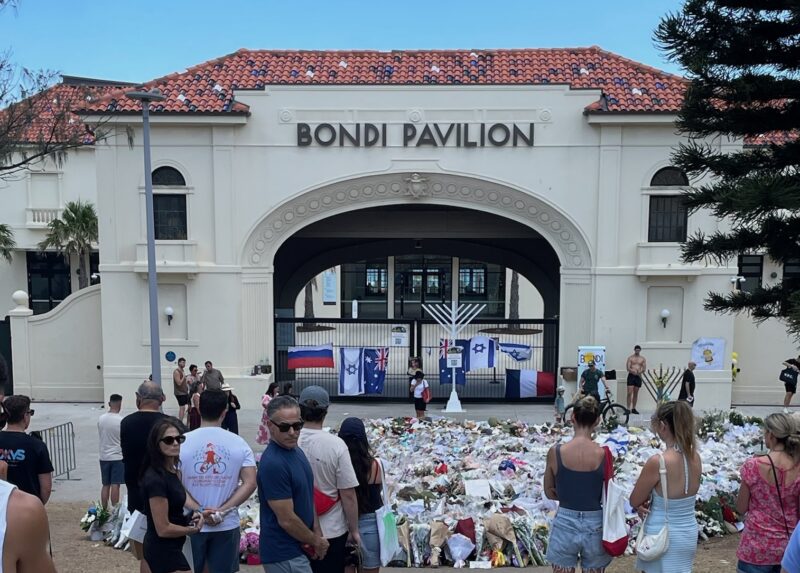
A tribute at the Bondi Pavilion in memory of the victims of an antisemitic terror attack at Bondi Beach in Sydney, Australia, on Dec. 16, 2025.
Just before Shabbat, Rabbi Weiss approached Australian Prime Minister Anthony Albanese and shared a letter with him from Rep. Ritchie Torres (D-NY) condemning the deadly antisemitic Hanukkah attack, expressing solidarity with Australia’s Jewish community, linking the tragedy to rising global Jew-hatred tied to anti-Israel extremism and urging leaders to meet with Rabbi Weiss to draw on his expertise in confronting antisemitism. The rabbi challenged the prime minister to show up more fully for the Jewish community. The response was respectful but restrained.
On his way out, New South Wales Premier Chris Minns accepted the rabbi’s offer of the priestly blessing. Minns bowed his head and closed his eyes; afterward, he shared that he felt shame that such an attack had occurred on his watch.
At the time, I registered the contrast between the two interactions and logged it as a lesson in leadership. Only later, after days of funerals, hospital visits and conversations across the community, did I understand what else about the moment stayed with me.
This was my first time in Australia, and I do not claim to understand Australian Jewish life beyond the eight days I spent there. What I do know is that moments of crisis have a way of stripping communal life down to essentials.
We traveled to Australia to do what Jews have always done in moments like this: show up. We were not there representing an institution or advancing a policy agenda. We went to attend funerals, sit with mourners, visit the wounded and stand alongside a community navigating grief, fear and anger all at once. Along the way, community leaders and members spoke openly about warnings they had raised over time, warnings that had not been fully heard. Bondi was not the first moment of concern. Far from it.
What stood out to me most was how public Jewish grief unfolded. At vigils and gatherings, grief was expressed in Jewish language and ritual, without much effort to translate or universalize it first. The events were not framed primarily for outsiders; and yet, people from outside the Jewish community still came. Political leaders entered Jewish spaces.
This was clarifying, not because Australia offered a model to import, but because the moment revealed something about structure and expectation.
American Jewish life evolved under assumptions of safety and acceptance that were real enough to allow deep integration. Those assumptions shaped institutions, leadership instincts and communal reflexes. When public Jewish life feels stable, institutions move carefully not to rock the boat, explain, contextualize and debate meaning before acting.
That environment is changing.
Part of what made the Bondi Beach massacre so shattering was its rarity. Large-scale violence of this kind remains historically uncommon in Australia — not only antisemitic violence, but mass violence of any kind. When it occurs, it registers as a rupture in the social fabric. In the United States, in contrast, where mass violence has become tragically familiar, institutions are conditioned to metabolize shock quickly. Meaning is often routed into familiar interpretive or policy frameworks. That baseline difference matters for how communities mourn and how leaders respond.
It also explains why some familiar American lenses felt misplaced in the conversations I had. Discussions about gun laws or limits on free speech were not dismissed because policy was irrelevant, but because those categories failed to name the nature of the harm. What mattered first was recognition that a minority community had been targeted and that the state bore responsibility for understanding how that could happen. The establishment of a Royal Commission on Antisemitism and Social Cohesion signaled that this recognition was shared. Antisemitism was named directly, and its consequences were framed as a concern for the health of society as a whole. That naming felt like an important first step, even as the outcomes remain to be seen. It mattered not as a solution, but as acknowledgment.
For me, the experience raised questions closer to home.
American Jewish institutions were built during a period when public Jewish life felt relatively predictable. Visibility often felt optional. Much of our institutional muscle memory was formed in an environment where belonging seemed durable, and threats could be parsed, debated and explained.
Today, parts of the American Jewish institutional ecosystem are still oriented toward interpretation rather than response. These instincts are understandable. They were shaped by a different moment. But they increasingly lag behind the conditions Jewish communities face today.
Bondi did not provide answers. It provided perspective. It showed what Jewish life can look like when the assumption of stability no longer holds, and when response precedes explanation.
For those of us responsible for shaping American Jewish institutions, the question is no longer whether the environment has changed. That much is clear. The more difficult question is how our organizations are learning to adjust, and whether we are giving ourselves the structures and instincts this moment now requires.
Bondi forced me to reckon with what it means to live and lead without the assumption of stability. It raised, rather than resolved, the question of how American Jewish institutions understand themselves now: as a minority that is clear about who it is, willing to be visible and able to act without first explaining itself or asking for permission.
Rabbi Amitai Fraiman is the founding director of the Z3 Project and a U.S.-based Jewish communal leader and writer. His work focuses on Jewish Peoplehood, Zionism and public Jewish life.