WHAT YOU SHOULD KNOW
What do looming changes to 990 Forms mean for nonprofits? Greater transparency and more red tape
Library of Congress
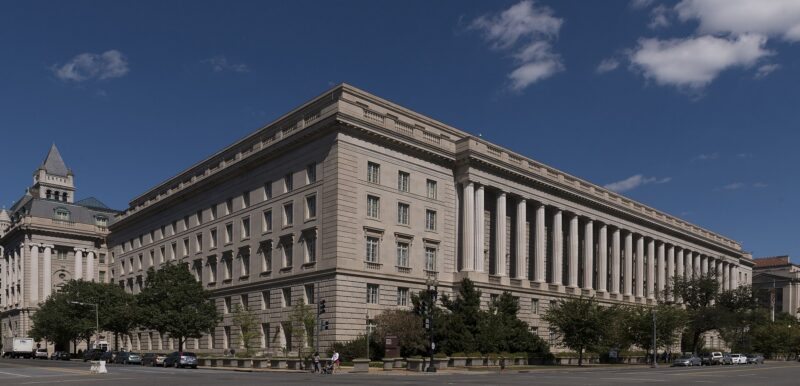
The Internal Revenue Service Building in Washington.




 Add EJP on Google
Last week, the Treasury Department announced planned changes to IRS tax Form 990 in a move that could lead to better transparency in how nonprofits use funding and expose foreign interference in the nonprofit world.
But experts told eJewishPhilanthropy that the change would still allow funders to hide their donations and would add an additional layer of bureaucracy for all nonprofits.
“Public money and tax-exempt status demand public accountability,” Treasury Secretary Scott Bessent said in the announcement. “We are ending the days of hiding fraud, abuse and extremist activity behind complicated nonprofit arrangements. When bad actors misuse charitable structures, directors and officers should understand that transparency can lead to scrutiny, accountability and liability under the law.”
Much of the change centers around “fiscal sponsorship,” in which nonprofits provide their tax-exempt status to outside projects — an increasingly common practice that is meant to improve the efficiency and speed of new initiatives. While it allows grassroots efforts get off the ground quickly with less bureaucracy, this method can also be used to obfuscate funding sources and governance structures, making it unclear who stands behind a fiscally sponsored project.
Fiscal sponsorships have drawn increased scrutiny by conservatives in recent years as they have grown more popular, particularly among liberal funders, such as the Tides Foundation, which is backed by philanthropist George Soros’ Open Society Foundations and supports a wide array of progressive causes, including the anti-Israel boycott, divestment and sanctions movement.
The new form would also require greater transparency about foreign donations — another area of increased concern in recent years, as non-U.S. funders, some of them tied to foreign governments, have been found to be funding a wide array of political activities in the States.
The 990 form change also comes as the White House is elsewhere cracking down on progressive groups, including filing fraud charges against the Southern Poverty Law Center for allegedly allocating donor funds improperly by using them to pay informants in far-right extremist groups.
The goal of the new 990 form is “to make the financial flows more transparent and to strengthen oversight,” Nancy Chun Feng, professor of accounting at the Sawyer Business School at Suffolk University, told eJP. “Especially for government grants and contracts, fiscal sponsorship arrangements and complex funding structures across entities.”
Feng interpreted the announcement as a “shift from entity-level reporting to network-level transparency,” looking at organizations’ nonprofit partners, many of which are not 501(c)(3) organizations.
But having more reporting requirements does not necessarily mean there will be a better understanding of how the funding is being used, she said. The revisions of the 990 form may also add complexity to the paperwork, which can cause confusion in how it is filled out by organizations and by the public that is reading it.
Additionally, a uniform form may not work equally well across all nonprofits, according to Feng. “Art institutes, journalism and advocacy organizations structure fiscal sponsorship differently, so a one-size-fits-all approach might not capture nuances across sectors,” she said.
For many overburdened nonprofits, the changes will add to a pile of paperwork, Rachel Sumekh, the CEO of TEN: Together Ending Need, told eJP.
“Many Jewish human service agencies receive large amounts of federal funding to support our community’s healthcare, senior services, disability services, etc.,” she said. “Increased reporting on what are already laborious requirements adds a huge burden. Government funding represents [much] of the funding that the over 170 Jewish human services agencies rely on, according to The Network [of Jewish Human Service Agencies. It is] the largest single source, which has already seen cuts from this administration. This means more staff time for reporting, rather than case management, for no extra dollars.”
The last time the 990 form was changed was in 2007, under the George W. Bush administration, adding disclosures on organizations’ governance structure and policies. The forms went into effect in 2008 and were used for the 2009 filing season.
Bessent’s reference to “fraud, abuse and extremist activity” in his statement about changes “made them sound much more ominous, perhaps, than the specifics might be,” Brian Mittendorf, the H.P. Wolfe Chair in accounting at the Fisher College of Business, told eJP.
There have been organizations, including the Nonprofit Open Data Collective, which includes ProPublica, the Aspen Institute, Charity Navigator, Arizona State University and Carleton University as partners, that have been pushing for the IRS to shift the 990 to be more accessible for the public, which will improve research into the work nonprofits do. But Mittendorf questioned whether “is it going to be a refined 990 that provides more information or is it going to be a refined 990 that’s really just for the sake of targeting a handful of organizations.”
There are legitimate concerns about the overuse of fiscal sponsorship, Mittendorf said, which causes the public to not know what money is being used for.
There is also a need for transparency with donor-advised funds, which also allow funders to hide their identities. This is not included in the current IRS change, however. There are also ways to improve 990s without much extra record keeping for nonprofits, “but that also doesn’t necessarily sound like what they’re looking to get.”
While there is no definitive timeline for the rollout of the new Form 990, he said, typically a change to a form is first announced, followed by its release to the public for feedback.
When feedback is sought on the new form, “it’s a great opportunity to participate in this process,” Feng said. “If increased complexity leads to concerns about compliance costs for smaller nonprofits, this may be an appropriate time to raise those concerns.”
The IRS proposed regulations for donor-advised funds in 2023. The agency received feedback from the public and held a forum in Washington, but when President Donald Trump took office for the second time, the regulations never went into effect, Mittendorf said. A similar situation could arise with this new proposal, he said.
People will need to “wait and see” what this all actually means, Mittendorf said. “I think the intent will be much more clear when we see what it is they’re proposing and how quickly they do so.”
The public has a legitimate concern “about the interest of foreign actors in our country, particularly in areas related to elections and [voter] mobilization,” Basil Smikle Jr., professor of practice and director of the master’s in nonprofit management program in the School of Professional Studies at Columbia University, told eJP. These foreign actors could be involved throughout the nonprofit world without the public knowing.
“The hope is that this kind of transparency would also make it easier for the government and law enforcement agencies to see how extremist groups are funneling their resources through nonprofits to be able to engage in certain types of behavior or manipulate or mobilize individuals,” he said.
However, Smikle noted that “extremism” can be in the eye of the beholder, leaving ample room for interpretation for different administrations, which comes with its own potential risks.
“Should the government make determinations about what is extreme and what isn’t?” Smikle said. “What kind of ideology is deemed, quote, safe versus which ones are deemed unsafe or unwelcome? What impact does that have on the work that a lot of well-meaning organizations might be doing?”
Smikle expects that there will be pushback against the changes, but that the administration will ultimately push them through.
This is part of “a broader conversation around the federalization of state-level policy,” Smikle said. Currently, each state’s attorney general has jurisdiction over a nonprofit’s status and is doing much of the work to weed out bad actors. “They’re not breaking new ground here… It’s an opportunity for the federal government to have a greater vision into the work of nonprofits in this country.”