Opinion
READER RESPONDS
The sixth path: What 18 years of Jewish educational media taught me about Doron Kenter’s ‘denominator’




 Add EJP on Google
In Short
Field-gained insights into how we can, to quote Kenter's December op-ed in eJP, "do more with the talent we have."
Doron Kenter’s recent piece in eJewishPhilanthropy, “Don’t overlook the denominator in the Jewish talent pipeline crisis” (Dec. 21, 2025), is one of the more honest things I’ve read in this space in a while. The field tends to treat human capital conversations as a recruitment problem. Kenter treats it as a math problem, and he’s right.
His core challenge is simple and clarifying: every fraction has a numerator and a denominator. We obsess over one and largely ignore the other. Recruiting more rabbis and educators matters, but if we never address the structural inefficiencies that determine how far each professional’s impact actually travels, we’re pouring water into a leaky bucket.
I want to affirm his framework and push it one step further, with 18 years of field data as context.
What one teacher can actually reach
In 2008, I sat in a Jerusalem apartment and started writing educational scripts. My goal was straightforward: bring the beauty and depth of Torah to Jewish kids in a format that could actually compete for their attention. I had no staff, no distribution deal and no roadmap. I had a laptop and a conviction.
Today, Torah Live’s content is used by more than 930 Jewish day schools, synagogues and outreach programs across dozens of countries. Our mission has been to translate every good character trait, every piece of hashkafa, every halacha, into the language of our generation: video. To date, more than $12 million has gone into producing a library of over 1,000 videos that log 1.3 million hours of viewing time annually. The videos are popular enough that EL AL features them on flights, where they’ve drawn over 100,000 views in the past 12 months alone.
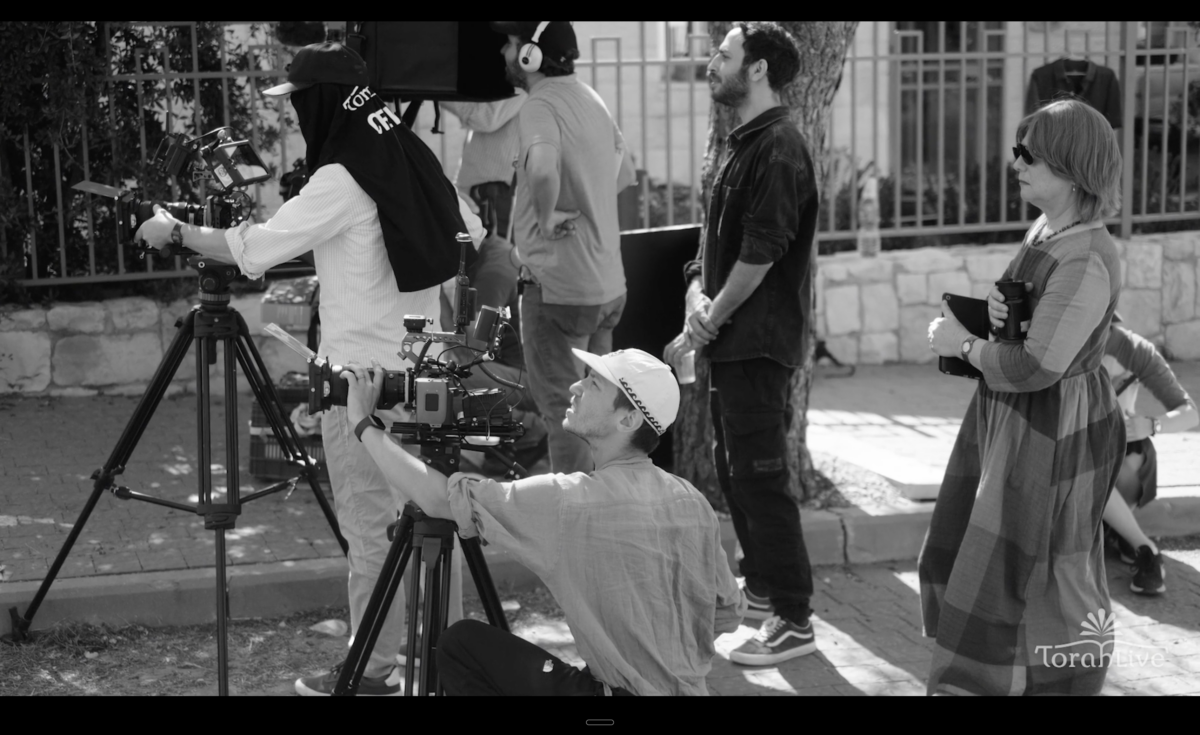
One educator. Eighteen years. Now reaching hundreds of thousands of Jewish children globally.
I don’t share this to brag. I share it because it’s precisely the kind of data point Kenter’s framework is asking for: a real-world example of what a radically improved denominator actually looks like in Jewish education.
Three things we’ve learned about leverage
Kenter offers five paths toward greater communal efficiency. I want to speak to three of them from direct experience, because they’ve shaped everything about how Torah Live is built.
AI doesn’t replace the teacher. It gives the teacher a co-teacher.
Kenter notes that AI may drive “a lower and less sustainable ratio of ‘professionals’ to ‘populations served’” and asks whether existing person-hours can go further with better tools. They can. But the frame matters.
The risk in how some of this conversation gets conducted is that AI starts to feel like a cost-cutting measure masquerading as educational philosophy. In Jewish education, that’s a dangerous conflation. A child who watches an animated story about honesty or self-control isn’t being shortchanged by the absence of a human in the room. They’re getting something that couldn’t have existed before: a perfectly paced, beautifully produced, halachically grounded learning experience that they’ll actually choose to watch again. The educator’s job, when that child walks into class the next day, is now richer. The AI handled the exposition; the human handles the relationship.
That’s not a lower ratio. That’s a better ratio.
The real bottleneck isn’t curriculum. It’s distribution.
Jewish day schools are full of talented, dedicated educators. Many of them have developed genuinely excellent curricula. What they almost universally lack is the production infrastructure to turn that knowledge into something a ten-year-old will choose over a YouTube video.
The field underestimates how much energy is absorbed by reinvention. Every school, every program, every camp re-teaches Shabbos. Every organization has its own version of a lesson on Jewish identity. Most of them are fine. Almost none of them have the production quality to command real attention from a child raised on high-end digital media. The denominator move here isn’t about staffing. It’s about shared infrastructure: investing in content that scales, so that educators everywhere can stop reinventing and start deepening.
Torah Live exists in that gap. But the gap is much larger than one organization can fill, and the field hasn’t yet treated it as the strategic priority it is.
The household is the unaddressed frontier.
This is where I want to extend Kenter’s five paths into a sixth: media-anchored learning at the household level.
Kenter’s third path, volunteerism and lay involvement, points in the right direction. But I think there’s a more specific opportunity hiding inside it. The most underleveraged actor in Jewish educational transmission isn’t the volunteer. It’s the parent.
For most Jewish families, formal education accounts for a few hours per week. The rest of the week is household time. What happens in that space is largely left to chance. The field has accepted this as immutable. It doesn’t have to be.
At Torah Live, we’ve built what we call Real World Impact challenges into our courses. A child learns about tzedakah through an animated story, and then the platform prompts them to take a specific, tangible action at home: donate to a cause, do an act of chesed (kindness) for a sibling, bring something to a neighbor. Parents receive the prompt. Kids report back. The learning closes a loop between screen and life.
Parents describe their kids being hooked on Torah Live, watching videos again and again until they know the scripts off by heart. Rabbi Mordechai Ginsparg told us he has to pull his kids away from Torah Live to come to the supper table. That’s the kind of pull we should be designing Jewish content to have, and it’s the kind of pull that makes household-level transmission realistic instead of aspirational.
This is what lay involvement can actually look like in Jewish education: not just adults volunteering at institutions, but families becoming the active site of Jewish practice, with media as the catalyst. The rebbi’s reach doesn’t end at dismissal. With the right content and the right structure, it follows the child home.
Reframing the screen for Torah parents
There’s a related conversation I think the field is overdue to have, and it sits one layer underneath everything I’ve described. Most parents have inherited a default posture toward screens: they’re candy to be rationed. The whole conversation is about minimizing harm.
I’d like to propose a different frame.
Screens are tools. The question isn’t how little our children can use them; it’s whether what they’re using them for aligns with our values. Digital minimalism, as Cal Newport teaches it, asks exactly that question of every digital activity, sets boundaries with intention, and models healthy tech habits for children. Torah communities can go further. We can create screen-free zones for family meals and learning. We can embrace outdoor play and real-world responsibility as the default and the screen as the exception. And when the screen is on, we can choose value-aligned educational content over mindless entertainment.
The goal shouldn’t be the least harmful screen time. It should be the most powerful use of technology to enhance Jewish learning, connection and creativity. That reframe, more than any single product or program, is what unlocks media as a serious educational denominator at the household level.
The harder conversation
Kenter ends his piece with a generous and honest observation: “This is not about doing less. It is about doing more with the talent we have.”
I agree. And I’d add one uncomfortable corollary: the Jewish philanthropic community will need to fund infrastructure differently than it currently does.
Right now, the field tends to invest in programs and people, not in shared platforms. Every organization builds its own wheel. Every initiative hires its own staff. The denominator never improves because nobody is funding the denominator.
If the field wants to achieve what Kenter is describing, foundations and funders will need to treat educational media infrastructure the way they’d treat a communal utility. At some point, the field has to decide whether serious Jewish educational content, the kind that can actually travel across time zones and school walls and into living rooms, is worth building and funding at scale.
The talent pipeline isn’t just a human capital question. It’s a question of what we’re building for the people we do have, and how far we’re willing to let their impact travel.
Kenter’s framework gives us the language to ask that question clearly. What we do with it is up to us.
Rabbi Dan Roth is a filmmaking rabbi from Jerusalem and the founder of Torah Live, a Jewish educational media platform.