Opinion
TIME FOR A CHANGE
The U.N. is about to choose a new leader. It can’t afford to get this wrong.




 Add EJP on Google
This week, as Jewish leaders take part in meetings with heads of state, government and ministers of foreign affairs on the sidelines of the U.N. General Assembly High-level Week, we should all have a clear message: The next U.N. secretary-general who will be elected in the coming months must stand up to antisemitism and extremism.
Next week, the Anti-Defamation League will join the other members of the J7 Task Force Against Antisemitism to urge U.N. member states to select a new secretary-general who will make confronting antisemitism a defining priority. Given the many problems in need of solution in our world today, it may seem to some like a small or obvious ask, but our most recent experience with the highest office at the U.N. has repeatedly shown that this isn’t the standard.
Bob Krist/Getty Images
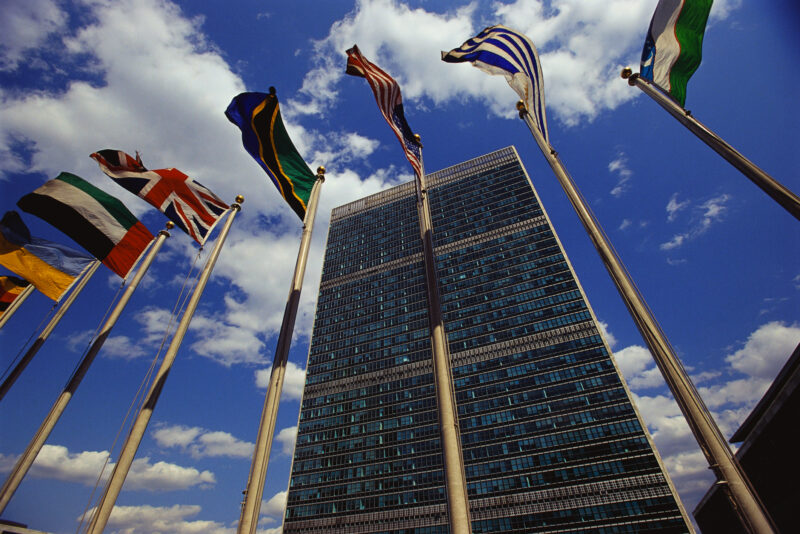
Flags fly outside the General Secretariat Building at the United Nations headquarters in New York City.
I am well aware of the many important issues world leaders will be discussing at this year’s High-level Week. It is also clear to me that the rampant scourge of antisemitism we’ve witnessed in the past few years around the world cannot be ignored. It’s not a narrow or secondary concern, even though it is too often treated as one. Despite the U.N. being one of the preeminent institutions charged with defending human rights, it, among others, has allowed this epidemic of anti-Jewish hate and prejudice to become normalized, both globally and within its own halls. And as we’ve come to see time and time again, when antisemitism is allowed to fester unchecked, or even encouraged, people get hurt.
According to our recent J7 Annual Report on Antisemitism, last year was the deadliest year for the Jewish diaspora in over 30 years. Twenty people were murdered in antisemitic attacks, the number of reported antisemitic incidents in J7 countries exceeded 23,000, and total incidents were up 136% compared to 2022, the year before Hamas’ 10/7 attack on Israel.
The data illustrates the urgency of our words and calls to action. Innocent people are being targeted, harassed and sometimes even killed because of who they are and what they believe. We have a global crisis on our hands, and it’s time for new leadership to finally push the U.N. to step up.
The secretary-general’s election is one of the most consequential decisions the U.N. will make this decade, and its results will reveal whether the world body’s founding promise of equal dignity truly applies to everyone, including Jews. That means every candidate must demonstrate a clear commitment to confronting antisemitism, both globally and within the U.N. itself, as a threshold requirement — not an afterthought or a topic that’s ignored altogether.
That is why our community needs to be united in our joint demands.
First, the next secretary-general must adopt and integrate the International Holocaust Remembrance Alliance’s working definition of antisemitism, already embraced by more than 40 governments and major international bodies, into how the U.N. understands and responds to antisemitism in all its forms, including its contemporary manifestations tied to Israel.
Second, the next secretary-general must ensure that there is accountability for antisemitic actions and rhetoric within the U.N. itself. That means pushing for reforms and procedures that hold the system accountable. That starts with vetting officials and mandate holders based on their expertise and fairness, not political horse-trading. It means real consequences when someone violates conduct standards, not violations that get quietly ignored. And it means having a faster way to act on antisemitic rhetoric or misconduct, one that doesn’t require getting every single member state to agree before anything happens. The claim that “nothing can be done” when a U.N.-affiliated official espouses antisemitism because they are “independent” is completely unacceptable.
And finally, member states must make sure that no U.N. funding, staff or institutional authority is ever used to spread antisemitism, extremism or incitement, whether that’s in educational materials or anywhere else carrying the U.N.’s name.
Antisemitism does not stay contained within one debate, one resolution or one leader’s term. What happens at the U.N. shapes attitudes far beyond Geneva or New York. A secretary-general who treats confronting antisemitism as central to restoring this institution’s integrity would send a signal that reaches Jewish communities from Buenos Aires to Sydney, Toronto to Cape Town and Berlin to London.
We came to UNGA this year as partners, not critics. We believe in what the United Nations is supposed to be, and we must all demand that member states treat this leadership selection as the reform opportunity it genuinely is: a chance to choose a secretary-general who will make the fight against antisemitism a defining feature of their tenure.
Marina Rosenberg is the senior vice president of international affairs at the Anti-Defamation League.