Opinion
WHAT COMES NEXT
The hostages are home. The fight is far from over




 Add EJP on Google
This week, a chapter closed in Jewish history. Our hostages are home. Thanks to President Donald Trump and his team, negotiations are underway for the next phase of the ceasefire, and the prospects for peace are greater than ever before. For so many of us, it’s a moment of intense joy and immense relief. Now, the difficult process of healing can begin within Israeli society, across the region and throughout the Jewish community around the world.
As we look ahead, we as a Jewish people need to be clear-eyed about what this war has taught us. When Hamas launched a genocidal attack on Israel, the world did not rally to our side. In fact, much of the world actually rallied against Israel and their nearby Jewish neighbors starting the afternoon of Oct. 7, 2023.
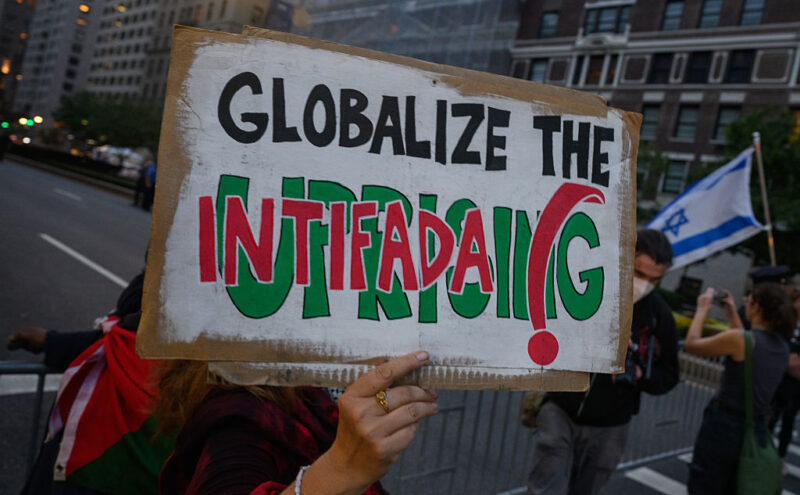
Alexi J. Rosenfeld/Getty Images
A protester holds a "globalize the intifada" sign near during an anti-Israel protest near Prime Minter Benjamin Netanyahu's hotel at the 80th session of the UN’s General Assembly on Sept. 25, 2025 in New York City.
I will always remember those fateful days. Instead of solidarity, we got excuses. Instead of an embrace, we got exclusion. Instead of sympathy, we got scorn. Indeed, in the 12-month period after the Oct. 7 massacre, the Anti-Defamation League tracked more than 10,000 antisemitic incidents in the United States alone, far and away the largest count we ever have seen. In 2024, ADL recorded 1,694 antisemitic incidents on college campuses, 84% more than in 2023.
A recent survey that the ADL conducted with the Jewish Federations of North America found that well over half of all Jewish Americans experienced at least one form of antisemitism in the past year; 14% have developed exit plans to flee the U.S. if the situation worsens. According to a new Washington Post survey, more than 40% of Jewish-Americans hide their Jewish identities in public, almost double the percentage measured in an AJC poll just two years ago. These are astounding findings — and there is very real reason for alarm.
In just the past few months, the home of the Jewish governor of Pennsylvania was firebombed after his Pesach Seder; a young couple was gunned down in cold blood outside the Capital Jewish Museum in Washington, D.C.; senior citizens marching in solidarity with the hostages were attacked and set aflame in Boulder, Colo., killing one; and two people were murdered outside a synagogue in Manchester, England, on Yom Kippur.
These stories barely scratch the surface, but all Jewish Americans know that antisemitism has spread in almost unimaginable ways. It is affecting people of every denomination and every segment of our community — from the kippah-wearing grandfather walking to synagogue on a Saturday morning, to parents working in white-collar jobs at public companies, young adults enrolled in college, and teens simply watching videos on social media.
Last year, at the ADL’s annual gathering, I quoted our friends at JewBelong to talk about this “oxygen mask moment” when we needed to prioritize fighting antisemitism above other concerns. Sadly, this remains an indisputable fact. Indeed, as the war against Israel receded on its territorial borders, the war against the Jews has only intensified in popular culture and public life.
We certainly have friends. I will never forget the calls that came in on Oct. 7, 2023, and in the days that followed, from leaders in different communities who extended a hand. But it is a sad truth that so many of our self-described allies simply disappeared or deeply disappointed us when we needed them.
And in the past week, as the IDF pulled back from Gaza and hostages were returned to Israel, how did the activists living outside Gaza respond? Did they cheer for the ceasefire they demanded for so long? Did they applaud for an end to the suffering on all sides?
Hardly. Indeed, nearly all those living among us who talk incessantly about justice and purport to support non-violence rejected the end of violence. Some reaffirmed their commitment to an agenda of anti-normalization. Others explicitly called for escalation. So-called anti-war groups literally called for more war.
For us, this merely confirms that the existential crisis that the Jewish Diaspora has experienced over these last 24 months is not going away. The issue is whether we can continue to live openly and proudly as Jews who support the existence of the Jewish state, or will we face the same fate of our ancestors in so many previous generations.
Confronted by this metastasizing threat, the ADL will strive to remain true to our centennial mission statement: to stop the defamation of the Jewish People and secure justice and fair treatment to all. But in this environment, we have no choice but to concentrate our energies like a laser beam on our core purpose, the reason why the ADL actually was founded so many generations ago — to protect the Jewish People.
We will make no apologies for focusing ferociously on the safety of the Jewish community at a time when that safety is at risk. We will not shrink from the task of ensuring that America remains a place where Jewish people can live, work, worship and thrive openly and proudly. For those that perpetrate antisemitism, spread anti-Zionism, discriminate against Jews, or attack our community in any way, we will use every tool at our disposal to stop you. We will push back in boardrooms, expose the issues in classrooms, and prosecute our case in courtrooms.
Already, the ADL has filed more lawsuits this past year than we have had in our previous 100-plus years combined, and we’re just getting started.
For years, ADL has used its voice and resources to help the public understand the broader landscape of social issues and hate. We are proud of that history; but sometimes we have ranged far from our core purpose. Today, as antisemitism becomes more pervasive and anti-Jewish hate becomes more intense, we simply need to lock in with relentless, unswerving focus like no time in recent memory.
And so, expect ADL will hit back even harder against anti-Jewish hate. That means expanding our efforts, making more investments, driving more innovations and building more partnerships. Simply put, this is the fight of our lives.
Finally, despite the claims from critics on both sides, antisemitism is not a partisan issue and the ADL is not a partisan organization. Still, we can do more to ensure balance in our work, such as bringing in the widest range of talent from across the ideological spectrum and listening to all voices who offer genuine counsel. With the best people in our corner, we can and will address all forms of antisemitism, and we will do so in new and impactful ways.
We also realize that we cannot wage this battle alone. Indeed, our hand will be open to all those who want to join us in this sacred work. Some of these allies will be ones we have worked with for generations; others will be newer. But when old and new friends fully commit to combat the scourge of antisemitism, we can build trust, increase our impact and find ways to support one another on multiple levels.
For example, this week I was proud to have been invited for the very first time to address the annual meeting of the National Hispanic Christian Leadership Conference, the largest Latino Christian organization in America, where we announced a historic partnership to fight antisemitism. Standing alongside hundreds of ministers and pastors from around the country, I spoke about our struggle. I shared the facts and framed the conflict as a common cause, and the response was overwhelmingly positive. It was crystal clear that the Jewish and Christian communities share not only a faith tradition but also a deeply aligned vision of building a better future for our children, regardless of how they pray — one that delivers dignity and respect, justice and fair treatment to all.
In closing, we will continue to pray for peace in the Holy Land even as we face the challenges that loom closer to home. But the ADL will bring all our heart, all our soul, and all our might to this struggle. And we will prevail.
Am Yisrael chai.
Jonathan Greenblatt is the CEO and national director of the Anti-Defamation League.