Opinion
BREAKING BARRIERS
A day of reckoning and renewal at the Rabbinate




 Add EJP on Google
Yesterday, a group of extraordinary women stood at the gates of the Israeli religious establishment, not with hammers to break them down, but with the profound scholarship of years of intensive Torah study. They arrived at the Ministry of Religious Affairs to take the Chief Rabbinate’s exams — the same rigorous examinations that define the professional and spiritual standing of the Orthodox world. They were met not with the dignity their learning deserves, but with what appears to have been a calculated, four-hour campaign of bureaucratic cruelty and bald-faced deception.
As an Orthodox rabbi and the founder of Itim, I — together with our partners Koleinu and The Rackman Center — had sued the Rabbinate eight years ago to make this day possible. When Deputy Chief Justice Noam Sohlberg wrote his High Court ruling last July, we were certain this day would come. And yet all day, I found myself oscillating between a sense of historic triumph and deep, religious shame. What we witnessed today was not a defense of halacha; it was its desecration.
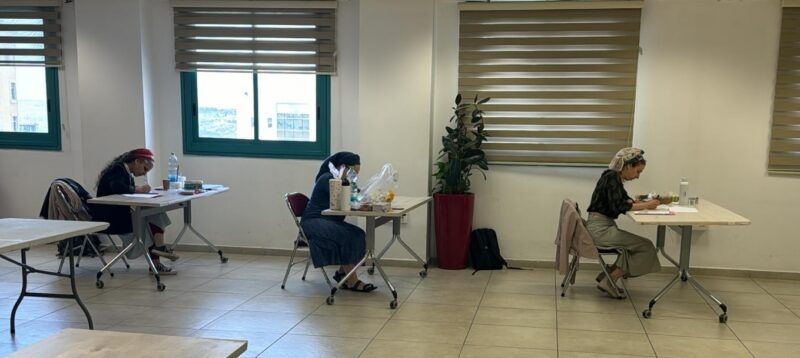
Natanel Hirsch/Itim
Three women take the exam administered by the Chief Rabbinate of Israel, the first women to do so in the country's history, on April 27, 2026.
Yet, through the haze of institutional failure, I saw something today that no “technical glitch” could stop: the dawning of a new era for the Jewish People and its Torah.
The morning began with a compromise. Last week, we were informed that the women would be segregated from the thousands of men testing at Jerusalem’s International Convention Center. They were to take their exams separately at the Ministry of Religious Affairs. We at Itim chose not to fight this. Our priority was the mission itself — getting the exams in front of the candidates. We assumed, perhaps naively, that even an institution as resistant to change as the Rabbinate would not stoop to sabotaging the exams themselves. We believed there was a baseline of professional and religious integrity that would be maintained.
We were wrong.
For four hours, these women were essentially held in a state of administrative detention in a room at the ministry. They were told there was a “technical glitch” preventing them from receiving the exams. Unable to leave, as they would be forfeiting their chance to take the tests, they were left in agonizing limbo, their nerves frayed, while across town thousands of men proceeded with their tests without interruption.
At 11:15 a.m., 45 minutes after the exams were meant to begin, I called the Chief Rabbinate’s director of exams. I reached him at the International Convention Center, where he was overseeing the men’s exams. There was no technical glitch. He told me explicitly: The director-general of the Rabbinate had received direct instructions from the chief rabbis not to administer the exams to the women.
While I have no way to verify this, I believe that this was not a mistake. It was a premeditated breach of a High Court ruling. If that is the case, this was an act of institutional rebellion funded by the public purse. More importantly, it appears to have been a violation of the most basic Jewish values. To look these women in the eye and lie to them for four hours is not the way of the Torah. Midvar sheker tirchak — distance yourself from falsehood — is a fundamental commandment, yet the Rabbinate appears to have used deception as a policy tool.
When Itim realized the depth of this bad faith, we did the only thing we could: We went back to the court. We requested an emergency, temporary injunction to halt the men’s exams mid-sentence. We argued that the state cannot facilitate a massive professional certification process for one gender while actively blocking it for another in the same breath. If the women couldn’t test, the system had to stop.
The court’s response was swift, and it forced the Rabbinate’s hand. Justice Solberg intimated in his decision that there was a hard deadline. And five minutes before that clock ran out, the director of exams finally appeared at the ministry with the test papers. His excuse this time? He claimed the Rabbinate “couldn’t find a rabbi” to supervise the room in the morning. It was a transparently weak attempt to mask a systemic refusal to obey the law.
In doing so, the Rabbinate proved that its opposition to the women’s examination is not based on a “higher” religious truth, but on a base desire for power and exclusion.
However, once the papers were finally distributed, the atmosphere transformed. The anger and frustration that had filled the room at the ministry began to evaporate, replaced by a fierce, silent focus. After a four-hour delay, the women took the exams, demonstrating a resilience that the Rabbinate’s leadership clearly lacks.
When the exams concluded, the exhaustion — the men finished at approximately 2 p.m., the women after 8 p.m. — was accompanied by satisfaction. There was a realization among the women that they had broken through a glass ceiling. As Ya’ara, one of the women, said to me, “I guess making history isn’t so easy.”
Today was an important milestone, but there is much work to be done. There are endless opportunities — religious, spiritual and economic that are all still in front of us. The momentum of history is on our side, but ensuring equality in Israel’s religious institutions will still demand years of work.
I anticipate that in the coming months and years, the number of women registered in advanced halacha programs in Israel will increase exponentially. For too long, brilliant women were deterred from these programs because there was no official recognition at the end of the road — no “finish line” recognized by the state. That barrier is gone.
In five years, we will look back at today’s drama at the ministry as a strange, desperate footnote. I believe that by then, we will see hundreds of women passing these tests. We will see a generation of female halachic leaders whose authority is grounded in the same rigorous testing process as their male counterparts. The fight we fought today in the court and at the ministry was for the women in that room, but it was also for the hundreds of women currently learning Torah across the country, and across the world, knowing now that their path is open.
We are at a crossroads. We can choose a path where the Torah is used as a tool for exclusion and deceit, or we can demand a Chief Rabbinate that reflects the integrity of the tradition that it claims to protect.
Today, the women showed us the path of scholarship and endurance. They proved that while you can delay the truth, you cannot defeat it. The Rabbinate learned a hard lesson today: the Torah belongs to all of us. It is not the private property of a few, and it cannot be held hostage by those who fear the very knowledge they are tasked to guard.
The struggle was difficult, and the deception was painful, but the result is undeniable. The doors are open. Now, let the Torah grow.
Rabbi Seth Farber is the founding director of Itim.