Opinion
ACCESS AND INNOVATION
A reflection on technology and belonging




 Add EJP on Google
Jewish tradition teaches that we should keep one note in each pocket: one that says, “For my sake the world was created” (Mishna Sanhedrin 4:5) and the other, “I am but dust and ashes” (Genesis 18:27). When we feel alone or afraid, we take out the first. When we feel overly certain of our own importance, we take out the second. The teaching is simple and profound: our tradition calls us to live in tension, to hold competing truths and to resist the urge to collapse them into something easier.
We are living through a moment defined by accelerating technological transformation. Artificial intelligence, automation and rapidly evolving digital tools are not only changing how we work, but how we learn, connect and participate in community. For those of us committed to expanding access to Jewish life, this moment brings both extraordinary possibility and profound responsibility.
Courtesy/JBI Library
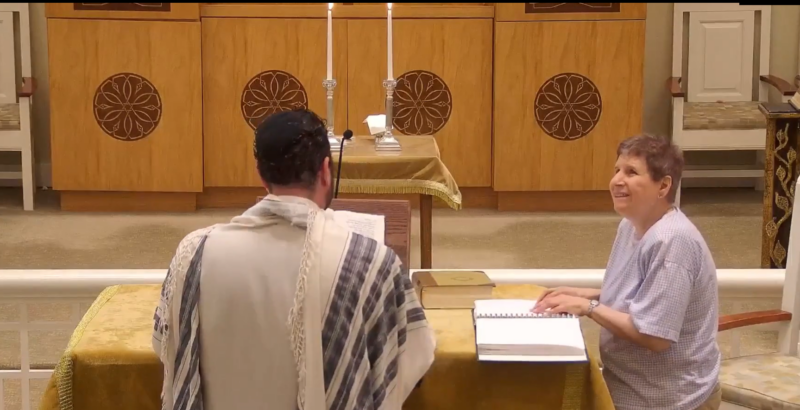
Audrey L., a JBI Library patron, reads from the bimah using a braille prayerbook.
I find myself imagining a new pair of notes for our time: in one pocket, “Technology is a gift — use it to expand what is possible.” In the other, “Not everything meaningful is new — keep it simple enough for people to enter.” The work is not choosing one over the other, but learning how to hold them both with intention.
At JBI Library, we partner with people who are blind, have low vision or have disabilities that make reading standard print difficult, ensuring they can fully access the Jewish life they seek. We produce large print and braille liturgy and sacred texts, lend more than 15,000 audio and written titles, create custom materials and build opportunities for learning, connection and belonging. For much of our history, producing a single prayerbook could take up to three years — years of hand-typing Hebrew, carefully formatting large print and braille and extensive proofing. It was painstaking, sacred work. And all the while, our patrons waited — often unable to fully participate in communal worship without the materials they needed.
Recently, we experienced a breakthrough. Working with an external consultant and drawing on an AI environment, we were able to complete the first stages of this process in a fraction of the time. What once took three years can now take three months. The implications are not merely operational — they are communal. Access delayed is, too often, access denied. With these tools, we are able to place essential texts into people’s hands with a speed that begins to match the urgency of their need.
And yet, even here, we are reminded that innovation does not replace human responsibility. Skilled staff — including braille readers — remain essential to ensuring accuracy, integrity and trust. The technology expands our capacity; it does not absolve us of care.
From the other pocket, a different truth emerges. Even as the world becomes more technologically sophisticated, not all forms of progress are equally accessible. Many of our patrons find navigating platforms like Zoom challenging, particularly when visual elements are not central to the experience. The very tools designed to connect can, in practice, create new barriers.
So we are making a different kind of move — not forward into greater complexity, but sideways into greater accessibility. We are expanding the ability to join our virtual community programs by phone. What once required managing email, links, interfaces and screens can now be as immediate as making a phone call.
If artificial intelligence allows us to compress years of labor and expand access to our texts, it is often familiar, enduring technologies that allow people to access one another — to show up, to listen, to be present in community.
This is the tension at the heart of Jewish life at this moment. We are called to embrace transformation without losing clarity, to pursue innovation without abandoning accessibility, to recognize that the measure of progress is not sophistication alone, but who is able to enter, participate and belong.
Like the notes in our pockets, these truths do not resolve into one another. They are meant to be held together, each one correcting, challenging and refining the other. And it is in that careful, ongoing balancing that we are able to build a Jewish community that is not only more advanced, but more just, more inclusive and more whole.
Michelle Shapiro Abraham is the executive director of JBI Library.