Opinion
ZACHOR
The forgotten pogrom and the fate of Libya’s Jews




 Add EJP on Google
On Nov. 5, 1945, mobs swept through the streets of Tripoli and other Libyan cities armed with clubs, knives and torches. By the time order was restored three days later, more than 140 Jews were dead, including children. Hundreds were injured. Synagogues, homes and shops lay in ashes; centuries-old neighborhoods had been destroyed in hours, and thousands of Jews were left homeless.
This pogrom was the beginning of the end for one of the world’s oldest Jewish communities. Jews had lived in Libya for two millennia, long before the Arab conquest that brought Islam to North Africa. They were artisans, traders and professionals. They spoke the Libyan dialect and Judeo-Arabic and were an intrinsic part of the region’s cultural fabric.
Courtesy
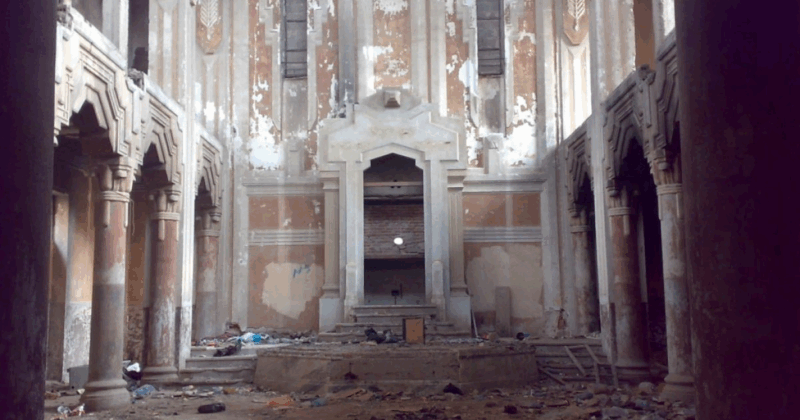
The ruins of Dar al-Bishi Synagogue in the walled Old City of Tripoli, Libya, in an undated photo.
Yet within a generation, their entire civilization vanished.
Displacement in the Middle East is a popular topic, but never focuses on this displacement. The 1945 pogrom wasn’t an isolated instance of violence; it was part of a series of antisemitic massacres that erupted across the region as rising Arab nationalism, Islamism and Nazi propaganda combined to isolate and target Jews.
When emigration to Israel became legal in 1949, over 30,000 Libyan Jews left for fear of what may come. They were right. By the early 1970s, every Jew in Libya had either been killed, expelled or forced to flee. Synagogues were turned into mosques or warehouses and Jewish cemeteries were bulldozed.
This story is not unique to Libya. Across the Middle East and North Africa, nearly a million Jews were driven out of their homes between the late 1940s and early 1970s. In Iraq, the 1941 Farhud Pogrom killed 128 Jews and set the stage for a community of 130,000 Jews to vanish. In Egypt, 80,000 Jews dwindled to nearly none. In Yemen, Syria, Tunisia and Algeria, the pattern was the same: life for Jews was made impossible by exclusion, the confiscation of property and the threat of violence, resulting in the emigration and demise of these historic Jewish communities.
A notable exception was Morocco, where Sultan Mohammed V resisted the antisemitic decrees of the Vichy regime during World War II and refused to persecute his Jewish subjects. While violence still eventually erupted — over 40 people were killed in the 1948 Oujdad Jerada riots — Morocco’s Jewish exodus was comparatively gradual. Morocco stands out in the Arab world for actively preserving its Jewish heritage, restoring and maintaining synagogues and cemeteries and recognizing Jewish history as an integral part of the nation’s identity.
The mass dispossession and expulsion of Jews from the Middle East and North Africa remains a footnote, and the notion that Jews are indigenous to the Middle East has even come to be treated as controversial. That is not an accident; it is a choice.
This silence serves a purpose: sustaining the myth that Jews are “foreign” or “European colonizers.” Meanwhile, the majority of Israeli Jews today descend from Jews expelled from Arab and Muslim countries. Their grandparents spoke Arabic, Persian or Kurdish; they ate the same foods and sang the same melodies as their Muslim neighbors.
The irony is stark. The same ideologies that destroyed Jewish life elsewhere in the Middle East — Islamism and Arab nationalism — now claim that Jews are trespassers in their homeland of Israel. This lie has found a willing audience especially among the Western far-left, who view Israel as a “settler-colonialist” state while erasing the Jews who were systematically displaced.
No Arab state has apologized. No United Nations resolution commemorates Jewish refugees from Arab countries. International institutions that demand remembrance for other displaced peoples remain silent on this one. Jewish victimhood is ignored because it’s politically convenient.
Today marks 80 years since the pogrom that terrorized Libya’s Jewish community. Few will note it. Libya has no Jews left to mourn. But we cannot let this history die with them. The erasure of Jews from the Arab world was not inevitable — it resulted from hate, incitement and deliberate state policy. And the silence that followed has been just as deliberate.
Remembering Libya’s pogroms restores to history a people erased from it. It reminds us that the Middle East’s Jewish story is not solely an Israeli one; it spans millennia across the region, deeply intertwined with the lands from which Jews were expelled.
To forget them is to accept their erasure. To remember them is our duty — one that has become controversial, but one we must uphold.