BARUCH DAYAN EMET
Stanley Chesley, class-action innovator and Jewish communal leader, dies at 89
Self-described 'king of the underdogs,' Chesley earned fame after earning millions for victims of a deadly nightclub fire and winning other high-profile cases, before being disbarred in 2013 for questionable business practices
COURTESY/ROBERT CUMINS
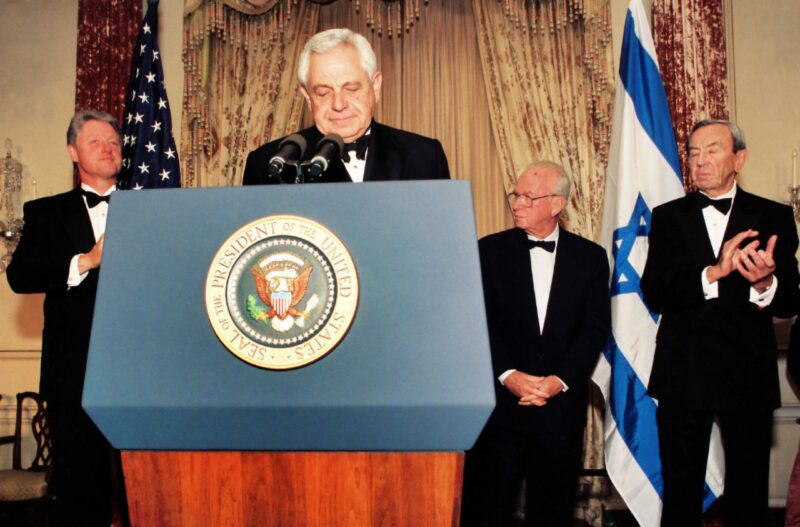
Stanley Chesley speaks at a United Jewish Appeal reception, next to President Bill Clinton and Israeli Prime Minister Yitzhak Rabin, at the White House in Washington on Oct. 25, 1995.




 Add EJP on Google
Just as the 1980s slipped into the 1990s, a fire swallowed a house in Cincinnati’s Black community, devouring the lives of the children within. Not a single fire detector was found at the scene.
The next day, nationally distinguished lawyer Stanley Chesley, then the president of the Jewish Federation of Cincinnati, marched into the local fire station and presented a check for $25,000 to the fire chief to ensure that households in the community were up to code.
“He never seemed to seek any” accolades for that donation, Elliot Karp, the federation’s chief development officer from 1989 to 2004, told eJewishPhilanthropy, “which was unusual for Stanley, I must say.”
Stanley Chesley died on Sunday at a long-term care facility in Cincinnati after a long battle with dementia, his family said. He was 89. One of the most powerful class-action attorneys in America, Chesley went from being a relatively unknown personal injury lawyer to a nationally renowned litigator after representing the victims of the 1977 Beverly Hills Supper Club fire that killed 165 people.
A celebrated philanthropist throughout Cincinnati and the Jewish world, his career ended in controversy after he was disbarred in 2013, accused of overcharging fees. Today, Chesley is remembered by peers as a man who lived large and brought everyone along for the ride, treating Jewish professionals and acquaintances with respect and always seeking ways to bring others up from similar humble beginnings as the ones he was born into.
“When Stanley was up there in the olam haba [world to come], and they looked at the ledger sheets,” Karp said, “I think there’s far more credit on the side of the balance sheet for all the good he did than any of the issues.”
The son of Jewish Ukrainian immigrants, Chesley was born in 1936 and raised in Cincinnati. His father was a traveling salesman who later owned a typewriter-repair shop.
Karp, who knew Chesley for over 34 years, remembers a man who always dressed impeccably, never wearing anything off the rack. At one point, Chesley owned a French-style mansion with a heated 25-car garage — the most expensive house in Cincinnati. He wore Brioni suits, loved luxury watches and Porsches. But despite his love for the finer things, Chesley didn’t talk down to people, Karp said, making sure Jewish professionals knew he had their back and appreciated them.
Every year, Chesley would send gift baskets to federation employees for the holidays. When he visited the office, he asked employees about their husbands or wives and complimented their ties, even if they cost a small fraction of his own. There was a time Chesley invited Karp to bring his family to dip into Chesley’s pool, even offering him the opportunity when Chesley wasn’t home. Once, Chesley insisted to the then-vice president of the United States, Al Gore, that he absolutely needed to meet Karp, and he personally introduced the two after taking Karp on a trip to Manhattan for a national convention with major leaders.
“He was the self-professed… king of the underdogs,” Karp said, recalling that Chesley was known for picking up random strangers’ checks at restaurants. (“He loved the grand gesture,” his daughter, Lauren Chesley Miller, told WCPO Cincinnati.) In the Jewish community, this was seen in his willingness to mentor future leaders whom Chesley believed would reach higher offices. Chesley was also constantly challenging the Cincinnati Jewish community to do more, particularly for Israel and Jewish immigrants. During his tenure, the city had a Jewish population of 25,000 people who helped resettle over 1,000 Russian immigrants — a testament to his passion, Karp said.
Although Judaism became “a huge part of his life,” his son Richard Chesley told eJP, his father did not celebrate his bar mitzvah. “I think part of [the reason he wasn’t bar mitzvah-ed] could have been how limited of means the family actually had at that point where they lived, and how they were just simply trying to get on with their life in America.”
Chesley was “that sort of true, up-from-the-bootstraps kind of guy,” his son said, and he never forgot that. Through undergraduate and law school at the University of Cincinnati, Chesley worked three jobs, including selling shoes at the historic Cincinnati department store Shillito’s, where he negotiated an increase in employee commission from 7% to 8%, which served as one of his first tastes of victory.
“Much of what he did [philanthropically] was a homage to his past,” said Richard Chesley, who is also a lawyer.
After 165 people were killed in a fire at a crowded concert at the Beverly Hills Supper Club in Southgate, Ky., Chesley made an unprecedented move. Instead of individually filing lawsuits for victims, he filed a class-action suit for nearly 300 victims, winning $50 million in litigation and settlements. The move changed how class-action suits were filed and led to national building-code reforms.
Known as the “master of disaster,” Chesley made billions in settlements for victims of tobacco smoke, breast implants, plane crashes, industrial explosions, the carcinogenic Agent Orange herbicide and sexual abuse by the Roman Catholic Diocese of Covington, Ky.
Chesley also provided pro-bono counsel for the World Jewish Congress and World Jewish Restitution Organization and served on the boards of the American Joint Distribution Center, the Hebrew Union College, the Isaac M. Wise Temple in Cincinnati and the Jewish National Fund-USA. At the Jewish Federation of Cincinnati, he served as both president and campaign chair. He also supported non-Jewish organizations, including the Cincinnati Human Rights Foundation and the NAACP, where he is a life board member, as well as the Democratic Party. During the 1990s, he hosted numerous fundraisers for President Bill Clinton at his house.
On Oct. 25, 1995, Chesley spoke at a United Jewish Appeal reception at the White House alongside Clinton and then-Israeli Prime Minister Yitzhak Rabin, who was assassinated in Tel Aviv less than two weeks later.
Mark Mallory, former mayor of Cincinnati, told eJP that Chesley was a mentor to him.
“We often had budget difficulties during the time that I was mayor, and one of the ways that it was decided to help balance the budget was to reduce the hours and days that our pools were open during the summer, and Stan really saw that as unacceptable,” he said. “He thought, ‘Look, kids in this community don’t deserve to have their recreation cut short, so he stepped forward, and, initially, he turned over a check for $80,000 that he was being paid by the city for some legal work that he had done. He turned that check back over to the city.”
For years after this, Chesley ensured Cincinnati kids had pools to relax in.
“He had that kind of community impact in a number of areas, some of which are known, some of which are not,” Mallory said.
Chesley’s latter years were marred by controversy. In 2013, the Kentucky Supreme Court disbarred him for violating ethics by charging $7.5 million more in fees from a $200 million settlement in a 2001 case against Fen-Phen, a diet drug that was shown to cause heart damage.
“The bottom line is,” Chesley told the Cincinnati Enquirer in 2006, “when somebody has talent, nobody criticizes the paycheck. It’s fascinating what I get attacked about is my skill and that I get remuneration for it.”
The money he charged clients didn’t all go to him, he said, but also to his over 90 staff members. The fees also allowed him to take on risky cases that were important morally but would take more time and pay less, he argued at the time.
Although Chesley was never criminally charged and denied wrongdoing, the disbarment stained his legacy, especially with the JNF-USA, where he had served as president and special ambassador to Israel.
“That’s sort of the tragedy of the whole thing. So many of the things that he worked to build and grow, JNF-USA, University of Cincinnati, he was on the board, when things went south, they went…” his son said, trailing off, struggling to say that the organizations distanced themselves from his father. This included JNF-USA taking Chesley’s name off their online listing of their national board of directors in 2019 after a Forward piece criticized the organization for still including him.
“I don’t blame any of them for doing what they had to do to protect their constituency,” his son said. “But that stuff hurt, make no mistake about it.”
In a statement sent to eJP after his death, JNF-USA celebrated Chesley’s legacy at the organization.
“Stan Chesley served as president of our organization for five years,” Russell F. Robinson, CEO of Jewish National Fund-USA, wrote to eJP. “During his leadership, we built the Sderot Indoor Playground — a place where children, who often have just 15 seconds to run for cover when sirens sound, could finally play in safety. To this day, that playground remains in use — the only fully fortified indoor playground in existence.”
The controversy should not overshadow the important work Chesley did, Karp said. “I don’t think any of us are perfect individuals, but I believe that the good that Stanley did as a member of the Jewish community, as a leader of the Jewish people, as a supporter for Israel and the good that he did as a lawyer, far outshine any of the mistakes he may have made, and it’s not for me to comment on or judge him for it.”
Chesley’s funeral was held on Tuesday afternoon at Beth Jacob Cemetery Chapel in Dayton, Ohio. He is survived by his wife, U.S. District Court Judge Susan Dlott, two children and six grandchildren.
Related News
PRESIDENTIAL REBUKE
Israel’s Herzog: Mamdani ‘makes no effort’ to hide disdain for Israel, Jews must fight back

MAJOR GIFTS
Center for Jewish History celebrates 25 years with a $25M matching grant
CLOSING WORDS
In AZM address, Cosgrove links communal ‘orthodoxy’ on Israel to rising anti-Zionism among young Jews
HIGHER EDUCATION
As Jewish donors reconsider academia, Jan Koum doubles down, endowing Israel studies at Stanford
ADVANCING A VISION
N.Y. federation donates $1M toward building shared-society center named for peace activist killed on 10/7