POWER OF THE PEN
Shocked by poor Gaza war reporting, L.A. couple launches fellowship to improve coverage on Israel, Jewish life
New initiative, created in partnership with Jewish Federation Los Angeles, will provide support to 10 early- to mid-career journalists
Courtesy
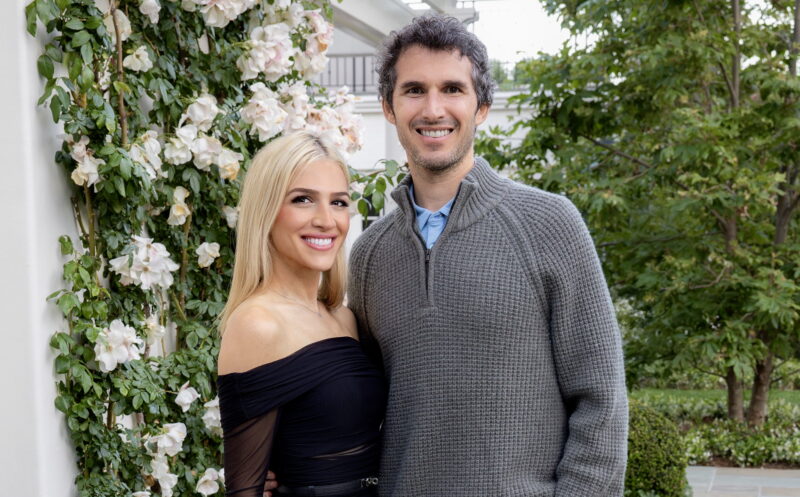
Jacki and Jeff Karsh.




 Add EJP on Google
The initial — and false — reports accusing Israel of bombing Gaza’s Al-Ahli Arab Hospital on Oct. 17, 2023, along with a wildly inflated death toll, spurred Jacki Karsh to action. The explosion had actually been caused by a failed rocket launch by the Palestinian Islamic Jihad terrorist group, killing dozens of people — not the hundreds that were initially claimed in news reports around the world, including the home page of The New York Times.
“The story was reported incorrectly and then the correction was so muted, it was not like, ‘Wow! We just completely messed up this story,’” said Karsh, a six-time Emmy-nominated multimedia journalist. “It had already affected how everyone perceived the war. When numbers come from a Ministry of Health run by Hamas, whether that’s done deliberately or not, it influences how people perceive the story — and it can even shape policies.”
To combat this, Karsh and her husband, Jeff, in partnership with Jewish Federation Los Angeles, have launched the Karsh Journalism Fellowship — a first-of-its-kind program focused solely on improving media coverage of antisemitism, Jewish life and Israel.
At a time when these topics dominate headlines, journalists often lack the background to report on them with accuracy and depth. “This is a pivotal moment to invest in rigorous journalism on Jewish issues,” Jacki Karsh told eJewishPhilanthropy.
The program offers reporters in-depth training, mentorship and access to leading experts to help ensure coverage that reflects the complexity and diversity of Jewish life — while actively addressing harmful biases and misinformation in mainstream reporting.
The Al-Ahli Arab Hospital bombing was just one example of the many instances of false and biased coverage surrounding the war in Gaza and the related rise in global antisemitism that made Karsh realize she had to act.
“I was thinking, if there had been one person in that newsroom who had stood up and said, ‘We need to wait. We cannot rush into this — this will have an impact if we don’t verify.’ They were getting more information from the terrorists who were responsible for Oct. 7. If we even just wait 24 hours — which, I know, in news is a lifetime — so even a few hours until the smoke clears… but there was nobody that really stood up.”
The Karshes opened enrollment for the fellowship late last month and plan to close it on Sept. 1. The program will begin in January 2026 and will take place over three immersive weekends in major American news markets. Over the course of a year, 10 early- to mid-career journalists from across media platforms will participate in intensive retreats in Los Angeles, New York, and Washington.
Each all-expenses-paid gathering will feature expert-led sessions on essential topics such as “The Myth of Jewish Media Control,” “How to Cover Antisemitism,” “Middle East Misinformation” and “Jews in the American Mosaic.” This multicity structure is designed to expose fellows to diverse perspectives, cultural institutions and communities while fostering a national professional network.
Each fellow will receive a $4,000 stipend and will complete a substantive reporting project under professional mentorship while continuing to work with their current editor.
Karsh had served as a board member of the Jewish Federation in Los Angeles for several years and recently returned from a federation mission to Israel, accompanying a delegation of local Los Angeles politicians — none of whom were Jewish — to see Israel for the first time.
“I’ve been to Israel a million and one times,” she said, “but this time was different. For me, it was really eye-opening to see Israel through somebody else’s eyes. I was witnessing how political leaders perceived Israel — some of them encountering the complexities of the region for the very first time.”
She said the group arrived with open minds and a genuine willingness to learn and ask questions. “It was a hard trip,” she admitted. “There were tough conversations, but I think it was probably one of the most rewarding things I’ve ever done.”
Karsh first presented the idea for the fellowship to the Jewish Federation in November 2023. Initially, she envisioned it as a local initiative based in Los Angeles but quickly realized its potential for broader impact.
“Jewish journalism about Jews affects the entire American Jewish population,” she said. “So why just isolate ourselves to Los Angeles? I told them I wanted to build something that would have a lasting impact on the Jewish story, both in America and abroad,” she recalled.
Rabbi Noah Farkas, CEO of Jewish Federation Los Angeles, supported the vision and suggested bringing in someone with experience beyond the federation’s scope. That’s when Rob Eshman joined the project. Eshman, a former editor-in-chief of the Jewish Journal and national editor of The Forward (now a senior columnist), serves as the fellowship’s director.
“This fellowship is designed for working journalists who want a deeper understanding of complex, controversial issues,” Eshman said. “We are building a program that will help build careers.”
The program has assembled distinguished journalists as mentors from across the ideological spectrum, including from The New Yorker, The Atlantic, The New York Times, The Spectator and ATTN.
As a journalist herself, Karsh has reported extensively on issues of homelessness, civic life and human interest stories. She is also an advocate for strengthening public understanding of antisemitism and Israel through rigorous journalism and public engagement. Her husband, Jeff, is the founder and managing partner of Tryperion Holdings, a leading investment manager specializing in value-driven real estate investments with over $2 billion in assets. The couple has three young children.
Karsh hopes the program will expand to include more journalists and cities, and that it will promote integrity and accuracy in newsrooms. “We want journalists to understand the impact that their reporting has on Jewish issues and Israel, and how that, in turn, affects the global Jewish population — and to understand the power of the pen or broadcast.”
“I think the stories about us are often not told by us,” Karsh said. “That leads to a lack of nuance, and an intense focus that can distort the reality on the ground. A lot of journalism today has been hijacked by activism. What was once a straightforward news piece has turned into something else entirely.”
Karsh doesn’t believe only Jews can tell Jewish stories — but she does believe the fellows can make a meaningful difference. “We’re hoping they understand the power of even a five-word comment. It can change everything.”
Related News
PRESIDENTIAL REBUKE
Israel’s Herzog: Mamdani ‘makes no effort’ to hide disdain for Israel, Jews must fight back
HIGHER EDUCATION
As Jewish donors reconsider academia, Jan Koum doubles down, endowing Israel studies at Stanford
CLOSING WORDS
In AZM address, Cosgrove links communal ‘orthodoxy’ on Israel to rising anti-Zionism among young Jews
ADVANCING A VISION
N.Y. federation donates $1M toward building shared-society center named for peace activist killed on 10/7
EXCLUSIVE
Detroit-based philanthropists Nancy, James Grosfeld donate $8M to renovate JDC’s Israel campus