AND THE WINNER IS...
Eli Sharabi’s memoir ‘Hostage’ tops 75th National Jewish Book Awards
Sarah Hurwitz, Pamela Nadell, Julia Ioffe and Allison Epstein also earn prizes for their books, with all winners considering 'what it means to be a Jew in complicated times," Jewish Book Council CEO says
Noam Galai/Getty Images
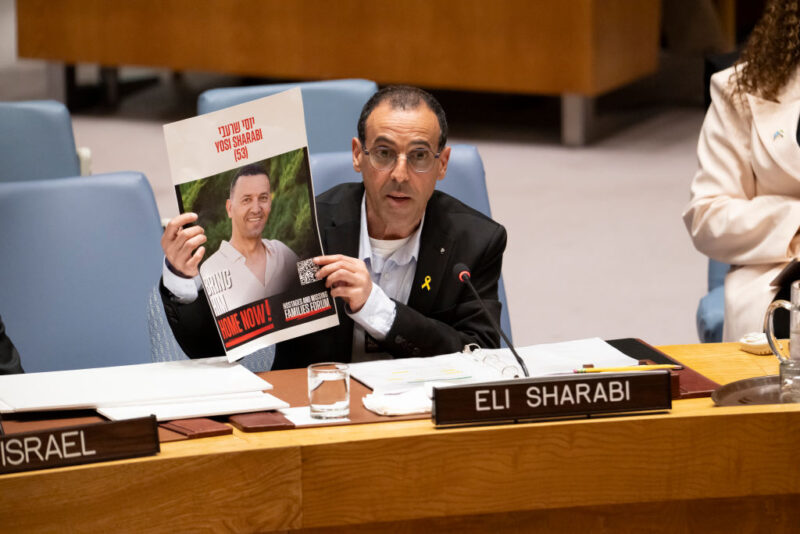
Former Israeli hostage Eli Sharabi holds up a photo of his brother Yosi Sharabi, who was killed while in captivity, as he speaks during a United Nations Security Council meeting concerning the situation in the Middle East at the United Nations headquarters on March 20, 2025 in New York City.




 Add EJP on Google
Eli Sharabi’s Hostage, a harrowing chronicle of his 491 days in Hamas captivity in Gaza following the Oct. 7 terror attack in which his wife and daughters were murdered, and a reminder of the resilience of the Jewish spirit, took home the National Jewish Book Award for book of the year, the Jewish Book Council told eJewishPhilanthropy ahead of the announcement on Wednesday.
Hostage shows the complexity a Jewish book can hold, Naomi Firestone-Teeter, CEO of JBC, told eJP. It doesn’t shy “away from trauma and the pain in our Jewish community and for [Sharabi] personally, but [it also is about] what it means to keep going, what it means to continue to live and breathe and be a Jew moving forward, and the idea of resilience.”
Last year, over 730 books were submitted to the Jewish Book Council for consideration in its annual National Jewish Book Awards, with 21 chosen as the “best reads” of 2025. JBC shared the results with eJewishPhilanthropy on Wednesday, with topics spanning queer love during the Holocaust, Israel’s war in Gaza and the feminist history of Russia.
In addition to Sharabi’s book being named the overall “book of the year,” Sarah Hurwitz’s As A Jew won the top prize in the category of contemporary Jewish life and practice; Pamela Nadell’s Antisemitism, an American Tradition won for American Jewish studies; and Julia Ioffe’s Motherland won for autobiography and memoir. Zeeva Bukai was awarded the debut fiction award for her novel, The Anatomy of Exile, a story of Palestinian-Jewish love severed by tribalism. Allison Epstein won the award for fiction for her book, Fagin the Thief, a retelling of Charles Dickens’ Oliver Twist told from the perspective of Jacob Fagin, the villainous shyster who taught Twist how to be a pickpocket. The remaining winners are listed on the JBC website.
Making the shortlist for the award for Holocaust memoir was an “an incredible honor,” Dani James, the translator of Return to the Place I Never Left by Tobias Schiff, told eJP. (At the time of the interview, she did not know that she had, in fact, won the award.)
“To think about all that it took and continues to take to have the Jewish Book Council exist and to make these awards possible and to have them continue to live on for 75 years and then to become part of it, not just part of its readership, but as a contributor to keeping these stories alive, it’s incredible,” James said. It’s “one of the most beautiful outcomes one can hope for when one undertakes what is a labor of usually several years [of] working kind of alone with this belief in both the work and oneself.”
As in every year, the selections are a “mosaic,” Firestone-Teeter said. There are books confronting modern-day antisemitism sitting “alongside books that are just talking about everyday Jewish life and celebration of that life and how to become more enriched by your Jewish experience and identity and history, and what it means to really take advantage of the inheritance in a positive way.”
In the award’s inaugural year, there were just two categories, fiction and Jewish thought, compared to the 23 today.
“There’s never been one book that’s going to define Jews and Jewish people and what Jews have experienced in any given year,” Firestone-Teeter said. “Even in our first year, we recognized that, and today, even more so, Jews are just as complex as they’ve always been.”
Still, there is a “through line” in all the books since the first award, Firestone-Teeter said: “what it means to be a Jew in complicated times.” Books in the early years of the award and books today are “still wrestling with the same themes about what it means to live Jewishly in whatever the contemporary moment is, and also, unfortunately, wrestling with contemporary antisemitism in whatever form it’s taken in whichever time period, and what it means to also think about writing out of trauma.”
The current marketplace is a tumultuous world for Jewish writers. Since Oct. 7, Jewish authors have had appearances canceled and are listed on Zionist blacklists. Writers as a whole are suffering loss, as book review sections are shuttered in major papers, with the Washington Post’s book section the latest casualty earlier this month.
“Being a writer and publishing a book is always difficult. It’s always a challenge,” Firestone-Teeter said. “There just isn’t enough space. There’s not enough real estate, so the fact that we can give a little more real estate to some of those books and authors [who were overlooked] is really powerful, especially when I think about debuts.”
James had difficulty selling Return to the Place I Never Left to agents because it is written in verse and is about the Holocaust, a topic sometimes seen by agents and publishers as having been written about ad nauseam. This is another reason why having the book receive acclaim is meaningful, she said. The granddaughter of survivors, James kept returning to Schiff’s book growing up in Antwerp, Belgium, where she spoke fluent Flemish, the language Return to the Place I Never Left was first published in 1997, two years before the author’s death.
The poetry in the book is unique and “really accessible,” she said. “It’s not this heavy prose that weighs you down… I see myself as having collaborated with the original author who I never met in real life, and all the people who have helped steward this story, keeping it alive to this day.”
According to a 2025 study published in the journal iScience, the amount of Americans who read for pleasure had fallen by 40% between 2003 and 2023. Even with readership in decline, “highlighting and platforming and sharing stories continues to be really important for a more peaceful world,” James said. “In times of such turmoil and danger and increased antisemitism. Memoirs and stories are such important components to challenging generalizations and challenging dehumanizing narratives.”
Jewish books also offer an opportunity to connect with readers on the fringes of the Jewish community, JBC president Elisa Spungen Bildner told eJP, “You never know how a Jewish book might affect somebody.”
Spungen Bildner read Marjorie Morningstar by Herman Wouk during a period in her life when she wasn’t that connected to the Jewish world, and she could not have imagined the journey it would have taken her on, pulling her back to the community, leading her to service as as JBC president and on the boards of 70 Faces Media and Foundation for Jewish Camp. She believes the books spotlighted for this year’s awards could spark similar journeys in others.
Firestone-Teeter hopes to “see even more Jewish books published and more Jewish stories showcased” in the next 75 years. “I want to make sure we’re reaching even more readers every year.”
In this brutal literary climate, Jewish readers are invested and showing up. In less than four months, over 2,000 readers have signed up for JBC’s Nu Reads bimonthly book club, which costs $180 per year per subscriber, showing readers are financially invested in supporting the authors who need it.
“There are a lot of challenges in front of us, but our community is activated,” Firestone-Teeter said. “They get it, and we want them to keep understanding the power of investing in Jewish literature.”
Related News

MAJOR GIFTS
Center for Jewish History celebrates 25 years with a $25M matching grant
CLOSING WORDS
In AZM address, Cosgrove links communal ‘orthodoxy’ on Israel to rising anti-Zionism among young Jews
HIGHER EDUCATION
As Jewish donors reconsider academia, Jan Koum doubles down, endowing Israel studies at Stanford

MAGICAL EXPERIENCE
Shefa launches psychedelics retreat for Jewish professionals suffering burnout
ADVANCING A VISION
N.Y. federation donates $1M toward building shared-society center named for peace activist killed on 10/7