LOVE (OF GOD) AND BASKETBALL
L.A.’s Sinai Temple hosts top athletes for summit exploring the connections between faith and sports
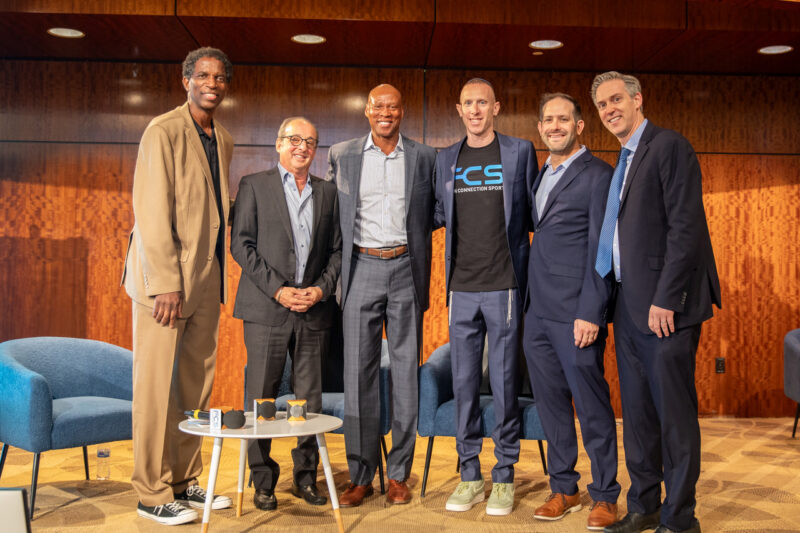
Courtesy/Allison Weiss
From left, former NBA player AC Green, sports photographer and podcaster Andy Bernstein, former NBA player Byron Scott, former professional basketball player Tamir Goodman, Fabric co-founder Saul Garlick and Rabbi Erez Sherman, co-senior rabbi of Sinai Temple in Los Angeles, are seen at the synagogue's 'Faith. Connection. Sport.' summit on Feb. 12, 2026.




 Add EJP on Google
LOS ANGELES — When Rabbi Erez Sherman, co-head rabbi of Sinai Temple, began calling potential partners about a bold idea — a summit exploring how sports and faith could help push back against rising division and hate — the response was immediate. They all said “Yes.”
Nine months later, the summit finally came to fruition under the title: “FCS: Faith. Connection. Sport.” Last Thursday, as the sports world gathered in Los Angeles for NBA All-Star weekend, dozens of participants arrived at Sinai Temple for six hours of conversations about the intersection of sports and faith, and what truly defines us.
“In both faith and sports, we find our greatest strength when we play as a team,” Sherman said at the event. “At a moment of rising hate and deep social fracture, this gathering is about reclaiming shared values of respect, dignity and responsibility to one another.”
Speakers included non-Jewish and Jewish sports legends and leaders such as Lisa Leslie, Eddy Curry, A.C. Green, Byron Scott, Angel McCoughtry, Bob McKillop and Tamir Goodman, the former Israeli American basketball player, dubbed the “Jewish Jordan” by Sports Illustrated.
Former Los Angeles Lakers players Scott and Green shared memories from their days on the court, offering both humorous anecdotes and lessons in character, teamwork and leadership. Interviewed by sports podcaster Andy Bernstein, the two reflected on how the game has evolved and the values that endure.
Scott noted that today’s players often have more of a “me” mentality, contrasting it with what he described as a collaborative ethos of his own era. Recalling his time playing with Earvin “Magic” Johnson, Scott said: “Magic could have had as many points as he wanted, but he knew that for us to be successful, he needed to give the ball to others. When we win, we all win.”
He also talked about the heartbreak of losing to the Celtics in ’84, the lessons from rebounding in ’85 and the many changes that came as the NBA grew commercially.
Remembering Lakers star Kobe Bryant, who died in a helicopter crash six years ago, Scott recalled that Bryant once told him, “I wish I had played back then with you guys.” Scott joked that his response was, “No, you don’t — because I would’ve been coming off the bench.”
“You never see a player like Kobe anymore,” he added, reflecting on Bryant’s rare combination of skill, discipline and generosity.”
Scott shared personal memories of coaching and playing against Bryant, including looking out for him during practices, and watching him bring along his daughter, Gigi, who also died in the crash. “I was blessed to be a part of his life for so many years as an opponent, a player, and a coach,” Scott said.
Sherman, the son of a rabbi, grew up in Syracuse, N.Y., and played basketball in his youth. While balancing religious life and sports can be challenging, Sherman said he learned early on that he didn’t have to choose between them.
“There was never a choice between faith and sports. It was never faith or sport. Never the sanctuary or the court. It was always faith and sports,” he said.
One person who gave him inspiration that it’s possible to be a basketball player and still observe the Shabbat, was Goodman. When Sherman heard about the Jewish basketball player who refused to play on Shabbat and gave up a scholarship at the University of Maryland because he couldn’t play on Saturday, he was inspired. Goodman eventually accepted a scholarship from Towson University and played there. His coaches shifted the games, so they wouldn’t fall on Saturdays.
Years later, the two met and became friends. Goodman, who retired from basketball, made aliyah and now works as the director of strategic brand initiative for the augmented reality startup Fabric, which partnered with Sinai Temple for the summit.
Goodman arrived from Jerusalem to Los Angeles and shared his personal story of faith on the court. He said that despite facing backlash as an Orthodox Jewish player — from both coaches and crowds — his faith kept him going, and his kippah always remained on his head.
Fabric’s co-founder Saul Garlick describes the organization’s mission as rooted in the same belief that brought the gathering to life. “Sports is the No. 1 industry that brings people together,” he said. “Fans come from all walks of life, all socioeconomic backgrounds. If we can create meaningful experiences around sports, we can build trust in society and strengthen social capital.”
Sherman noted that while many donors already support major efforts to combat antisemitism, not nearly as many have considered how sports can play a meaningful role in that work.
“People give to the big organizations fighting hate,” he said, “but they don’t always see how sports can help advance that cause as well.”
Another key supporter behind the gathering is philanthropist David Kleinhandler, whose connection to Sherman dates back 20 years. At the time, Sherman was a rabbinical intern and taught Kleinhandler’s daughter at Temple Shalom in Greenwich, Conn. Kleinhandler, deeply involved in philanthropic work supporting Israel and interfaith causes, traveled from New York to support the summit.
“I was wearing a Syracuse sweatshirt from my alma mater,” Kleinhandler said. “Erez came out of the classroom, looked at me and said: ‘So you like Syracuse basketball?’ And we instantly connected.”
He added that Sherman and his family quickly became like extended family. “We actually sponsored Erez when he did his first podcast. When he came to me years ago with this big idea about creating a conference on sports and faith, I was immediately excited.”
Kleinhandler said the project resonated deeply with him. “It’s about more than the games or the celebrities. It’s about building relationships, listening to people’s experiences, and helping others reconnect with who they really are.”
Additional partners in the summit included the Anti-Defamation League, JCA (Jewish Coaches Association) and Project Max, a nonprofit that combats antisemitism through sports.
Sherman now hopes to turn the summit into an annual gathering, with plans to host next year’s event during Super Bowl week and a future convening alongside the 2028 Olympics in Los Angeles.
Related News
EXIT INTERVIEW
Elizabeth Sokolsky, longtime EVP of Birthright Israel, to retire next year
ADVANCING A VISION
N.Y. federation donates $1M toward building shared-society center named for peace activist killed on 10/7
CLOSING WORDS
In AZM address, Cosgrove links communal ‘orthodoxy’ on Israel to rising anti-Zionism among young Jews
HIGHER EDUCATION
As Jewish donors reconsider academia, Jan Koum doubles down, endowing Israel studies at Stanford
PRESIDENTIAL REBUKE
Israel’s Herzog: Mamdani ‘makes no effort’ to hide disdain for Israel, Jews must fight back