EXIT INTERVIEW
Outgoing Revson President Julie Sandorf, backer of major NYC initiatives, ‘awaiting answers’ from Mamdani on how he’d tackle antisemitism
In wide-ranging interview, Sandorf, who steps down at the end of the year, describes her 18 years in the position, her concerns for the future and what comes next
Jimi Celeste/Patrick McMullan via Getty Images
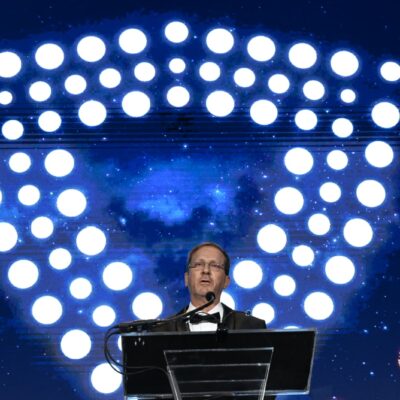
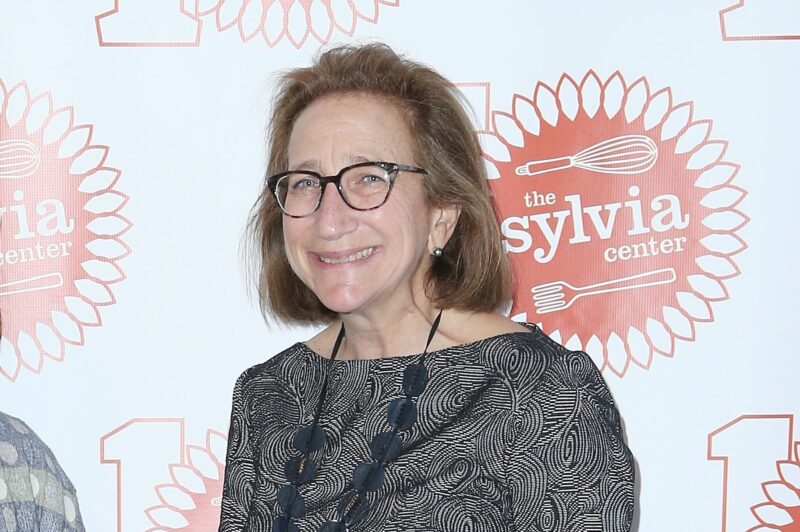
Julie Sandorf, outgoing president of the Revson Foundation, attends a gala event in New York City on Oct. 26, 2017.




 Add EJP on Google
When Julie Sandorf took over as president of the foundation named for Revlon founder Charles Revson in January 2008, the country was in the grip of the financial meltdown known as the Great Recession.
Under Sandorf’s guidance, the Charles H Revson Foundation, a nationally focused philanthropy created in 1956 to support Jewish life, Israel and biomedical research, intensified its focus on the New York City metropolitan area, with the intent of creating frameworks for national impact through local civic life. Over the course of nearly two decades, the foundation funded local journalism, which had wilted under the financial pressure of the recession; propped up the city’s library system; and supported postdoctoral fellows across the city and the surrounding area, as well as helping create Manhattan’s Culture Pass and the Center for Pastoral Education at the Jewish Theological Seminary.
Eighteen years later, many of the foundation’s funding priorities have been hit hard under President Donald Trump’s administration. At the same time, many fear that New York City itself is changing, with the possibility that a democratic socialist, Assemblyman Zohran Mamdani may become mayor at a time of rising antisemitism in the most Jewish city in the world.
Following the recent announcement that she will be stepping down from her role at the end of the year, eJewishPhilanthropy spoke with Sandorf about her time at Revson, the state of journalism, how she views the current political moment and what’s next for her.
This interview has been lightly edited for clarity.
Nira Dayanim: You’re moving on from the Revson Foundation after nearly two decades, two particularly eventful ones at that. Why now, and what’s next?
Julie Sandorf: Well, I should start by saying that it has been the greatest joy and privilege to serve the trustees of the Revson Foundation, a foundation that’s had really a remarkable history of punching above its weight class and taking risks and being pretty fearless about trying new ideas. It has been just a remarkable, remarkable experience. The best part of this experience is I have come to meet, know and have very deep relationships with grantees, colleagues and my bosses and my staff that have enriched my life incredibly. So I’m just sitting here, looking at the trees, feeling incredibly grateful that I had this unique opportunity, and I have had the best job in New York. It is rare to be able to serve a group of trustees that are so thoughtful, so accomplished, so modest and so menschy, and that’s been true for the whole 18 years, with four different board chairs and rotating set of trustees. I just feel very lucky.
So what’s next, and why now? I’m going to be 68 in December, and before I entirely lose what brain cells I have left, I would like to do some writing. I’d like to do some reflecting on the amazing opportunities that I’ve had professionally. And I’d like to be able to walk to a museum in the morning, if I feel like it, and explore areas of interest that because of both my professional life and my volunteer activities on boards, I haven’t had the time to do. And, you know, it’s time. It’s time. I feel like we are living in a time of generational change, and I have always been lucky in knowing when it is time to move off the stage.
ND: You joined Revson as former President Barack Obama was rising to prominence, and you’re leaving it in the midst of a second Trump presidency. Many of the funding priorities for the foundation — local journalism, biomedical research, election reform — are facing increasing pressure in the current political moment. How does it feel to be closing this chapter at this moment?
JS: I am very concerned about the future of the next generation of promising and talented scientists. In my mind, it’s unexplainable that the United States, which has been the world’s leader in biomedical research, that the work of these amazing science researchers, not only helped develop a vaccine for COVID-19 virus, but is a huge spur for the economic strength of our country. We might be losing a generation of that talent, and it’s just unexplainable and inexcusable. And I am very frustrated by that. The Revson Foundation has modest resources and could never fill that gap. And I am hoping, in this interim time, that some of the newer philanthropists who have far greater resources will understand the absolute importance of this in the future of our economy, our leadership and curing diseases. It’s not a political issue.
I look at Israel… We were the co-founder of an extraordinary program that was developed by the Weizmann Institute to try to even out the gender gap among post-doctoral researchers. In order to achieve the highest levels of scientific research in Israel, postdocs have to leave the country and work in labs internationally. And for women [who are typically at the age when they are starting families], that was particularly challenging. … And it was wildly successful. It’s been replicated in almost every university in Israel.
The loss of this unbelievable infrastructure in the United States might accrue to the gain of institutions like Weizmann, like major research centers in Europe, who are willing, ready and able to bring these labs overseas. And good for them, and I hope that they’re able to do so, because this is just a tremendous loss to the United States.
In our New York City funding, we were really kind of a leader in this. In 2008, when I got to the foundation, within six months of my tenure there, The New York Times’ Metro section folded into their national section, The New York Sun folded, El Diario was on its last legs, and The Village Voice was too. Many community papers were really hurting. We began looking at what a local foundation could do to start reimagining local journalism for the 21st century. New York was particularly important because, to an outsider, it’s the media capital of the world. You’ve got three daily newspapers. But the reality was The Daily News in 2009 I believe, had about 200 reporters just on their city desk, and now it’s less than 10. The New York Times has re-shifted its orientation to a national and international outlet, and meanwhile, it is absolutely critical for the state that a robust media retain its role as watchdog, holding institutions of power accountable, as explainers of what is going on in the city as complicated as New York…
It is absolutely critical that there is robust journalism. It’s evident in New York and evident in Israel, that if nobody’s watching City Hall, bad things happen. And we certainly have experienced that over the past eight to 10 years. In Israel, it’s far more of an emerging area for us. In 2023-2024 we started seeing not only the economic threats to journalism that are being experienced by every news outlet in the world, but with this current government, regulatory threats as well. We began, very slowly, supporting [the Israeli nonprofit investigative news organization] Shomrim — which is sort of the ProPublica of Israel, and supporting reporters who would be reporting on unrepresented sectors in Israeli society, including Arab society. After Oct. 7, Revson, through Shomrim, created an emergency fund for journalists. We were able to raise $400,000 in very short order to provide direct grants to journalists who were working on the front lines at the very beginning of the war, which was an unprecedented effort in Israel. Journalists aren’t often thought of as folks who experience trauma, but as you well know, that’s just not true, especially in the days following the events of Oct. 7. I cannot imagine what they saw.
ND: I was particularly struck by the fund for front-line reporters through Shomrim following Oct. 7. There’s been a lot of emergency funding directed towards Israel in the last few years but I haven’t seen anything quite like that. Where did that idea come from?
JS: I was sitting in New York feeling completely devastated and heartbroken by the events of Oct. 7. The reporting that was coming out was first, and the reporting I trusted, quite frankly, was that of Israeli journalists writing for, JTA, Times of Israel, and other outlets. And it just occurred to me that journalists are not first in line when people think about emergency needs. And so I wrote to Alona Vinograd, who is the CEO of Shomrim, and I said to her, “What do you think about setting up an emergency fund to provide grants, straight grants, to journalists to do whatever they need to do with them?” And as you well know, journalists in Israel, as in the United States, are not richly paid. And Alona said, “Absolutely.” So in the five days following that, we put together a very simple application, super simple criteria — basically credentialed working journalists who are Israeli. We did not want grants going to journalists from international organizations, they had to be Israeli, and it could be anyone from the Israeli press. I went about shaking the tin can here. Within less than two weeks, we had this thing up and running. … They were grants of $2,000 apiece and we were able to in a couple of months provide these grants to 170 journalists who were kind of floored.
ND: ?Under your leadership, Revson pivoted to focus deeply on New York City — housing needs, arts and culture, support for immigrants, etc. At the same time, Jewish life and Israel are a huge part of Charles Revson’s original commitments. It’s a particularly interesting time to be a funder at this intersection, with many fearing that the position of the city’s Jewish community is shifting for the worse. How do you view that and what do you make of Mamdani?
JS: It has not been easy to be a Jew in New York City over these past few years… What I love most about New York is its incredible diversity. Working hand in hand with folks that represent many different constituencies and communities in our city, after Oct. 7 I found myself, and this is still true, spending a lot of time explaining to people what was going on and why it was going on. A lot of folks, while very educated across the spectrum, say, “Well, this is what I read in The New York Times.” And I’d say, “Well, here’s your reading list: You can’t just read The New York Times!” In some cases, with partners in secular philanthropy I’ve been dismayed by a knee-jerk reaction that hasn’t always beenwell-informedd. I feel that it’s been a responsibility to try to help people understand the full picture of Israeli society. To this day, I’m explaining to folks that Israeli society is far more diverse, and actually far more civically active and far more engaged in supporting democratic norms in the Jewish state than we’re seeing here in the U.S., quite frankly. We would not want to be painted with a paintbrush of the ideological orientation of our leadership, nor should all of Israeli society be painted with that same paintbrush…
With respect to the [mayoral] election, oh boy.
At Revson, we look at civic infrastructure as the key pillars of a strong society. This is true in Israel, and it’s true in New York. Those pillars are strengthening our civic squares — I feel our greatest accomplishments has been the strengthening of our public branch libraries across the city, our work in journalism, our work to support vibrant open spaces and parks and our work to engage folks in civic life, through voting and through being informed citizens and exercising this incredible privilege we have in the United States.
When I reflect on the primary election, Mamdani ran a great campaign. His campaign embodied “small-d democracy,” all things that we believe in. Engaging citizens, engaging people on the future of our city. He’s very talented at doing that. And I also admired the positivity and hope and optimism that he brought to that campaign.
As a Jew and a 42-year resident of the city of New York, I would like to know where the red lines are between freedom of speech and freedom of protest and breaking the law and harassment and assault and larceny and destruction of public property and private property. I would like to know where he would, as mayor, draw that line. Because I am a true believer in freedom of speech and freedom of peaceful protest, but all too often in New York City, especially since Oct. 7, that line was crossed with little consequence. I would also love to know who he would see as his leadership cabinet and his agency commissioners. I worked closely with city government for almost my entire career, and effective city government is all about who gets hired, period. So those are my questions. I am eagerly awaiting those answers.
Ed: note: Shortly after this interview, Sandorf sent this follow-up statement regarding Mamdani’s nomination, highlighting recent antisemitic incidents at the New York Public Library, Brooklyn Museum and a New York bookstore: “Since Oct. 7th, the destruction of property, targeted at our cherished secular civic, cultural, educational institutions and private property, including Jewish restaurants and homes, escalating reports of antisemitic incidents targeted at visibly identifiable Jews, and physical threats targeted at ‘Zionists’ in public spaces is not only a question of safety and security for New York City’s diverse Jewish communities. It is the epitome of illiberalism and undermines the ethos, values, and very essence of an open, welcoming and pluralist civic life that has made our city flourish. … Clear lines between lawful protest and unlawful acts must be drawn, with consequences for those who break the law, if not for the safety of the world’s second-largest Jewish population, then for the sake of everyone who lives and works and loves our open, pluralist city.”
ND: You mentioned you’ll be working on a writing project, what will that entail?
JS: I have never written a book before. I honestly have no idea how to do this. It will require some help and support, which I hope to get from wonderful friends who are writers. I’m hoping, in some way, to write a reflection on my formative experience working in the South Bronx in 1983 in the neighborhood that had been declared by two presidents as the most bombed-out symbol of urban blight in America. I had the unbelievable good fortune of working for a community advocate named Genevieve Brooks. She had grown up in the Jim Crow South and moved to New York as a teenager. She moved to [the South Bronx] when it was a white, working-class, Jewish and Italian neighborhood, only to see the white flight and 90% of the neighborhood burned to the ground. As a volunteer, she had the perseverance, the strength, the incredible interpersonal skills to create partnerships with local police precinct captains, local fire captains, that then organized community residents into cleaning up the streets and then eventually into revitalizing that community.
The life lessons she taught me were the formative experiences that carried me through the rest of my career. I think they’re important lessons about how Jews and Black Americans work together as partners and have enriched each other’s lives. That’s about as far as I’ve gotten. I don’t know if this will be a biography, or a story of our 43-year friendship. But I’ll be sort of interweaving that and the lessons that I learned by her example and her dignity and her tenacity to rebuild a world that had been forsaken.
Related News

MAJOR GIFTS
Center for Jewish History celebrates 25 years with a $25M matching grant
EXCLUSIVE
Detroit-based philanthropists Nancy, James Grosfeld donate $8M to renovate JDC’s Israel campus
CLOSING WORDS
In AZM address, Cosgrove links communal ‘orthodoxy’ on Israel to rising anti-Zionism among young Jews
HIGHER EDUCATION
As Jewish donors reconsider academia, Jan Koum doubles down, endowing Israel studies at Stanford

MAGICAL EXPERIENCE
Shefa launches psychedelics retreat for Jewish professionals suffering burnout