EVENT PLANNING
Oct. 7 memorial preparations fraught as American Jews yearn for hostage return, grapple with war
Organizers say they are struggling to navigate the logistics of events — timing amid High Holy Days and avoiding anti-Israel protesters — and the complexities of the current moment; some communities are just avoiding it entirely
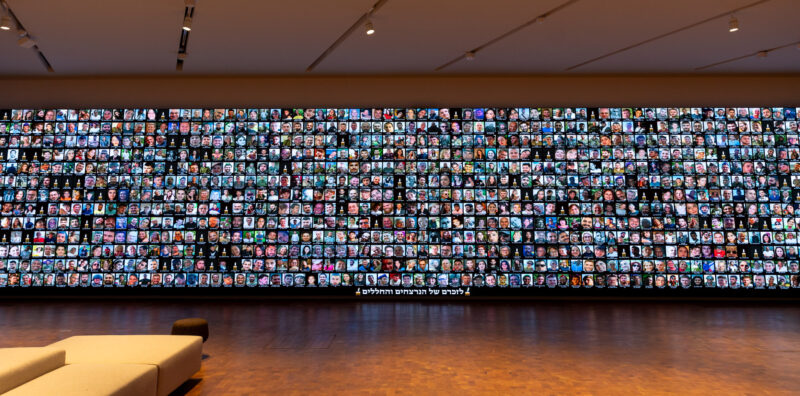
Dana Bar Siman Tov/NLI
A memorial wall at the National Library of Israel showing all of the civilians killed in the Oct. 7 terror attacks.




 Add EJP on Google
As the second anniversary of the Oct. 7 terror attacks approaches, Jewish organizations and their supporters are planning programming to mark the day. But with Israel’s war with Gaza still raging amid growing international denunciations, 48 hostages still held captive and uncertainty about whether Hamas will accept President Donald Trump’s ceasefire plan, organizers say they are navigating fraught territory on multiple levels
This year, even the timing of memorials is complicated by the fact that Oct. 7 falls on the first day of the weeklong Sukkot holiday, which is liturgically described as “zman simchateinu,” or “the time of our joy,” an idea that is at odds with communal mourning.
For some, there is ambiguity about what exactly should be memorialized: just the attacks themselves — the deadliest massacre of Jews since the Holocaust — or also the past two years of war, which has resulted in the deaths of thousands of Palestinian civilians. For many, the answer is the former, while others, particularly those in progressive communities, will incorporate the latter as well.
Some Jewish organizations are avoiding the matter altogether and refraining from memorializing the attacks to avoid arguments and communal tensions over the content of such an event.
While Uria Roth, director of the JCC Association of North America’s Mit-habrim program, which provides JCCs funding for Israel-related programming, told eJP that he hasn’t heard of any JCCs holding programs that are overtly critical of Israel’s actions post-Oct. 7, “I do hear, not just at JCCs, but across the [Jewish] communities, ‘Maybe we should avoid [Oct. 7] this year, especially because at this point, we don’t know where we’re going.’”
Roth hazarded that this would change if and when the war in Gaza ends. “I think you’ll see double the number of ceremonies happening, because it will be easier to talk about [Oct. 7] once the war is over, versus during the war,” he said.
Memorializing the Oct. 7 attacks in Israel is fraught as well. After last year’s state memorial ceremony was opposed by many survivors and victims’ families, this year the government decided to refrain from organizing one. Instead, the main ceremony, taking place in Jerusalem on Tuesday at 9:30 p.m., will be organized by the Israeli nonprofit Kumu and American Israeli group AID Coalition, which are crowdfunding the event.
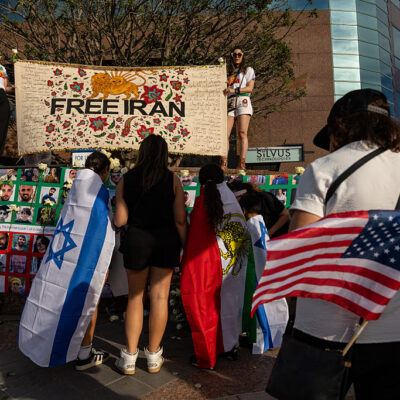
Outside of Israel, efforts to mark the anniversary with the war in Gaza still raging also risk disruption by anti-Israel activists. In some cases, the locations and times of events are being disclosed just before they start or only to those who register in an effort to avoid protests. Some groups are also facilitating at-home memorial options.
“I’m very concerned that Oct. 7 becomes an excuse for pro-Hamas imbeciles on campus and elsewhere,” Mark Charendoff, president of Maimonides Fund, told eJP.
To combat this, Maimonides Fund is helping to fund the American release of two four-episode dramas chronicling Oct. 7: “Red Alert” on Paramount+ and “One Day in October” on HBO, both premiering on the anniversary of the attacks. Having a “dispassionate third party” such as HBO and Paramount+ providing a platform for stories about Oct. 7 is important, Charendoff said.
“Hasbara has become a dirty word. I’m not sure it should be,” he said, referring to the Hebrew word for “explanation,” which is used to describe efforts to shape public opinion about Israel. “HBO does not have a stake in this fight, so to speak, so when they’re willing to host or platform something, it is meaningful.”
While there has been a “Surge” of Jewish engagement in the wake of Oct. 7, “not all of our community is engaged in synagogue life or Jewish communal life, but they do watch streaming services like HBO and Paramount+,” Charendoff said. “We have the potential to reach a lot of people who might be struggling with how to think about Oct. 7 or whether to think about Oct. 7, and that’s not just the Jewish community, that’s the broader American community.”
Another funder of “Red Alert,” Charles and Lynn Schusterman Family Philanthropies, told eJP: “Two years after the Oct. 7 Hamas terrorist attack, it remains just as critical to keep the stories alive of those who experienced this harrowing day, when the largest number of Jews were massacred since the Holocaust.”
An Oct. 7 program or event will open itself up to pushback, Charendoff said, specifically pointing to an exhibit that will tour 24 campuses through Hillel International, a regular Maimonides Fund partner. The exhibit is based on Haaretz journalist Lee Yaron’s book 10/7: 100 Human Stories and features eight-foot-tall panels highlighting the stories of 13 victims of the attacks. Because the exhibit will be prominently displayed on main quads and in university museums, there are concerns people will deface it and tear it down, but “that shouldn’t stop us,” Charendoff said.
University administrations are “being far more responsive” to vandalism and antisemitism than in the first year post-Oct. 7, Rabbi Ben Berger, senior vice president for education, community and culture at Hillel International, told eJP. “Being much more aware of the needs of Jewish students.”
Last year, to mark the first anniversary of the massacres, hundreds of Hillels held public vigils at campuses across the country, some at schools that also held pro-Palestinian rallies that same day featuring students bellowing “From the river to the sea” and “Intifada revolution.” This year, Hillels are holding programming and rallies with speakers, including Oct. 7 survivors and freed hostages. Many of these events were planned by Jewish Agency fellows, some of whom survived the Oct. 7 attacks themselves.
It’s important that these events are public, Berger said. “We’re trying to tell real human stories here and appeal to people’s empathy, no matter where they’re coming from. For us, it doesn’t negate the suffering of the Palestinians. It’s not a political comment on every day since Oct. 7. It’s about the lives that were taken on that day.”
While the JCC Association’s Roth said that some organizations are avoiding Oct. 7 memorials, there are more than 100 JCCs holding events including art exhibits, storytelling and visits from experts and former hostages. Roth hopes that events memorialize those who died by focusing on what they loved, such as specific foods, music or yoga.
He added that these events need to be handled delicately and recommended small groups and panels where participants and experts can discuss the attacks and the past two years in a considerate way.
While a recent Jewish Federations of North America study showed that a third of Jews were more engaged in Jewish life than pre-Oct. 7, OneTable’s “Surge” was even more pronounced, with the amount of unique Shabbat dinner attendees nearly doubling to 85,000 unique users this year.
The organization has focused its curriculum only on memorializing the day itself — rather than the past two years — promoting Gather to Remember Dinners, where Shabbat hosts mark Oct. 7 in a way that is meaningful to them. OneTable is also holding four larger dinners itself, which will be held in public venues in Atlanta, Chicago, Boston and Austin, Texas.
This year, the organization updated its “A High Holidays Guide After October 7” because “the trauma feels very different” this year compared to last, Sarah Abramson, CEO of OneTable, told eJP. “There’s a different approach to rawness. There’s an approach here that’s really about living consistently in the gray, living in the unknown, living with the past.”
While OneTable’s resources do not discuss the war in Gaza, there are a few references to the war in the guide as well as resources for holding respectful debates and nothing stops hosts from discussing their views at the dinner. “I’m not at the dinner,” Abramson said, “and I’m not in any way putting my points of view around what it means to hold grief and space into your dinner.”
Because Oct. 7 falls at the beginning of Sukkot, many in the Jewish world are struggling with when to hold commemorations. OneTable, JCCs and many Reform congregations are holding events throughout the month of October. Still, some Reform congregations will mark it on the holiday.
“It sort of fits with Sukkot in that we sit in our fragile, frail, vulnerable, little sukkah, and you can’t actually have ultimate protection when you sit out in your Sukkot,” Rabbi Rick Jacobs, president of the Union for Reform Judaism, told eJP. “It can rain, It can sometimes get windy. We’re vulnerable in this world.” On Oct. 8, the movement is holding an online conversation between Rabbi Josh Weinberg, executive director of the Association of Reform Zionists of America, and Yaron.
Oct. 7 is “first and foremost… still a commemoration of the tragedy and trauma” of the attacks, Jacobs said, but “we can’t not also think about the pain that the war has caused innocent Palestinians in Gaza.”
You also can’t avoid facing the rising antisemitism and that the hostages aren’t home, he said.
“After two years, it’s front and center,” he said. “And it’s not [as though we] only feel the pain of the Palestinians. We feel the deep loss as a Jewish people. Our family [members] were murdered, raped, taken hostage,” he said.
The Chabad-Lubavitch movement is organizing an event in New York’s Central Park on Tuesday that is explicitly not a “mourning” event, but rather a “Circle of Unity,” in which thousands are expected to “unite in a celebration of Jewish life, identity and resilience.” The event is supported by philanthropist Dan Loeb, as well as the Jewish National Fund, the Israeli-American Council and the Hostage and Missing Families Forum.
While “Oct. 7” has become shorthand for the attacks even in Israel, which generally marks events based on their Hebrew dates rather than Gregorian, for many religious Jews, the anniversary of the massacre is marked on the 22nd day of the Hebrew month of Tishrei, which this year falls on Oct. 14. In Israel, this is the date of the holiday of Simchat Torah, ordinarily a joyous celebration of the Torah.
“Simchat Torah is a celebration of the values of the Torah and the values that we dance with and we’re joyful of,” Rabbi Moshe Hauer, executive vice president of the Orthodox Union, told eJP.
And yet, the horrors of the Oct. 7 attacks are now forever entwined with the holiday, Hauer acknowledged. “We feel that more than ever… We’re not going to make Simchat Torah into a day of mourning. It’s a day of consciousness,” he said.
This second anniversary is a lonely one, Hauer added. While Israel has had victories and suffered losses, it is isolated diplomatically. “Two years people are still being held [hostage] is something people have to stop and absorb,” he said.
Hauer recommended congregants pause during their outbursts of dancing this Simchat Torah to sit together in a circle, hold the Torah close and sing of better days in the future.
Related News
ADVANCING A VISION
N.Y. federation donates $1M toward building shared-society center named for peace activist killed on 10/7
HIGHER EDUCATION
As Jewish donors reconsider academia, Jan Koum doubles down, endowing Israel studies at Stanford
CLOSING WORDS
In AZM address, Cosgrove links communal ‘orthodoxy’ on Israel to rising anti-Zionism among young Jews
EXIT INTERVIEW
Elizabeth Sokolsky, longtime EVP of Birthright Israel, to retire next year

MAJOR GIFTS
Center for Jewish History celebrates 25 years with a $25M matching grant