WHAT YOU SHOULD KNOW
Most Israelis will fast, attend prayers on Yom Kippur, new survey finds
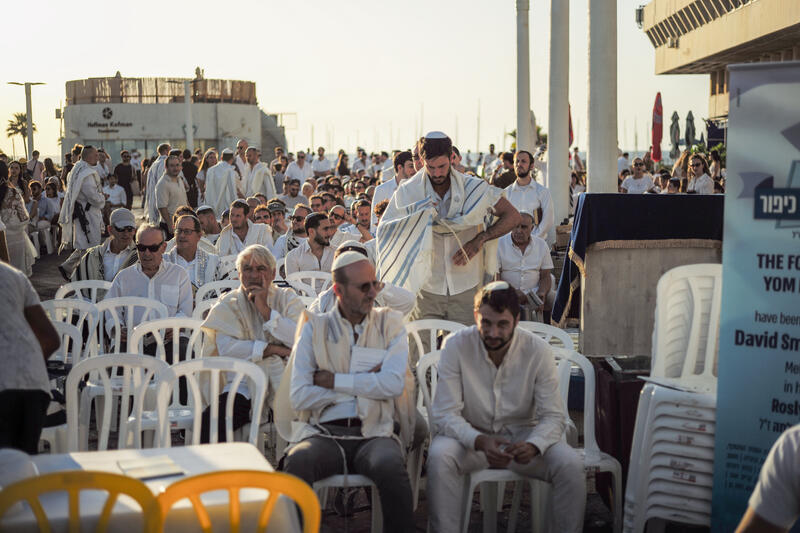
Erik Marmor/Flash90
Israelis participate in a public prayer service in Tel Aviv, on Yom Kippur, on Oct. 2, 2025.




 Add EJP on Google
When Yom Kippur begins on Sunday evening, the majority of Israelis will mark it by fasting and attending synagogue services, according to a new survey by the Israel Democracy Institute think tank. But a deeper dive into the poll shows subtle and substantial differences between demographic groups, particularly the significantly higher levels of observance among Mizrahi Israelis.
The survey, which was released yesterday, finds that nearly three-quarters of Jewish Israelis — 74% — said that they intend to mark the holiday by fasting, either fully (63%) or partially (11%). In addition, 57% of respondents said that they planned to attend prayer services.
“The findings show a strong attachment to Jewish tradition, as expressed through fasting and synagogue attendance on Yom Kippur, across broad sections of Jewish Israeli society,” wrote the researchers, Ariel Finkelstein, Ya’ari Padan and Shlomit Ravitsky Tur-Paz.
These levels are higher than those reported in similar, albeit older, studies conducted in the United States. The Pew Research Center’s “Jewish Americans in 2020” found that 40% of American Jews said that they fasted on Yom Kippur, and 35% said that they attend synagogue “a few times a year, such as for High Holidays.”
The IDI survey offers at last a partial explanation for this disparity between Israel and the United States: Israel has many more Mizrahi Israelis, who are far more likely to both fast on Yom Kippur and attend services.
Based on interviews in July and August with 1,002 Jewish Israeli respondents ages 18 and over, whom IDI said constituted a representative sample of Jewish society in Israel, the researchers found that 88% of Mizrahi Jews said that they observed the fast either fully (81%) or partially (7%), compared to 64% of Ashkenazi Jews and 71% of mixed-heritage Jews.
Some 68% of Mizrahi Jews said that they planned to attend services, compared to 50% of Ashkenazi Jews and 51% of mixed-heritage Jews.
The IDI survey found that 51% of respondents said that they intended to pray in an Orthodox synagogue, and 6% said that they would go to a Reform or Conservative one. This largely appears to align with a recent survey commissioned by Israel’s Reform movement, which found that 6% of Israelis identified as Reform and 2% as Conservative — roughly twice the levels as in 2022.
While the poll found that Mizrahi Jews are more traditional in the sense that they are more likely to observe the main elements of the holiday — fasting and prayer — this was not reflected in their choice of synagogue. Mizrahi Jews’ attendance rates for Reform and Conservative synagogues were, in fact, slightly higher — though still within the 3% margin of error — than those of Ashkenazi and mixed-heritage Jews at 6.5%, compared to 5% and 6%, respectively.
Curiously, the poll did not examine the popularity of Israelis’ other Yom Kippur tradition: riding bicycles on the country’s empty roadways.