CAPITAL CONFAB
Jewish leaders, philanthropists to gather for first post-war JFNA General Assembly in D.C.
The gathering marks a pivot as the Jewish community considers what comes after the Oct. 7 war
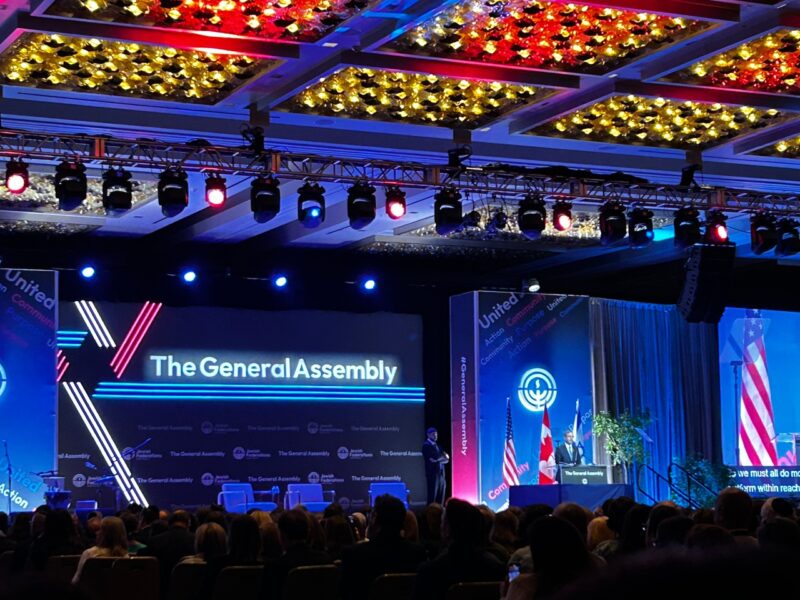
COURTESY
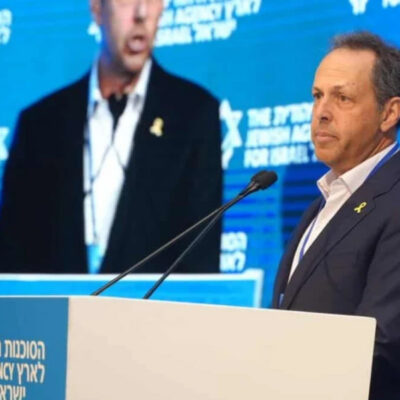
Israeli President Isaac Herzog addresses the Jewish Federations of North America's General Assembly in Washington, D.C., on Nov. 11, 2024.




 Add EJP on Google
Some 2,000 Jewish communal leaders, philanthropists and nonprofit officials from North America, Israel and beyond will gather in Washington on Sunday for the start of Jewish Federations of North America’s annual General Assembly just as the haze of the last two years of war and rising global antisemitism starts to lift.
One month after a ceasefire went into effect in Gaza, all the living Israeli hostages have returned home, though the remains of three hostages are still in Hamas’ hands. Stateside, the longest government shutdown in American history has come to a close, reducing some of the pressure felt by Jewish social services nonprofits, including JFNA, due to pauses in food assistance benefits and other social services earlier this month.
The Jewish community has become accustomed to emergency mode, JFNA’s president, Eric Fingerhut, told eJewishPhilanthropy, but he hopes this GA can be a moment for “reflection,” and a pivot.
“This gives us a moment to reflect,” said Fingerhut. “When we reflect, we have to reflect on what clearly we were prepared for, and what we weren’t as prepared for as we should have been, so that we can now bolster those areas and prepare for the future.”
The convening will provide an opportunity for Jewish leaders to reveal how they are thinking about Jewish communal priorities in the aftermath of the longest war in Israel’s history. The event’s organizers are billing this period as the start of a “defining moment in Jewish communal life,” according to the description of the Sunday evening plenary that kicks off the conference.
“Our community stands at a crossroads,” the description reads. “The plenary will frame the challenges and opportunities of the year ahead as we work to rebuild Israel, ensure Jewish security and combating antisemitism, and invest in strengthening Jewish life and identity.”
The GA agenda is so far lacking some of the marquee speakers it boasted in recent years. The speakers kicking off the GA include Rahm Emanuel, a longtime Democratic official and possible 2028 presidential candidate; authors Sarah Hurwitz and Micah Goodman; CNN contributor Scott Jennings; and Fox News host Jessica Tarlov. There are currently no Trump administration officials listed on the agenda — a change from last year, when Biden administration Homeland Security Secretary Alejandro Mayorkas spoke.
Two years ago, meanwhile, hundreds of thousands of Jewish activists converged on Washington for a rally to demand the release of the hostages and an end to antisemitism. At last year’s GA, a unity rally at Nationals Park drew political officials including Michigan Gov. Gretchen Whitmer, a Democrat, and Reps. Virginia Foxx (R-NC) and Ritchie Torres (D-NY). No members of Congress are listed on the agenda yet.
“I think that we are, just like last year, bringing really relevant, high-level conversations to the main stage. In addition to, I think, already high-level speakers, there will be some additional names added soon,” said JFNA’s executive vice president, Shira Hutt.
The last few years have highlighted the Jewish community’s ability to raise and deploy emergency funds, said Fingerhut. But one area was revealed as a weakness, he argued: civic engagement on a local level.
“Our ability to engage civically with government, and especially local governments, schools and the like, were not as robust as they need to be for this moment. Doesn’t mean they weren’t there. It just means that, given what the challenge of the moment is, we weren’t at that level. So we reflect on that, we learn from that, and now we invest in strengthening those areas of work,” he said.
The conference will also mark a turning point in JFNA’s grantmaking. After raising $908 million through its Israel Emergency Campaign in the aftermath of Oct. 7, 2023, the vast majority of which has already been allocated, the organization will be shifting to a new phase. Aptly named “Rebuild Israel,” the new initiative will focus on the long-term rebuilding and recovery of Israeli society.
“Our hope and goal is that we continue to raise money to help in wherever areas Israel feels that we could be helpful in rebuilding communities and Jewish life in Israel,” Gary Torgow, JFNA’s board chair, told eJP.
While recent developments in Israel might mark the end of “emergency mode,” said Fingerhut, the community is still in crisis. Like last year’s GA, a core focus at the gathering will be security needs due to increased antisemitism — which spiked following Hamas’ terror attacks and remains both pervasive and unpredictable. Following two deadly attacks on the Jewish community over the summer, the cost and stakes of that conversation have heightened.
Another core focus, Fingerhut explained, will be leveraging the continued impact of “the Surge” in Jewish engagement by discussing efforts to bolster Jewish education, and to develop curricula that can create a sense of pride and resilience in the face of current challenges.
“We have these opportunities, and they come out of the crisis of the last two years, all of them, but this is our chance to address them. Now, when there’s a little bit of a moment to pause in the emergency mode that we were in,” he said.
The GA will also be an opportunity to take stock of the relationship between Israeli and diaspora Jewry, with many Israelis flying to Washington to participate in the conference. Naama Klar, director of the Koret International School for Jewish Peoplehood at ANU – Museum of the Jewish People, will be attending the General Assembly after skipping the gathering during the war.
Her attendance is partly to learn more about the “Surge,” she told eJP, and to bring the perspectives of Israeli and Diaspora Jewry into conversation.
“I think a global outlook is missing. We should examine those phenomena together, because people who feel in their hearts more Jewish because Oct. 7 happened to them, need to be understood collectively,” said Klar.
Related News
EXIT INTERVIEW
Elizabeth Sokolsky, longtime EVP of Birthright Israel, to retire next year
HIGHER EDUCATION
As Jewish donors reconsider academia, Jan Koum doubles down, endowing Israel studies at Stanford
CLOSING WORDS
In AZM address, Cosgrove links communal ‘orthodoxy’ on Israel to rising anti-Zionism among young Jews

MAGICAL EXPERIENCE
Shefa launches psychedelics retreat for Jewish professionals suffering burnout
EXCLUSIVE
Detroit-based philanthropists Nancy, James Grosfeld donate $8M to renovate JDC’s Israel campus