WHAT YOU SHOULD KNOW
Jewish camping world gathers to look ‘onward’ to the coming summer, long-term stability
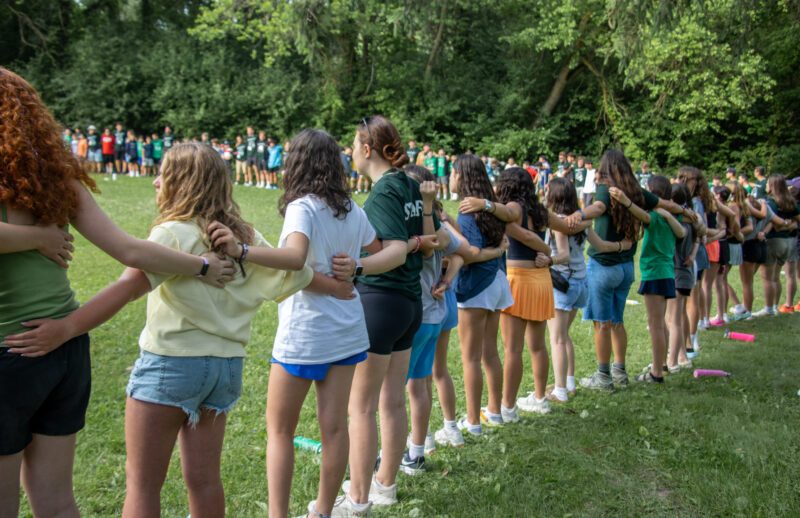
Courtesy/Foundation for Jewish Camp
A photo from Summer 2025 at Beber Camp in Mukwonago, Wis.




 Add EJP on Google
It’s the peak time to enjoy the fall foliage in Western Massachusetts, but for the roughly 400 Jewish camping professionals attending the Harold Grinspoon Foundation’s JCamp 180 conference in Springfield this week, all thoughts are on the summer.
The theme for this year’s gathering, which kicked off yesterday, is “Kadima,” the Hebrew word for “onward.” According to Sarah Eisinger, JCamp 180’s director, the phrase takes on multiple meanings this year, as the community marks the apparent end of the Israel-Hamas war and as the Jewish camping world shifts its focus to long-term organizational development goals following several years of crisis.
In 2023, the conference took place 10 days after the Oct. 7 attacks, Eisinger noted. Days before camps were set to open this past summer, the 12-day Iran-Israel war started, creating a brief staffing shortage as 1,500 Israeli staff members scrambled to reach North American camps. Having overcome those challenges, this conference is a moment to chart a course forward, said Eisinger.
“This summer was just a really incredible summer of Jewish joy and safety and stability for the Americans and the Israelis alike. So we’re going to be celebrating that. We’re going to be acknowledging and celebrating the release of the living hostages. We’re going to be praying for and acknowledging the hostages whose remains we’re still waiting for,” Eisinger told eJewishPhilanthropy.
“But then we’re going to turn and talk about the investments that we’re continuing to make in camp. We know one of the most important things we can be doing in our communities to invest in our camps, and we’re going to talk about that for the next couple days.”
As the Jewish camping world looks to the future, the conference’s session topics will focus on resilience — both regarding Israel and the growing climate-related challenges faced by summer camps. The latter issue is particularly relevant after 27 campers were killed in flash floods at Camp Mystic, a Christian camp in the Texas Hill Country, in July. The conference will also cover “innovation, people and the funding to cover that resilience and innovation,” Eisinger told eJP.
As Jewish camps face rising operating expenses, said Eisinger, the camping world is challenged to find new funding models. “It used to be that, you know, tuition would cover the costs of camp, but that’s not really happening anymore. What we are seeing [is] that camps must fundraise in order to meet those operating expenses,” she said.
According to Eisinger, the rising costs of insurance, fuel, kosher food and especially security are felt most intensely. The latter is one of the largest growing expenses camps are facing, she added. That can include things like video cameras and security guards, but also cyber security and general training.
“Everyone wants campers to be safer, and it’s one of the largest and growing expense lines in running a Jewish camp. It’s what makes a Jewish camp a lot more expensive than, say, a secular camp. But they’re managing to do it, and they’re doing it by leaning on their community, by their boards and to the donors who know that camp is an investment that’s worth making,” Eisinger said.
Many camps operate on tight budgets, often close to the line of breaking even, said Eisinger. As the camping community moves forward, financial sustainability and the role of endowments in Jewish camping’s future, a core focus of JCamp 180’s work, will be crucial, Eisinger said.
“More than two-thirds of the camps are operating within a very narrow break-even point. So that’s the most important work,” said Eisinger. “We’ve made an investment in developing new endowments across the field. We found that the field was grossly under-endowed. We have a four-year initiative, we’re just finishing Year 2 of it, but more than 80 camps have started endowments as a part of this. We don’t have billions of dollars yet, but what we have is the foundational work.”