WHAT YOU SHOULD KNOW
Fresh fight over ‘aliyah,’ just in time for Yom HaAtzmaut
Flash90
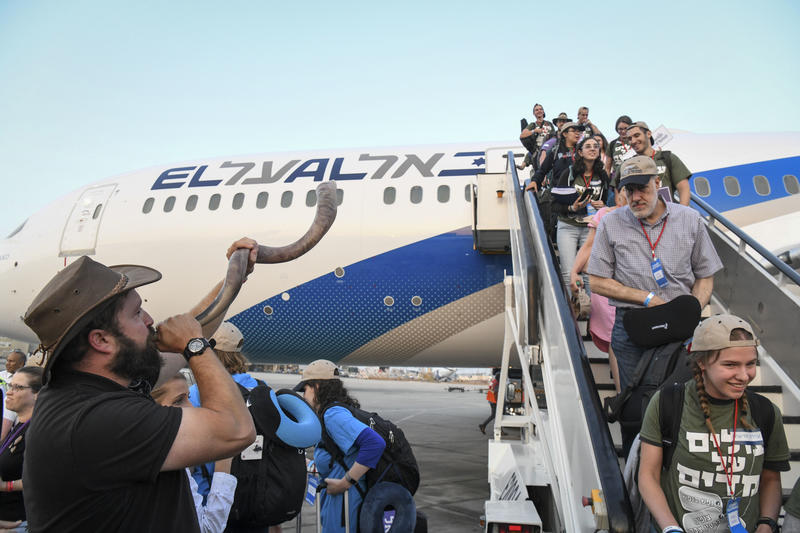
New immigrants from North America arrive on a special 'aliyah' flight" on behalf of the Nefesh B'Nefesh organization, at Ben Gurion Airport in central Israel on Aug. 14, 2019.




 Add EJP on Google
Just in time for Yom HaAtzmaut, Israel’s Independence Day, a fight is brewing over Jewish immigration to Israel, aliyah, particularly from the United States. Several fights, actually.
Aliyah, literally “going up,” has long been a fraught topic for American Jewry. Immigration to the land of Israel has always been a central tenet of the Zionist movement, and encouraging Jews in the Diaspora to make that move has accordingly been a key focus of that movement’s activities worldwide. The exception to this for the past 76 years has been the United States, following a famed 1950 agreement between then-president of the American Jewish Committee, Jacob Blaustein, and then-prime minister of Israel, David Ben-Gurion, in which the latter agreed inter alia that while Israel wanted American Jews to immigrate, it would not pressure them to do so.
This led to a reality that is natural and obvious to American Jews and often incomprehensible to their Israeli counterparts, in which one could consider themself to be a devout, through-and-through Zionist while harboring no intention of ever making aliyah.
Though it has frayed at the edges, the Blaustein-Ben-Gurion Agreement, which also barred both sides from intervening in one another’s domestic affairs, has largely dictated the relationship between American Jewry and Israel since it was announced by the two leaders at a Jerusalem luncheon on Aug. 23, 1950.
A provocative opinion piece that was published over the weekend in the Israeli weekly Makor Rishon looks to change that. In it, columnist and former editor Haggai Segal — a longtime leader of the settler movement and a former member of the terrorist Jewish Underground group — issued a “final call” to American Jews, demanding that they make aliyah.
“Dear brothers, you are traitors,” Segal writes. “You are committing treason against us and committing treason against yourselves.”
Writing in Hebrew — a language few American Jews speak fluently — and in an outlet that few American Jews have heard of, let alone read, Segal delivers an ultimatum to American Jews: Immigrate to Israel en masse in the next five years or else the Israeli Rabbinate should effectively excommunicate U.S. Jews and no longer include them when considering what percentage of Jews live in the Land of Israel (a consideration for certain aspects of Jewish law). He also calls for the shuttering of the Jewish Agency for Israel and ending its emissary program if American Jews don’t immigrate — apparently oblivious to the fact that the vast majority of the Jewish Agency’s funding comes from American Jewry.
Daniel Goldman, a British-born, Israel-based donor with deep ties to the religious Zionist community, noted this in a rebuttal piece in Makor Rishon a few days later: “In the past decade, the lion’s share of the emissaries budgets for youth movements, college campuses and Jewish schools have come from the [Diaspora] communities themselves, through federations, Keren Hayesod and private donors from within the communities. The emissaries are the product of a partnership, not of Israel dispensing charity. And in this partnership, the Israeli government is the little partner.”
Goldman, who also noted that the State of Israel has often alienated American Jewry, warned that “no period in the history of our people has ended well once Jews started calling their brothers ‘traitors’ — they only led to darker periods.”
While Segal’s threats are both improbable, impractical and off-base, his column condemning American Jews for choosing to remain in the Diaspora has nevertheless struck a nerve, both with progressive Jews, who bristled at the condescension and the anachronistic negation of the Diaspora (shlilat hagola), and even among conservative Israelis who broadly agree with his outlook but considered his tough tone and threats of excommunication to be counterproductive to the cause.
Segal also ignored American Jewish immigrants’ contributions to the Zionist cause. Yesterday, as Israel marked its Memorial Day, Yom HaZikaron, by reciting the names of the 25,644 people who have fallen defending the Zionist enterprise, two of the first names that were recited belonged to Jacob Tucker and William Scharff.
American veterans of the Jewish Legion in World War I, Tucker and Scharff stayed behind after their release to defend northern settlements in then-Palestine and were killed 106 years ago in the Battle of Tel Hai, one of the most formative skirmishes in Zionist history. The American pair, along with the six other people who died in the battle, including famed Zionist leader Joseph Trumpeldor, are still remembered in the name of Israel’s northernmost city, Kiryat Shmona, literally City of the Eight, a war-torn community that has never been able to shake off its connection to this bloody history.
American Jewish immigrants have also helped create many of the fundamental institutions of the state that still exist today, including the Hebrew University of Jerusalem (Judah Magnes), the Hadassah Medical Organization (Henrietta Szold), the Israel Electric Corporation (Pinhas Rutenberg), Israel Aerospace Industries (Al Schwimmer) and the national Tipat Halav network of child welfare clinics (also Szold, the powerhouse), among others. American olim still play an outsized role in Israeli civil society, founding many of its most influential organizations, from the food-rescue group Leket Israel (Joseph Gitler) and the Israel Union for Environmental Defense (Alon Tal) to Nishmat: The Jeanie Schottenstein Center for Advanced Torah Study for Women (Rabbanit Chana Henkin) and the Ohr Torah Stone education network (Rabbi Shlomo Riskin). While large swaths of the Jewish world are opposed to and appalled by him, there is no doubt that the American-born firebrand and terrorist Meir Kahane, whose disciples include Israel’s National Security Minister Itamar Ben-Gvir, also continues to influence Israeli society and the broader Jewish world.
Segal is correct, however, that American Jewish immigration to Israel has always been negligible compared to the size of the American Jewish population. Over the past five years, roughly 3,500 American Jews have immigrated to Israel annually. On a per capita basis, roughly 10 times as many British or South African Jews immigrate to Israel each year compared to Americans.
The past two-plus years since the Oct. 7 terror attacks have underscored the interconnectedness of all Jews, with events in Israel directly affecting those abroad, and world Jewry providing greater support for causes in Israel.
But for many in Israel, this bloody period — in which some 2,000 Israeli soldiers and civilians have been killed and thousands more injured and hundreds of thousands of Israeli citizens have put their lives on hold to serve in the reserves — has highlighted the differences between those serving on the front lines of what they consider to be an existential conflict for the survival of the Jewish People and those who are not.
The rise in deadly antisemitism around the world has also further given weight to the voices calling for Diaspora Jews to come to Israel, where they no longer have to rely on the good graces of non-Jewish authorities to protect them. This claim is complicated by the fact the number of Jews killed in Israel post-1948 has always far, far exceeded the number in the Diaspora — a claim that itself is further complicated by the fact that there has never been a better or safer time to be a Jew than in the 78 years since the creation of the State of Israel. Granted, correlation doesn’t necessarily equal causation, but that’s a strong case for those arguing that Israel makes Jews ultimately safer, even if antisemites do use Israel to justify deadly attacks on Jewish communities abroad.
Jewish figures in the Diaspora — across the political spectrum — have also pushed back against these calls for aliyah. On the left, Esther Sperber, the founder of the American branch of the Smol Emuni (Faithful Left) movement, decried the ongoing “negation of the Diaspora,” in a response piece to Segal. “Just as Diaspora Jews have long supported Israel, emotionally, politically, and financially, Israelis must learn to respect and understand the choice to live a Jewish life beyond its borders,” she wrote.
Before Segal’s piece came out, Rabbi Efrem Goldberg, the leader of a prominent Boca Raton, Fla., Orthodox community, spoke out against condescension toward Diaspora Jews, noting biblical precedents for their being multiple centers of Jewish life.
“There is this mentality, increasingly, especially as antisemitism is rising in America, a phenomenon we call the ‘aliyah snobs,’” Goldberg said in a recent episode of his podcast with educator Yael Leibowitz. “There are different centers of Jewish life, and while Israel, of course, is the ultimate destination, and it’s our homeland, and it is categorically different than anywhere else, are we certain that the divine plan is for absolutely everyone [to move there]? Is there some value — not as a cop-out, not as an excuse, not as a like, ‘I’m taking one for the team by staying here’ — but is there some notion of there being multiple centers?”
Curiously, this debate over aliyah has largely neglected emigration from Israel, also known as yerida (literally, going down), despite significantly more people leaving the country each year than arriving — a phenomenon that appears to be driven by a combination of economics, security concerns and politics.
Alongside this debate about the necessity of aliyah, a smaller discussion has arisen around who is making aliyah — or rather whom the State of Israel is encouraging to make aliyah. A recent article published in the Israeli news outlet Ynet cites inside sources from Israel’s Immigration and Absorption Ministry who told the website that the office — run by Ofir Sofer, of the Religious Zionism Party — is focusing solely on encouraging religious Jews to make aliyah from the United States and Western Europe, namely England and France.
The article, which should come as no surprise to anyone who follows the ministry’s social media pages, has rankled non-Orthodox figures, who see this focus on religious communities as exclusionary.
And yet, considering the ministry’s total budget for encouraging aliyah stands at roughly NIS 67 million ($22 million), there is a “more bang for your buck” argument to be made for this focus on Orthodox communities, whose members are far more likely to make aliyah than their non-Orthodox counterparts.
Regardless of where these efforts are directed, the past 78 years indicate that, barring major investment and collective focus, they will likely have limited results. The great waves of aliyah over Israel’s history have only come out of external crises — what immigration experts refer to as “push factors” — whether that was the post-Holocaust refugee crisis and post-Israeli independence attacks on Jewish communities in Arab countries, the famines and oppression in Ethiopia or the antisemitic brutality of the Soviet Union or, most recently, Russia’s invasion of Ukraine. (To be clear: This does not diminish the Zionism of the immigrants — they could have gone elsewhere, but chose to come and stay in Israel.) Israel has yet to credibly attract mass waves of immigrants through its “pull factors,” making aliyah from the U.S. and most Western countries an ideological and idealistic decision.
The only significant rise in American aliyah came in the heady post-Six Day War period of the late 1960s and early 1970s, though even this comparably massive wave topped out at 7,158 — 0.1% of the American Jewish population at the time.
And yet the past 78 years also indicate that while small, that American Jewish immigration punches far above its weight.