Opinion
ART OF INCITEMENT
Drawings For Genocide




 Add EJP on Google
In Short
Artists may ignore (or even desire) the possible consequences of antisemitic content in their work, but courts and lawmakers can't put their heads in the sand.
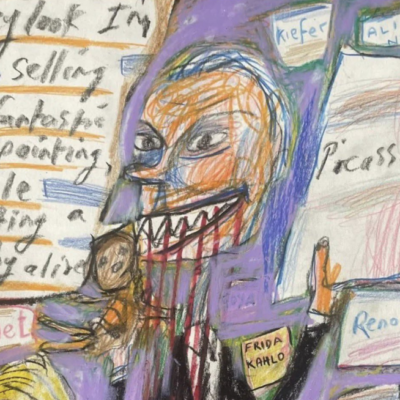
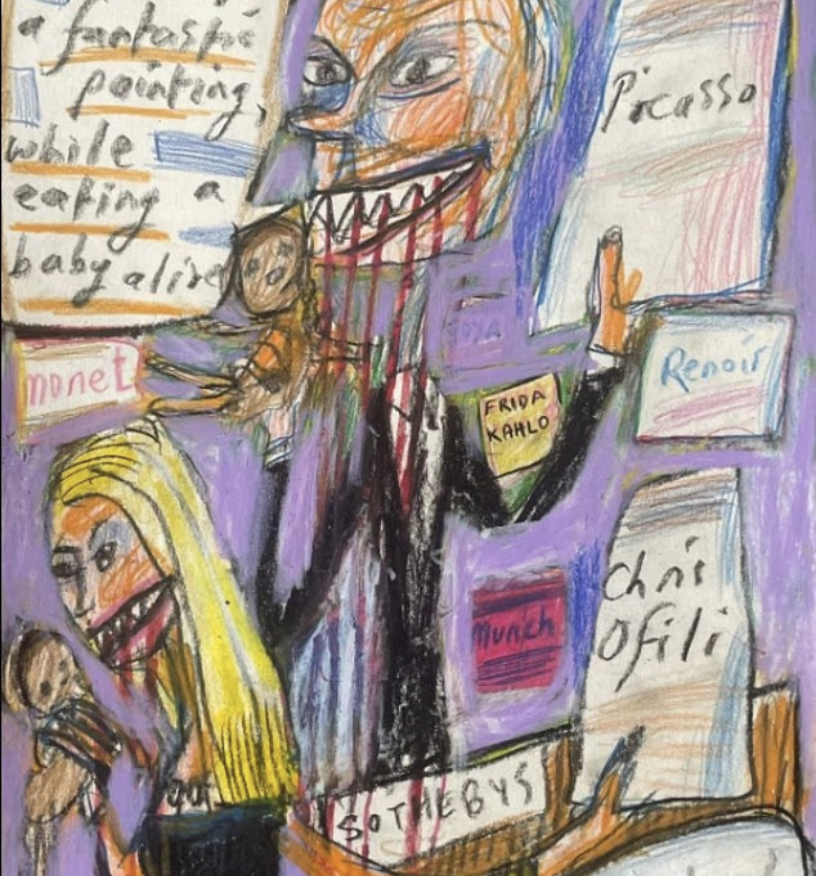
“Drawings Against Genocide” was the title of a recent gallery exhibit in seaside town of Margate, Kent, featuring illustrations by British artist Matthew Collings.
“Drawings For Genocide” would have been more like it.
The exhibit at Joseph Wales Studios — which was removed from the local council’s tourism website in response to public outcry — included illustrations of Jews with devil horns, Jews eating babies and Jews with skulls and swastikas, blood dripping from their mouths, with captions such as “We love death.”
British officials have said that “no criminal offenses” have been committed by the artist, because the images amount to “criticism of the Israeli state.” But that’s in the eye of the beholder.
British law protects political speech, even when it “offends, shocks, or disturbs.” However, other laws in the United Kingdom prohibit the public display of “abusive or insulting material” that is intended to “stir up racial hatred.” So far, it appears, the British authorities in this case have decided to err on the side of the antisemite.
In Canada last week, other artists tested the boundary between criticism of Israel and hatred of Jews. Participants in an anti-Israel rally in Toronto on March 22 carried signs displaying unmistakably antisemitic images. One showed a demonic, monkey-like Orthodox Jew, complete with yarmulke and side-curls (peyot), emerging from a cave and asking, “Has Iran Stopped?” Another illustrated placard showed a hook-nosed man, again with yarmulke and curls, beseeching the United States to “Help Us, Daddy!” as rockets rain down around him. A third sign at the rally showed rats crawling into a hole shaped like a Star of David.
Canada, like the U.K., has both speech protections and laws against “hatred offences” such as “inciting hatred in a public place.” The Hate Crime Unit of the Toronto police says it is investigating the signs at the rally.
Here in the United States, it’s not against the law to express antisemitic sentiments, whether verbally or in print or through artwork. But that doesn’t mean the authorities are helpless to act, at least in some cases. Consider the recent controversy in Denver over a mural commissioned by the History Colorado Center.
The mural was supposed to focus on the city’s Vietnamese community. Instead, artist Madalyn Drewno painted a variety of anti-Israel and anti-Jewish images, with a few Vietnamese-Americans thrown in. Several of the images inverted the Holocaust by falsely claiming Israel committed “genocide” in Gaza. Others portrayed Jewish money controlling American politicians, one of the oldest antisemitic libels in the book. Drewno also included an image of a protester with a sign reading, “Congress is Not For Sale,” reminiscent of the infamous claim by Rep. Ilhan Omar (D-MN) that her colleagues support Israel because they receive Jewish bribes: “It’s all about the Benjamins,” Omar asserted.
Also prominent in the Colorado mural was the official flag of the Palestine Liberation Organization, a longtime symbol of the campaign to destroy Israel and replace it with “Palestine.” Thirteen PLO flags appeared on the canvas.
History Colorado Center decided not to display the hateful mural. Drewno and the American Civil Liberties Union accused the center of suppressing her right to free artistic expression. While American law guarantees Drewno’s right to paint whatever she wants, the law does not obligate the state-funded history center to display it.
From England to Toronto to Denver, the artists who are employing their skills in the service of hate appear to be oblivious to the possible consequences of their incitement. Just weeks ago, less than 80 miles from the gallery in Margate, antisemites firebombed Jewish private ambulances in front of a London synagogue. Earlier this month, three Toronto synagogues were raked by gunfire. And in Boulder, Colo., last year, 30 miles from Denver, an Islamist terrorist set Jews on fire, burning an elderly woman to death and injuring others.
In this terrifying environment, government officials around the world, acting within their legal limits, need to err on the side of protecting Jews from the haters, not hide behind platitudes about free speech and hope the problem will just go away.
Rafael Medoff is director of the David S. Wyman Institute for Holocaust Studies and the author of more than 20 books about Jewish history, Zionism and the Holocaust.