WHAT YOU SHOULD KNOW
Deadly Haifa missile strike highlights terrible need for accessible bomb shelters
David Cohen/Flash90
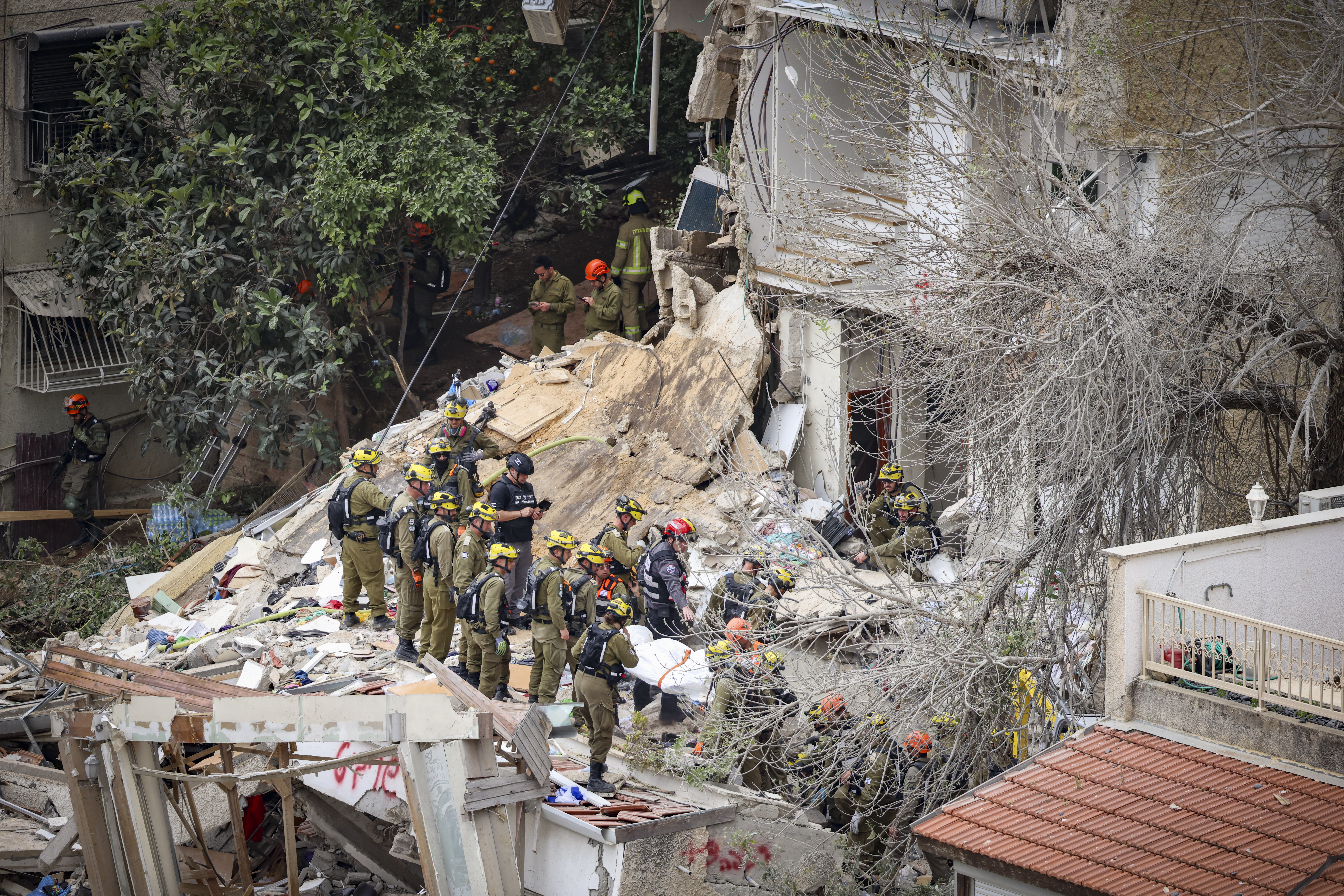
Israeli rescue forces recover bodies at the scene where a missile fired from Iran struck a building in Haifa on April 6, 2026.




 Add EJP on Google
Israeli search-and-rescue workers pulled four bodies — a couple in their 80s, their son in his 40s and a woman in her mid-30s — from the rubble of a building in the northern port city of Haifa this morning after it was struck by an Iranian missile, Magen David Adom medics said.
Initial reports indicate that the four people had taken shelter in the six-story building’s stairwell when the air-raid sirens sounded, unable to make it to the public shelter nearby due to the couple’s age. In addition, an 82-year-old resident of the building was seriously injured by debris, and a 77-year-old woman, a 38-year-old woman and a 10-month-old baby were all lightly wounded by shrapnel, according to MDA, which took them to local hospitals for treatment. Other residents of the building, who were able to get to the shelter, did not sustain significant injuries.
The devastating strike, which largely destroyed the building despite the missile’s warhead apparently not detonating, yet again highlighted the importance of bomb shelters and the deadly cost that comes from people not being able to reach them, particularly those who are elderly or disabled.
During the first Iran war last June, I wrote about Yosef, one of the tens, possibly hundreds, of thousands of Israelis with disabilities who are estimated to be living in homes without an accessible bomb shelter. Living in a fourth-floor apartment with no elevator that was built before fortified rooms were required, Yosef, who has one leg and uses a wheelchair, has nowhere to go when the air-raid sirens sound.
Nearly a year — and dozens of sirens — later, little has changed, neither for Yosef nor for the thousands of other Israelis in the same situation, despite efforts by Israeli civil society to raise awareness about the issue and to push the government to address it.
As the war against Iran and Hezbollah enters its sixth week, and missiles and rockets continue to rain down on Israeli cities and towns, organizations that advocate for people with disabilities are calling for the government to address this long-standing issue.
“In every attack, every round of fighting, every war, the number of people with disabilities who are wounded is above their representation in the population because they are the most vulnerable — like the couple today [in Haifa] and the carer who was killed in Tel Aviv [on the first day of the war] because she stayed with her client,” Idit Saragusti, the director of policy implementation at the disability advocacy nonprofit BiZchut, told eJewishPhilanthropy today. “The problem has been known for years and years and years.”
Throughout the war, the Knesset has held multiple committee hearings on the subject, though these have yet to lead to substantive changes on the ground.
“For years, we have been asking [for help], and yet no formal plan to address this issue has been created,” Yuval Wagner, the founder and chair of the disability nonprofit Accessibility Israel, said in such a Knesset hearing last month.
“Most of the solutions that are put forward are appropriate for people with light disabilities,” he said, referring to municipal plans to move people with mobility issues permanently into public shelters. “People with severe disabilities can’t sleep on camping cots without their medical aids. Give us a good recommendation for how to solve this problem immediately, in an organized and properly managed way — and, of course, for the long term.”
As is often the case, the issue can be traced to arguments over who is responsible for addressing it. In Israel, the Welfare Ministry is largely tasked with supporting Israelis with disabilities. While the ministry acknowledges its responsibility to ensure access to bomb shelters for people living in the facilities it oversees, it does not believe that it must do so for Israelis with disabilities who live at home or are otherwise not under its direct oversight. According to the ministry, providing accessible protection for that population is the responsibility of the local government, which is broadly responsible for building and maintaining public shelters.
The problem, of course, is funding. “The local governments don’t have the ability to do this alone. That is, unless they get the resources to address it,” Saragusti said.
In some cases, the Welfare Ministry has intervened, she noted, but only rarely. “They have evacuated something like 200 people, which is a joke compared to the scope of the problem,” she said. (In a Knesset hearing on March 17, the Welfare Ministry said it had evacuated 267 people.)
Even as many activists push for the government to offer relocation for people with disabilities who don’t have access to a bomb shelter, many people in that situation are not interested in that option, preferring to stay in their own homes, particularly as the war grinds on for weeks on end. Still, Wagner said in the Knesset, evacuation is the only viable solution for people who are bed-ridden or don’t have a carer.
Saragusti and BiZchut hope to address the issue by handing responsibility for it over to the military by creating the position of a “community supporter in times of emergency” — a role that would be filled by a reservist from the Israel Defense Forces’ Home Front Command — who would be specifically tasked with providing support to people with disabilities and other vulnerable populations within their municipality.
A major problem, Saragusti noted, is that there is no up-to-date database with information on every person with a disability, which can “make the problem seem impossible to address.” A common statistic that is used to discuss the problem — that 800,000 people with disabilities do not have access to a bomb shelter — is based on a finding by the State Comptroller’s Office, which Saragusti says is surely an exaggeration, failing to include access to public shelters and other alternatives besides an in-house fortified room. An older couple without a fortified room in their home could, for instance, move in with one of their adult children who does have one. Better data could make the problem far more manageable, she said.
Saragusti and BiZchut pin much of their hope on a 2005 amendment to Israel’s Equal Rights for Persons with Disabilities Law that included provisions ensuring the right to public services, such as security. Though the law was passed more than 20 years ago, the national security regulations were never written by the Defense Ministry, Saragusti said. In recent months, the Knesset had begun deliberations on the subject, but these were put on hold when the parliament went on recess last month.
Saragusti noted that even if the regulations were written, they likely would not go into effect immediately. They could, however, be used to create a framework that could be quickly implemented, she said.“After Passover, the Knesset will hopefully get back to it,” she said.