HOLOCAUST EDUCATION
Yad Vashem to open Munich center, focusing on Holocaust’s victims lives
New education facility — the institution’s first outside of Israel — is designed to complement Germany’s current focus on its responsibility as perpetrator of the genocide
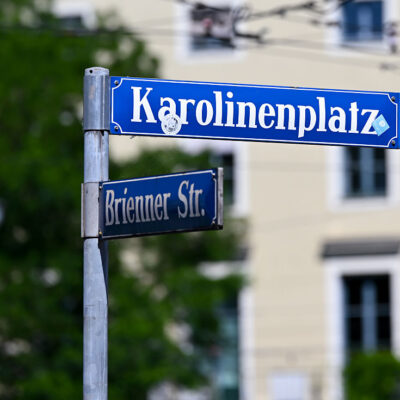
Sven Hoppe/picture alliance via Getty Images
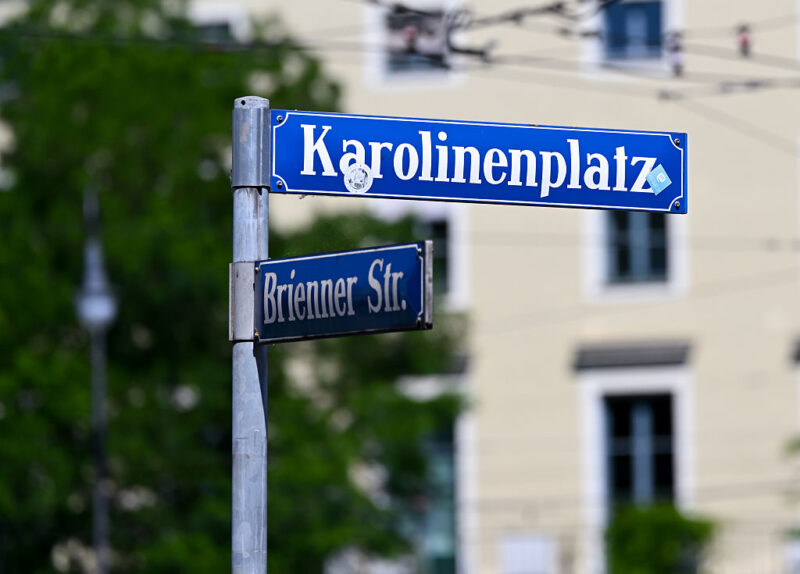
A sign with the inscription 'Karolinenplatz,' indicating the area in Munich where an educational center of the Israeli Holocaust memorial Yad Vashem is to be built.




 Add EJP on Google
Yad Vashem, the World Holocaust Remembrance Center, is set to open a new educational center in Munich, with support from the German government. At a time of rising antisemitism, the initiative aims to deepen Holocaust education by providing a unique Jewish and victim-centric perspective, complementing Germany’s existing focus on perpetrator responsibility.
Located in central Munich’s Karolinenplatz and slated to open in three years, the education center will be Yad Vashem’s first outside Israel.
The idea originated during Yad Vashem Chairman Dani Dayan’s first trip to Germany in 2023, when he met then-Chancellor Olaf Scholz and proposed the concept. Yad Vashem already has extensive cooperation with Germany’s 16 federal states, but recognized an opportunity to bring its distinct approach, Noa Mkayton, director of Yad Vashem’s overseas education and training department, International Institute for Holocaust Education told eJewishPhilanthropy.
Since Germany was a perpetrator of the Holocaust, Shoah education in the country centers mainly on how such a thing can happen, how a democracy can become a dictatorship and how people can lose their moral compass within a few years. The new center, however, will focus on the Jewish perspective, emphasizing the experiences, choices and agency of Jewish victims, fostering empathy rather than pity, she said.
“These are questions from Germany having the headline, ‘never again a perpetrator,’ which is totally understandable,” she said. But “Yad Vashem actually has the focus on the victim’s perspective, on the Jewish perspective. How did they experience, what were their choices … although they did not have choices? What is the agency of Jews during and even before, of course, and after the Holocaust? How can we teach the Holocaust in a way that actually arouses sympathy and empathy for the Jews? We don’t want this pitiful view of this skeleton that you see in liberation. We really want to try to ask the question, ‘Who was this person?’ So this is one thing that we very strongly bring into the picture.”
In another response to the rising antisemitism, the center will implement target group-oriented teaching, starting earlier than the ninth grade, Mkayton said. By portraying the Holocaust through individual human stories and primary resources such as testimonies and diaries written by young Jews, the goal is to cultivate an empathetic, open-minded attitude among learners, aiming to prevent and combat the hatred of Jews from an early age, she said. Some partners in Germany have been open to that approach, while some less so, she said.
“We really want to create something that would offer a low-key entrance to the topic. It doesn’t have to be this very long, very dark, very traumatizing story. It should be something where you always also keep the learner emotionally safe.
You would never ever, for example, promote educational activities where the learner is forced into the identity of, to jump into the shoes of, feel like [victims] felt. We don’t want that. We want him to feel like he is who he is and we want to offer him empathic entry points into the story.”
The center will also provide training and discussions for teachers, preparing groups for visits to Yad Vashem in Jerusalem, which will remain the central hub, she said.
In addition, the center will contribute a transnational perspective to Holocaust education in Germany by broadening understanding beyond local German sites to encompass the Holocaust’s widespread impact across Europe and North Africa, she said. This will help learners understand the broader historical context and contemporary Europe they are living in, she said.
Professor Judy Baumel-Schwartz, director of Bar-Ilan University’s Arnold Finkler Institute of Holocaust Research, noted the importance of dealing with the culpability of the European people and governments for their role in the Holocaust when setting up an Holocaust education center in Europe.
“One can’t shuck it off and say ‘it was almost a century ago’ and ‘things are different today.’ The Holocaust is based on human emotions of fear, hate, political manipulations, terror and military dictatorship. Those haven’t changed,” said Baumel-Schwartz, who has no connection with the new Yad Vashem educational center. “The Holocaust was based on 2,000 years of anti-Jewish sentiment, murder of Jews, vilifying Jews over that period, making them the traditional scapegoat for any problem arising. That has to be taught — meaning the long-term historical background and not just what happened in Germany between 1933-1945. It was a 12-year period based on 2,000 years of hatred of Jews.”
The overall budget for establishing the center is approximately €20 million ($23.3 million), while the annual operating budget is estimated at €5 million ($5.8 million), Yad Vashem told eJP, without naming sources of the funding.
In a statement, Dayan said the choice of Munich, the birthplace of the Nazi Party, carries a “deep symbolic significance,” reflecting the importance of confronting the history of the Shoah where it began.
“As we move further from the era of living survivor testimony, historically grounded Holocaust education is more important than ever. Through this Education Center, Yad Vashem will bring to Germany its unique educational approach at a critical juncture of growing Holocaust distortion, denial, and antisemitism,” Dayan said. “Working together with our German partners, this center will help ensure that the truth of the Holocaust is preserved and passed on to future generations.”
Yad Vashem also announced its readiness to establish an extension of its Education Center in Leipzig, Saxony. The center will include interactive learning spaces and serve educators across the region as well as neighboring countries. In addition, Yad Vashem plans to expand its long-standing educational partnership with North Rhine-Westphalia, launching a process to develop the Yad Vashem Holocaust Education Center into a model for nationwide cooperation.
The center has been endorsed by Chancellor Friedrich Merz; Karin Prien, the federal education minister and federal and state leadership, according to the Yad Vashem statement.
Prien said the education center will aim to strengthen Holocaust education and combat antisemitism in Germany and across Europe.
“Knowledge of the past is essential to preventing such evil in the future. Many young people in Germany still know too little about the Shoah — the systematic murder of millions of Jews under National Socialism,” Prien said.
She said that Yad Vashem’s educational expertise will not only help convey the perspective of the victims of the Shoah “more effectively through innovative formats” but will also train educators nationwide.
The German federal government will continue to support the establishment of the center and provide legal and organizational assistance, she said. In addition, pilot projects are being funded to enable the educational center to have an immediate impact.
In interviews to German press, Meron Mendel, an Israeli-German social scientist and director of the Anne Frank Education Centre in Frankfurt/Main, expressed concerns about the establishment of the new center, citing what he said was ties to the Israeli government and arguing that it could be influenced by the right-wing government. Criticism for the center also came from Jens-Christian Wagner, director of the Buchenwald and Mittelbau-Dora Memorial Foundation. Both men questioned why partnerships with existing German institutions, which might have been preferable, were not explored.
In a response provided to Kan news, Dayan dismissed the comments as “nonsense.”
“Yad Vashem is not a governmental institution, but rather a state institution. It belongs to the State of Israel and the [Jewish People] — including its victims and survivors — and is completely independent. This has been proven in practice on countless occasions. The reputation of Yad Vashem as the world’s leading institution on Holocaust remembrance — including the educational field in which the center will operate — does not need validation from Mr. Mendel,” Dayan said.
Mkayton told eJP that she expected that there would be more debates about the center in Germany’s “vivid and active” memorial landscape with its myriad of voices and opinions.
“There will be topics and there will be debates and there will be a discussion, that is clear to me,” she said. “But I am actually positive that this will be an enriching step still.”
Related News

MAGICAL EXPERIENCE
Shefa launches psychedelics retreat for Jewish professionals suffering burnout
ADVANCING A VISION
N.Y. federation donates $1M toward building shared-society center named for peace activist killed on 10/7
HIGHER EDUCATION
As Jewish donors reconsider academia, Jan Koum doubles down, endowing Israel studies at Stanford
EXIT INTERVIEW
Elizabeth Sokolsky, longtime EVP of Birthright Israel, to retire next year
PRESIDENTIAL REBUKE
Israel’s Herzog: Mamdani ‘makes no effort’ to hide disdain for Israel, Jews must fight back