Opinion
NORTHERN EXPOSURE
The story of Canadian Jewry: middle powers, small communities, big impact




 Add EJP on Google
When Mark Carney spoke at Davos in January about the role of “middle powers,” he offered a useful reframing of influence. Countries like Canada, he argued, are not defined by overwhelming size or hard power alone, but by their geopolitical positioning. Their ability to shape world affairs comes from the unique perspective, relationships and values they bring to the table.
Though Carney was speaking about geopolitics, the same idea applies to Canadian Jewry, particularly to its smaller communities. Too often, public discourse around Jewish life in North America is reduced to that of Jewish communities in the U.S., and Canada’s unique place in the story of North American Jewry is unfortunately often lost; and when Canada’s story is told, it is typically solely through its largest population centers, Toronto and Montreal. It is long past time we acknowledge that this narrative is incomplete. If we want to understand the Canadian Jewish story in its full breadth and depth, its significance to the larger North American Jewish conversation and where Canadian Jewish life is headed, we need to look beyond its largest hubs and toward its smaller communities.
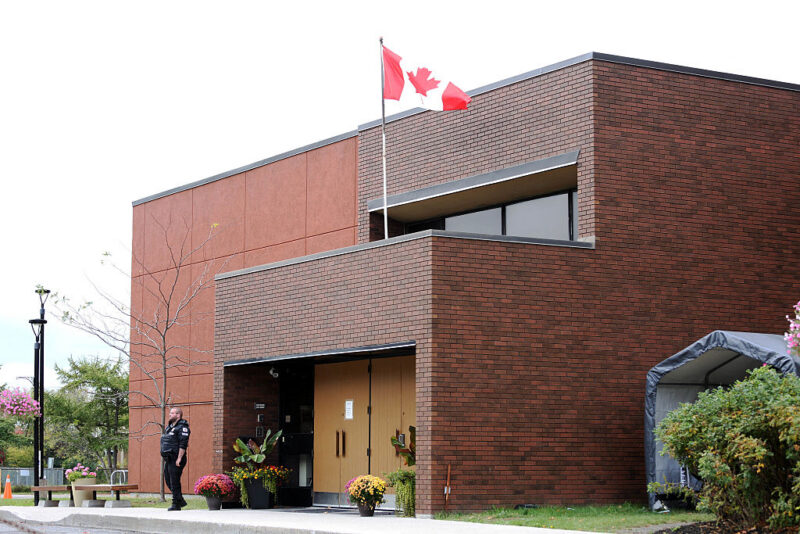
Dave Chan/AFP via Getty Images
A security guard stands outside the front door of Machzikei Hadas synagogue on Oct. 8, 2023 in Ottawa, Canada.
Though their story often goes untold, more than a quarter of Canadian Jews live outside Toronto and Montreal, in cities like Calgary, Edmonton, Winnipeg, Hamilton, Ottawa and Vancouver. These small but mighty communities are often treated as smaller versions of larger ones, defined more by what they lack than for their uniqueness and contributions. While it is true that they have fewer Jewish institutions, resources and people compared with Canada’s major cities, this framing misses something essential: These are not scaled-down replicas; rather, they are structurally different ecosystems with both distinct challenges and strengths.
Recognizing both the needs and the potential of these communities, the Shalom Hartman Institute of Canada partnered with four Canadian foundations — the Ronald S. Roadburg Foundation, the Azrieli Foundation, the Morris and Rosalind Goodman Family Foundation and the Asper Foundation — to launch the Courageous Leadership Canada Initiative in 2024. The initiative brought together lay and professional leaders from small and mid-sized Jewish communities to study, reflect and collaborate around the core questions shaping Jewish life today. While the program was designed to strengthen leadership pipelines and establish networks among its small community leaders, it also revealed that these small communities are not peripheral to the Canadian Jewish story — they are essential to understanding it.
What did we learn? Three core insights emerged from our work.
First, smaller Jewish communities face unique challenges that larger communities do not. For instance, they face the pressure of sustaining institutions with fewer people and fewer financial resources. They must also deal with leadership gaps due to a smaller pool of prospective leaders from which to draw. Their limited scale also means they often have difficulty maintaining inclusive, diverse Jewish life. Smaller communities are also frequently overlooked by the larger Canadian Jewish communal ecosystem, creating feelings of marginalization. Vast geographic separation between small communities (and between small and large ones) make it even more challenging to promote intercommunal collaboration. These challenges are compounded by broader issues facing Canadian Jewry — from rising rates of antisemitism since Oct. 7, 2023 and communal fractures due to differing perspectives on the war, to a growing sense of abandonment by Canadian civil society. These challenges impact all Canadian Jews, and small communities in particular struggle to confront them on their own.
Second, representation in the broader Canadian Jewish communal ecosystem matters. For many leaders in smaller communities, one of the most powerful aspects of this work has been the experience of being seen. It has allowed them to recognize that they are part of a broader Canadian Jewish story. This absence of representation is also an absence of recognition; many participants in our program expressed feeling isolated, even lonely, in their roles, given their sense of disconnectedness from the larger national community. This is on top of the isolation they already experience as part of the small network of Jewish leaders in their community. That gap has practical consequences. When leaders see themselves as participants in a national ecosystem rather than as isolated actors, they begin to act differently. They launch cross-community collaborations, join national conversations and contribute ideas with greater confidence. For instance, one participant was inspired to consider how to better connect Jewish professionals from across the country, and others shared that the program enabled them to be more confident to bring challenging issues and questions to their own work. Representation in this sense is not merely symbolic; it shapes who participates, who leads and what becomes possible.
Third, constraints drive innovation. Smaller communities operate with tighter resources and fewer institutions; the silver lining however is that these constraints often produce more adaptive and collaborative leadership models. The Jewish Federations of Edmonton and Calgary have collaborated to support both advocacy and security with shared funding that has come from external partners including the Alberta government. Additionally, as a part of the Courageous Canada Initiative, leaders from the Calgary cohort in collaboration with Calgary Jewish Federation put together a community town hall with the goal of strengthening Jewish community inter-agency communication and relationships, which brought together nearly all the Jewish agencies in Calgary, many of which had not worked together before.
The same spirit is reflected in the funding model behind this work. Multiple foundations chose to collaborate rather than operate independently, pooling resources to support communities that require aligned strategy rather than fragmented investment. What emerges in smaller communities is a form of leadership that is more relational, more flexible and often more resilient than the models found in larger centers. In some cases, such as in Vancouver, communities across denominations share infrastructure — from a shared mikvah to pluralistic Jewish schools — highlighting their ability to collaborate across differences and pool resources based on shared priorities and commitments to the community.
A fourth takeaway was the need to navigate questions around communal boundaries. Participants shared insights about the fragility of Jewish identity, about the tensions they frequently encounter between Jewish principles and the need to be pragmatic given their size and limited resources and about the challenge of sustaining a commitment to pluralism while maintaining meaningful boundaries. Many participants expressed the sentiment that, as members of small communities, they frequently feel the need to protect their boundaries to maintain a sense of communal cohesion; yet through engaging with new ideas and frameworks offered through the program, many began to also recognize the importance of engaging with diverse ideas and stretching the bounds of what they might typically consider acceptable. As one participant put it, the work requires “thinking more about what I am prepared to tolerate versus condemn…and being open to understanding, even when it is uncomfortable.”
Finally, part of what makes these insights particularly important is that Canadian Jewish identity and Canadian Jewish leadership is distinct. Unlike in the United States, there is no Canadian-specific seminary or training pipeline for Jewish communal leaders. Many leaders are Canadian-born or part of the wave of Jewish immigration from places like South America or Israel. They often adapt frameworks specific to other contexts that don’t account for Canadian specificity, and without fully considering how they fit within the Canadian context. Yet Canadian Jewry is shaped by its own unique influences of bilingualism, strong ties to Israel and a broader national ethos influenced by multiculturalism and indigenous reconciliation — as well as a more recent emergence of patriotism in reaction to Trump’s annexationist rhetoric. Canadian Jewry is not simply “a decade behind” American Jewry, as it is often misunderstood to be. Instead, it is on a different trajectory: one uniquely its own, and that can only be understood on its own terms.
If Canadian Jewry is to understand itself, Canadian Jews must recognize the full scope of our own story. As we Canadian Jews think more seriously about our distinct sense of Canadian Jewish identity, it’s also important that Americans begin more intentionally considering the uniqueness of the Canadian lens within the broader North American landscape, to gain a fuller picture of North American Jewish life. To successfully do so, we should look not just to Canada’s largest centers but also beyond, and take seriously the insights emerging from its smaller ones.
Middle powers matter. So do small communities. Their influence lies not in their size, but in what they reveal, what they test and what they make possible for the rest of us.
Karen Kollins is the director of the Shalom Hartman Institute of Canada.