Opinion
STEPPING UP
From Berlin to the global rabbinate: Leading in the age of Rabbi Google




 Add EJP on Google
When I first walked into the Jewish Theological Seminary, the center of learning for Conservative/Masorti Judaism, more than three decades ago, I was simply curious.
Conservative/Masorti Judaism did not exist in my native Germany, even though it traces its roots to 19th century German rabbi Zacharias Frankel. I had only a vague sense that it might become relevant for me. I never imagined that this first step would eventually lead me to become president of the Conservative/Masorti Movement’s Rabbinical Assembly — a role I assumed last month — and to bring my own perspective as a German Jew to that work.
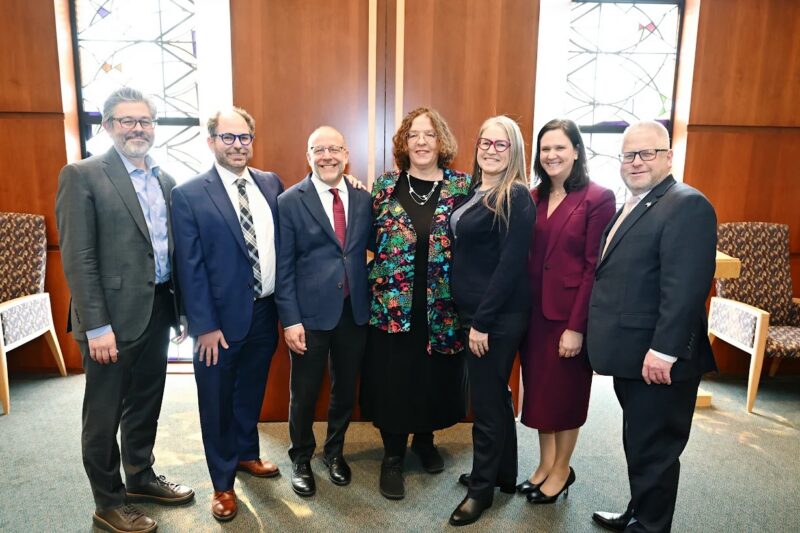
Courtesy
Rabbi Gesa Ederberg (center) with other leaders of the Conservative/Masorti movement's Rabbinical Assembly at an installation ceremony at Congregation Beth Sholom in New Jersey on March 10, 2026.
Yet even in those early days, something captured my imagination.
Living in the dorms at JTS and sitting in Midrash classes, I saw people davening three times a day, passionately engaged in Jewish learning and invested in living a halachic life in the modern world. It felt like I was in an ongoing conversation with earlier generations of rabbis, studying the past in order to build the future.
I remember thinking: This is the kind of Judaism I want to bring back to Germany.
And in many ways, that is exactly what I have done as a rabbi and community builder, co-creating spaces where being Jewish is both meaningful and joyful, rooted in tradition while fully engaged with the world around us: a bilingual nursery school; the Jewish International School – Masorti Grundschule; the community at Oranienburger Strasse Synagogue; and spaces where sincere dialogue and encounter between people of all religious backgrounds can take place.
That journey — from Germany to the United States and back again, with four years of studying and starting a family in Israel — has also shaped my understanding of Conservative/Masorti Judaism and the role our rabbis can play in Jewish life today.
Nearly 1,700 Conservative rabbis lead congregations, schools, institutions and organizations that reflect the extraordinary diversity of Jewish life across continents. From Berlin to Jerusalem to Buenos Aires and New York, our communities are connected not only by shared tradition but by shared questions about what Jewish life should look like in a rapidly changing world.
That global perspective matters more than ever, in an age when “Rabbi Google” — and now “Rabbi AI” — can provide instant answers to almost any question. Information is everywhere, but information alone does not create meaning, community or moral clarity.
That remains the work of rabbis.
Jewish communities today face challenges that transcend borders: rising antisemitism, difficult debates about Israel and Jewish identity and the rapid pace of technological and cultural change.
In this environment, rabbis are called not simply to provide answers but to guide conversations, but to help people wrestle with enduring questions of Jewish law, ethics and identity. We help translate ancient wisdom into contemporary life. We accompany individuals and communities through moments of celebration, struggle and transformation.
For me, this work has always been shaped by a global perspective. As a rabbi serving Jewish communities in Germany, I have seen firsthand how Jewish life continues to rebuild, evolve and reconnect across borders. The conversations taking place in one community increasingly resonate in others. I feel a special obligation in that dynamic, as the first female pulpit rabbi in Berlin since Regina Jonas, who was ordained in 1935 and murdered in the Holocaust.
This moment is precisely where the Conservative/Masorti movement offers something essential to the Jewish world.
Our tradition insists that Jewish life is grounded in halacha, Jewish law, while also recognizing that interpretation and engagement with modern life are part of the ongoing rabbinic conversation. We are deeply rooted in tradition while remaining intellectually honest and open to new realities.
That balance between continuity and change is not always simple. But it is precisely what makes Conservative/Masorti Judaism so vital today.
Across the world, our rabbis are helping their communities navigate questions that earlier generations could scarcely have imagined, while still grounding those conversations in the wisdom of Jewish tradition.
My own journey — from that first day at JTS to serving Jewish communities in Germany and now helping to care for and connect Conservative/Masorti rabbis worldwide — has reinforced one thing for me: The future of Jewish life depends on strong, thoughtful and connected rabbinic voices across communities, across continents and across generations.
Rabbi Gesa Ederberg is the president of the Rabbinical Assembly of the Conservative/Masorti movement.