Opinion
FOLLOW THEIR LEAD
What Jewish representation in textbooks can learn from Black history education




 Add EJP on Google
The impression one gets of Jews from the textbooks and other curricular materials in public school classrooms is, to put it simply, underwhelming — and that’s due in large part to the incompleteness of Jewish representation.
Let’s start with a thought experiment to demonstrate:
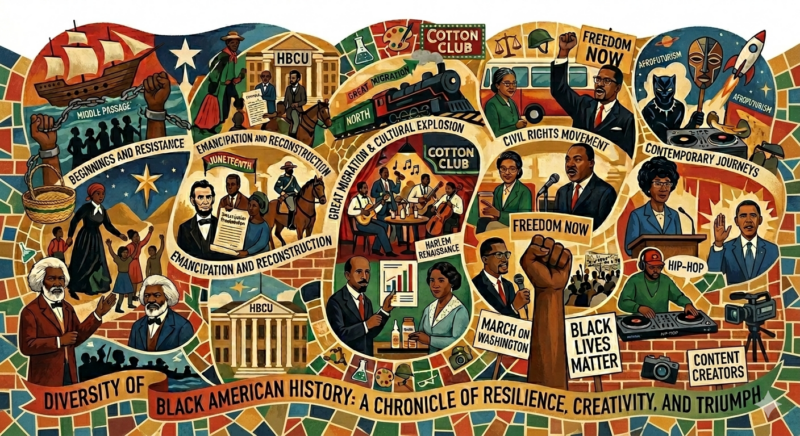
Generated by Gemini
Illustration representing key events and subjects in Black American history.
You’re a suburban public school student who has had little to no contact with Jewish people thus far in your young life. School is the one reliable site to learn about all sorts of people: social studies classrooms abound with narratives of human experience and diversity. Your teachers have embraced multicultural approaches to teaching and learning, so your U.S. history classes feature African American, Indigenous and immigrant communities and your world history teachers have introduced you to the range of cultures and societies around the world. In the course of all that learning about the spectrum of humanity, however, Jewish people are rarely present; and when Jews are introduced, you’re learning about the ways they’ve been misperceived, mistreated and/or murdered. In fact, for the duration of your entire K-12 education the study of Jews becomes synonymous with the study of persecution.
By the end of these lessons, what do you actually know about Jewish people as they define themselves?
I’ll be the first person to stand up and proclaim the value of teaching and learning about antisemitism and the Holocaust. As someone who has spent years bringing such lessons to classrooms, I understand the intrinsic value and necessity of this work. Yet I also recognize and concede its limitations. When the history of persecution is the primary, if not only, formal educational context in which students encounter Jewish representation, those of us who produce curriculum, work with teachers and educate students are arresting the potential of Jewish representation in the classroom. We’re also formulating our approaches to education and Jewish representation in curriculum in ways that are out of touch with the current realities of social studies education.
In recent years, I’ve been deeply inspired by the work of Black scholars who are formulating innovative approaches to bringing Black history into classrooms in ways that are multifaceted, complex and, importantly, deeply grounded in humanity. LaGarrett J. King of the University of Buffalo has spent years developing a Teaching Black History Framework; I first encountered his work in a 2020 article, when his framework was still in an early stage of development.
Without appropriating the tenets of this framework, it is worth noting how King presents his model for teaching Black histories. First, it is not a list of topics, events, episodes or periods. He does not list the names of individuals or important dates; he does not simply say, “Teach about slavery, then the Jim Crow era, and then the Civil Rights Movement.” Such a model needlessly circumscribes the range of possibilities, minimizing teachers’ creativity, imagination and appreciation for the uncharted curricular possibilities they could adopt.
King begins his framework with the study of how Black people have been oppressed, but doesn’t end there. He continues to include Black agency, resistance and resilience. Black emotionality, in all its complexity, from joy to anger to hope. Black identities, defined in the plural, not the singular. Even without listing its principles exhaustively, we already see an emphasis on transcending the way Black people have been perceived and mistreated in favor of centering and underscoring the capacity for Black people to act, think, create, emote and embody complexity. This framework should inspire educators and curriculum developers focused on Jewish history to venture beyond exclusively focusing on the victimization of Jews.
We need a framework that orients the representation of Jewish history, people, culture and identity toward something more innovative, conceptual and inspiring. Such a framework must prioritize valuing of Jewish humanity and cannot let it be supplanted by the study of the history of inhumanity, dehumanization and persecution. Such tragedies must be taught, but not in isolation and not as the sum total of what public school students learn about Jews. A focus on Jewish humanity is a necessary vehicle to demystifying the complexity and vitality of Jewish peoplehood.
The global scope of Jewish culture and history must also be celebrated in a new framework. Jewish history is world history, and there is no reason why Jewish people are not present in this area of study. World history is overflowing with untapped potential: When we globalize Jewish stories in schools, we create more touchpoints and allow for more ongoing and repeated Jewish representation. Jewish identities, cultures, expressions and experiences are full of vitality. What it means to be Jewish is not static, fixed or unchanging. Students need to see Jewishness as evolving and fluid; this is its own anecdote to a multitude of inaccurate tropes.
Classrooms also need to emphasize the diversity of Jewish identities. Jewish people are not monolithic and the false impression students receive of Jewish people when they see a narrow slice of Jewish identities in curriculum has the effect of marginalizing, erasing, and misrepresenting so many Jewish people. The range of Jewish cultural, ethnic, linguistic, and other identities deserves to be considered in schools. Even without teaching directly about antisemitism, emphasizing Jewish diversity is a rebuttal of every trope that presents Jews in singular and essentialized terms.
Intercultural dialogue and intergroup relations between Jews and other communities should also be present in a new framework. Jewish vibrancy is, in part, a consequence of cross-pollination and exchange with other communities. Additionally, students should be exposed to these historical and contemporary tensions and questions around Jewish continuity and assimilation are entwined with the study of Jewish relations with other communities.
The need to expand and improve the representation of Jewish people in schools is too important for those of us invested in this work to simply double down on what we’ve done in the past. We need to create new vehicles for teaching and learning and tap into new sources of inspiration. A new framework must emphasize Jewish agency and include a multitude of Jewish voices, showcase and demonstrate Jewish creativity and contributions to world history and provide students with opportunities to learn about Jewish values.
Dan Osborn is the executive director of Project Mosaics, a 501(c)(3) education nonprofit whose mission is to expand the representation of Jewish people, history and culture in public and independent schools so all students may encounter the diversity and vibrancy of Jewish identities and experiences around the world.