MAJOR GIFTS
Center for Jewish History celebrates 25 years with a $25M matching grant
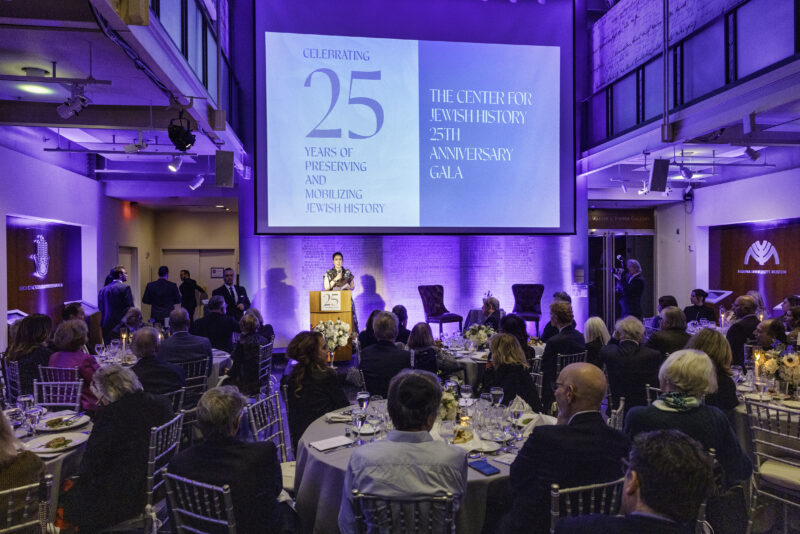
Courtesy/Center for Jewish History
“Celebrating 25 Years of Preserving and Mobilizing Jewish History,” the Center for Jewish History's 25th anniversary gala, was held at the institution’s headquarters in Chelsea on Dec. 9, 2025.




 Add EJP on Google
When the Center for Jewish History in New York City was formed 25 years ago, it was on shaky ground. Many in the Jewish world felt the five previously independent organizations — YIVO, the American Jewish Historical Society, the American Sephardi Federation, the Leo Baeck Institute and the Yeshiva University Museum — would be at each other’s throats as they joined together to form a larger, interconnected institution. Instead, it was a $30 million debt that nearly forced the center to shutter in the aughts.
Today, the center remains united, and that perseverance was celebrated at last night’s gala, titled “Celebrating 25 Years of Preserving and Mobilizing Jewish History,” which was held at the institution’s headquarters in Chelsea. The gala, which featured a conversation between historian Sir Simon Schama and author Dara Horn, took place the day before what would have been the 90th birthday of the center’s founding chairman — lawyer, businessman and philanthropist Bruce Slovin, who died in August.
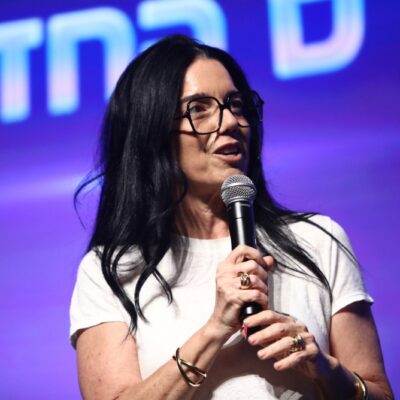
At the event, CEO Rio Daniel announced a $25 million matching grant that will help pave the next quarter century for the organization. The funds are a gift from couple Bill Ackman, a hedge fund manager, and Neri Oxman, an American Israeli designer. Several donors have already responded, pledging a total of $16 million.
The center, which Daniel referred to as “the Library of Congress for Jewish history and historical culture,” houses the second largest Holocaust collection in the world after Yad Vashem, and the second largest collection of Jewish history and culture after the National Library of Israel. This year, the center welcomed almost 300,000 visitors, nearly six times more visitors than in past years. The jump was attributable at least in part to “Anne Frank The Exhibition,” a full-scale recreation of the Frank family’s hiding place featuring 100 original collection items from the Anne Frank House in Amsterdam, including several never-before-exhibited artifacts.
“In my experience, you should allocate your philanthropic resources based on how important the cause is,” Ackman, who couldn’t attend the gala due to a prior engagement, said in a pretaped video shown at the event. Ackman, Oxman and their daughter have attended the Anne Frank exhibit, he added, which brought “history to life in a very powerful way.”
He credited his father, real estate entrepreneur Lawrence David Ackman, who died in 2022, for pushing him to do more for the Jewish community. “At [this] moment, what’s more important than preserving the history of the Jewish people?” he said in his speech.
The grant “is meant to give the center some incremental financial independence so we can actually do the kind of programming and bring people in and let creativity be the limitation for what it can do, as opposed to being budgetarily constrained,” Ackman continued. “The number of people that support the center is really, really important, and then the dollars matter too, and that’s why we’ve made this a challenge grant.”
The increased attention on the museum this year drew new and returning donors. The honorees at the gala, dubbed “Guardians of Jewish History,” included Amy Goldman Fowler, a former chair of the center and trustee of the Lillian Goldman Charitable Trust and the Amy P. Goldman Foundation; Michele Tocci, a center board member and president of the David Berg Foundation; and Shelby White, a center board member and founding trustee of the Leon Levy Foundation. Slovin was also honored at the event.
“There’s a reengagement process going on,” Gavriel Rosenfeld, the center’s president, told eJP about the return of past donors.
Since he and Daniel joined the organization three years ago, they’ve pushed it to be more public-facing, Rosenfeld said, seeking to tap into those who hadn’t yet experienced what the center has to offer. Past donors “see the revitalization, the new dynamism.”
The center’s location allows easy access to students from nearby colleges, including New York University and Fordham University, with which the center has close ties. Last January, the center opened a new bookstore and lobby to increase curb appeal. Connecting with colleges strengthens its popular fellowship program for a mix of early-, mid- and advanced-career scholars.
Fellows are like astronomers, Daniel remembered a donor telling her. “You have the stars — you have the archives — but unless you have an astronomer reviewing through a telescope and interpreting what’s in the sky, how do you really know what you have?”
The center has produced many touring exhibits over the past several years, including “Kindertransport: Rescuing Children on the Brink of War” and “Jews in Space: Members of the Tribe in Orbit.” Another donor pushed the center to take its “JewCE: The Museum and Laboratory of the Jewish Comics Experience” exhibit on the road; it concluded a long stay at the Capital Jewish Museum in Washington in March.
New initiatives include uplifting survivors’ stories by partnering with social media influencers, who will delve into their genealogy and explore the mysteries of relatives lost to their families due to the Shoah, thanks to a grant from the Claims Conference. A new semi-permanent exhibit, which is still in the planning phase, will focus on 3,000 years of Jewish history.
Rosenfeld views the center as being in its third phase of development: The first was bringing the nonprofits under one roof; the second was overcoming financial woes in the aughts thanks to a massive capital campaign, paying off its mortgage in 2011 and leaving the nonprofit debt free; and the third is building an endowment, which received a massive boost at the gala.
The grant secures the center’s future, Rosenfeld said: “That will put us in a position for the next quarter century to be able to be as mission-focused as we can be.”
“We owe so much more to Jewish culture, to do so much more, and that’s why we need an endowment,” added Daniel. “And an endowment isn’t a ‘Oh, great. We’ve done it. Let’s coast.’ The endowment is the start of the next phase of protecting Jewish history to make sure that truth is out there, because archives can exist but unless you’re interpreting them and making them accessible and [democratizing] information and all of that, then they languish. We need to fight against the evaporation of history and the languishing of history.”
Related News
PRESIDENTIAL REBUKE
Israel’s Herzog: Mamdani ‘makes no effort’ to hide disdain for Israel, Jews must fight back
ADVANCING A VISION
N.Y. federation donates $1M toward building shared-society center named for peace activist killed on 10/7
EXIT INTERVIEW
Elizabeth Sokolsky, longtime EVP of Birthright Israel, to retire next year
HIGHER EDUCATION
As Jewish donors reconsider academia, Jan Koum doubles down, endowing Israel studies at Stanford
CLOSING WORDS
In AZM address, Cosgrove links communal ‘orthodoxy’ on Israel to rising anti-Zionism among young Jews