GOING INTERNATIONAL
With fourth cohort, Atlanta-based Jewish Kids Groups solidifies North American expansion
The organization, which provides Jewish after-school care as an alternative to Hebrew schools, is opening in new locations in five U.S. states and Canada, with plans for more
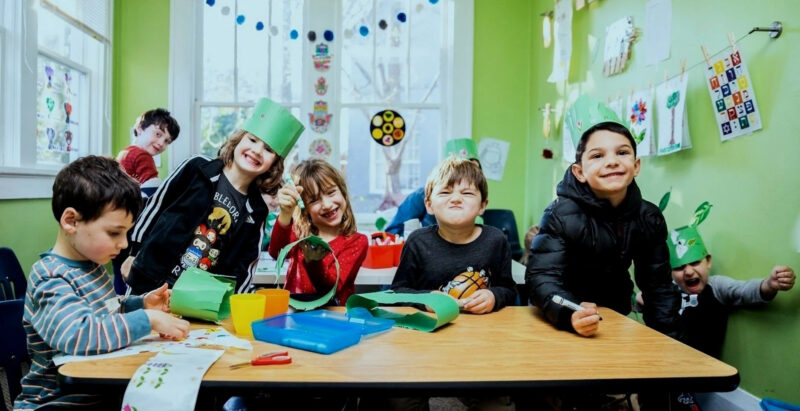
Courtesy/Jewish Kids Groups
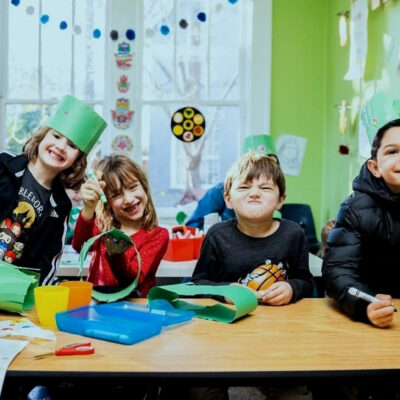
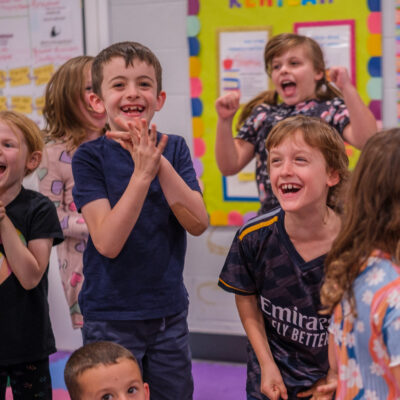
Children take part in a Jewish after-school program, in an undated photograph.




 Add EJP on Google
In the spring of 2023, Jewish Kids Groups, the Atlanta-based nonprofit that designs and implements Jewish after-school programming for elementary-aged children, took its first steps toward national expansion.
Recognizing both a gap in after-school support for Jewish families and communal ambivalence toward traditional supplementary Hebrew school models, the organization — focused locally since its founding in 2012 — launched the Jewish After School Accelerator to help synagogues, federations and other community organizations develop Jewish programming after school on weekdays.
Three years on, JKG has helped launch 20 new sites, which serve a total of 711 students. The latest cohort, announced last week, will add seven locations to that total beginning this fall, expanding the organization’s reach to Michigan, Florida, New York, California, Maryland and — for the first time — Canada. The organization is also accepting applications for a fifth cohort for the following school year.
According to Rachel Dobbs Schwartz, JKG’s chief innovation officer, the organization’s goal is to both expand “the pie” of Jewish families participating in some form of Jewish education — by building relationships with local schools and community organizations, attending PTA meetings, and engaging at community events — and establish “a new field” within Jewish education.
“There’s about a convoy of school buses — around 7,000 kids — exiting Jewish education on an annual basis,” Dobbs Schwartz told eJewishPhilanthropy. “Our goal is to try and stop that bleed by creating more options. We don’t want to subdivide the pie of people who are already engaged. What we want to do is engage the unengaged.”
Since 2023, JKG has provided its annual cohorts with a $100,000 matching grant, 10 months of hands-on pre-launch support and two years of mentorship through the accelerator program. Each year, the new after-school programs scale in participants, from 15 in the first year to 45 by the third. “This sort of slow build also allows for medium-sized organizations, smaller organizations to participate in this,” Dobbs Schwartz told eJP.
Inspired by services like the Harold Grinspoon Foundation’s PJ Library, which “naturally” incorporates Jewish education into families’ daily routines, the goal is to ultimately make the after-school model ubiquitous, said Dobbs Schwartz. “That adjacency service of giving someone something that they need, something that maybe they don’t even know that they want, but they do, has been sort of the magic in many different Jewish spaces across the country,” she said. “We see after-school [programs] in a very similar vein.”
According to Dobbs Schwartz, while the programming is designed to cater to a range of Jewish involvement — including both those who aren’t affiliated with a synagogue and those who “just can’t get enough Jewish” — it has specifically engaged a significant number of families that weren’t previously involved in synagogue life.
“We’re seeing growth in Jewish engagement of the family. We’re seeing knowledge growth. We’re seeing families feeling cared for, and families engaging in synagogue life in a different way than they had beforehand,” she told eJP. “Fifty percent of the students who enrolled in these programs have never set foot in the synagogue before.”
In 2013, when JKG was still exclusively in Atlanta, the organization received a $50,000 grant from the Marcus Foundation, Jay Kaiman, the foundation’s president, told eJP. The foundation has remained a significant supporter since, last year donating $2 million to the initiative. Several other funders in the Jewish world have supported JKG as well, including the Michael and Susan Dell Foundation, the Tepper Foundation and the Zalik Foundation.
“They put ‘cool’ into Hebrew School,” Kaiman told eJP. “It was obvious to Bernie that [JKG’s founder and CEO Ana Robbins] was right, that people don’t like Hebrew school for a lot of reasons, and if she could put ‘cool’ back into it, then we thought that was a good bet. And it was. It started out with just one location, and we wanted to see how it went. And [they’ve] taken it over the years and grown it and made it what I consider to be very successful.”
According to Kaiman, when JKG was first presented to the Marcus Foundation, the largest concerns were whether their proposed model would be widely adopted and if it would be viewed as competition within the Jewish education niche.
“They have not,” said Kaiman. “They’ve looked at it as enhanced value added to programs within their own communities. I do believe it’s a disruptor. But in this case, we really needed a disruptor.”
Related News
ADVANCING A VISION
N.Y. federation donates $1M toward building shared-society center named for peace activist killed on 10/7
HIGHER EDUCATION
As Jewish donors reconsider academia, Jan Koum doubles down, endowing Israel studies at Stanford

MAGICAL EXPERIENCE
Shefa launches psychedelics retreat for Jewish professionals suffering burnout
EXIT INTERVIEW
Elizabeth Sokolsky, longtime EVP of Birthright Israel, to retire next year
CLOSING WORDS
In AZM address, Cosgrove links communal ‘orthodoxy’ on Israel to rising anti-Zionism among young Jews