Opinion
LESSONS FROM THE FIELD
What the war in Ukraine is teaching Jewish philanthropy about sustained care




 Add EJP on Google
Jewish philanthropy is living through a period of sustained complexity: Global crises overlap rather than resolve. Emergencies stretch into years. Resources are finite, while moral responsibility feels anything but.
In this environment, philanthropy is being asked not only to respond generously but to adapt intelligently. How do we support urgent needs without losing sight of long-term vulnerability? How do we balance scale with flexibility, and infrastructure with human responsiveness?
Courtesy
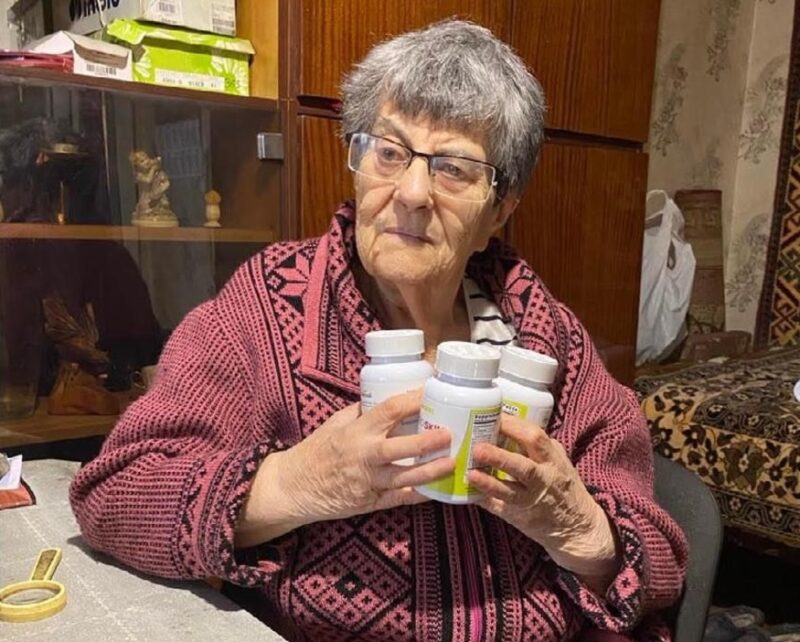
Lyudmila, one of the Jewish seniors assisted by Action for Post-Soviet Jewry in Ukraine.
Ukraine offers a powerful case study.
When war erupted in 2022, Jewish philanthropy mobilized with remarkable speed and generosity. Federations, foundations and individual donors acted decisively, saving lives and stabilizing communities. That response reflected one of our community’s greatest strengths and values: the ability to rise to the moment when history demands it and care for each other.
Today, the challenge in Ukraine is different. The crisis in the country has become chronic rather than acute, especially for the Jewish seniors living alone in frontline and near-frontline communities that Action for Post-Soviet Jewry (Action-PSJ) has cared for over the past 50 years. These are individuals for whom evacuation is not an option and “recovery” is an abstract concept. They are aging in place amid blackouts, inflation, disrupted services and deepening isolation.
The elderly living through this prolonged crisis are not only vulnerable recipients of care; they are also the keepers of Jewish identity in a region marked by some of the most persistent and violent forms of antisemitism in modern history. Many safeguarded Jewish life through the Holocaust’s aftermath, decades of Soviet repression and forced assimilation and the fragile years following the collapse of the USSR. Their presence sustained communal memory, ritual and belonging when open Jewish expression was often dangerous or forbidden.
The role of small legacy organizations
Large institutions play an indispensable role in Jewish philanthropy. They bring scale, visibility, infrastructure and long-term stability. They convene partners, mobilize significant capital and anchor communal response.
But prolonged crises also require nimble, relationship-based organizations. Often, small legacy groups like Action-PSJ, with decades of local trust, cultural fluency and the ability to pivot quickly as conditions change, are embedded in daily realities and can tailor responses in real time, especially when standard delivery mechanisms falter.
In Ukraine, that flexibility has become essential. For many elders living in apartment buildings, even leaving home carries risk: if an elevator stops during a blackout, someone with limited mobility can be stranded for hours. Medical clinics are often difficult or unsafe to reach, and when accessible, they must prioritize war-related injuries and acute emergencies over chronic conditions common among the elderly. Vouchers, while well-intentioned, are valid only at certain shops — often far from home and inaccessible when transportation is disrupted or power is out. Pharmacies may operate sporadically and pharmaceutical warehouses have been recent targets of Russia’s aggressions; payment systems also frequently fail during blackouts. Under these conditions, even thoughtfully designed aid can miss the narrow windows when help is actually usable.
These realities have pushed Action for Post-Soviet Jewry to rethink not whether to continue help, but how help must function when time, mobility and access are radically constrained.
One response that has proven especially effective is guaranteed, predictable cash assistance paired intentionally with wraparound services such as telehealth, care coordination and trusted local support.
Cash assistance restores dignity and choice. It allows a senior to buy medication during a brief window when a pharmacy is open, have cash to use at the corner store during a blackout or cover transportation when public options fail. It enables people to address their own aid gaps rather than conform to predetermined ones.
Importantly, guaranteed cash assistance is not a philosophy replacing traditional care models. It is one tool in a diversified humanitarian portfolio that works best when paired with infrastructure, professional services, and deep relationships. Cash alone is insufficient; cash within an ecosystem of care can be transformative.
This is where the complementary strengths of Jewish philanthropy matter most. Large institutions provide stability and scale. Smaller organizations contribute flexibility, trust and innovation. Together, they form an ecosystem capable of responding to emergencies and to prolonged vulnerability.
Lessons beyond Ukraine
The experience of supporting Jewish seniors in Ukraine is not only about fulfilling an enduring moral obligation, although there is certainly that. It is also an opportunity for Jewish philanthropy to reflect on how we design systems of care that remain responsive under sustained strain.
Ukraine is teaching us how to combine flexible financial support with high-touch human connection; how to listen closely to those we serve; and how to adapt responsibly without abandoning structure or accountability. These lessons have relevance far beyond one geographic context. They apply to elder care, to marginalized communities and to any context where dignity, choice and continuity must be preserved under pressure.
Jewish life and philanthropy thrives when it embraces pluralism — of traditions, of institutions and of ways to show care. As we navigate overlapping global and communal challenges, Ukraine remains a place where that pluralism is being tested in real time. It reminds us that philanthropic success is not measured only by how quickly we respond to emergencies, but by how thoughtfully we sustain care once urgency fades.
The question before us is not whether we can afford to stay engaged, but what kind of philanthropic ecosystem we want to build when crisis becomes the long horizon rather than the passing storm.
Debbie Kardon serves as the executive director of Action for Post-Soviet Jewry (Action-PSJ), a Boston-based nonprofit that has spent 50 years meeting the critical aid gap for Jewish seniors across the former Soviet Union. Through its Ukrainian-run NGO, Action for Ukraine (AFU), Action-PSJ provides guaranteed cash assistance, medical coordination, and wrap-around humanitarian support to seniors living through the war.