Opinion
POTENT FORCES
‘We’ll always have day school’: The relationship between Jewish nostalgia and Jewish fluency




 Add EJP on Google
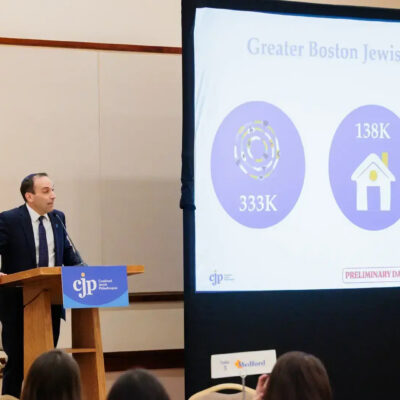
I first pondered the term “Jewish fluency” after I watched writer and podcaster Dan Senor’s 45th annual State of World Jewry address in May. I presently serve as board chair at Sinai Akiba Academy in Los Angeles, and as the video of Senor’s speech made its way around our school board and school community, the word “fluency” struck a chord as a non-native English speaker.
Like most people with ties to Jewish day schools, I was pleased to hear Senor’s specific comments about Jewish day schools, namely that they are vital for building “Jewish muscle memory” and creating a strong sense of Jewish community and pride. While I couldn’t agree more with his strong support for Jewish day schools, I think that the future of these institutions, particularly those affiliated with the Conservative movement in the United States, rests not only on this idea of Jewish fluency but also on Jewish nostalgia. To preserve Jewish fluency, we need Jewish nostalgia; at the same time, Jewish nostalgia can only take us so far without Jewish fluency.

Ashok Sinha/Adobe Stock
Illustrative.
Feelings of nostalgia have always had a strong pull on me and have no doubt shaped core aspects of my personality. My nostalgia is made up of memories and experiences that include moving to the United States from Budapest when I was five years old; being the granddaughter of Holocaust survivors; and growing up in a Conservative Jewish synagogue community in Pasadena, Calif.
I also think that nostalgia can encompass a sense of disappointment about experiences and memories I didn’t have, but that I knew existed and wish I could have. We have a great word for this feeling in Hungarian, which unfortunately doesn’t have a direct translation in English. That’s why I would say I have nostalgic feelings about Jewish education and knowledge — resources I couldn’t fully access as a child — as well.
While I somehow blocked out the entire process of learning how to speak English in the first few months after we moved to the United States, I can instantly tap into the joyful memories of experiencing all the hope, confusion and excitement of being a pre-teen and teenager against the backdrop of my synagogue and Jewish community. I want my children to have all the Jewish experiences I didn’t have and would not have had in communist Hungary, as well as all the formative Jewish experiences I did have at the Pasadena Jewish Temple and Center (my synagogue growing up), through BBYO (my Jewish youth group in high school), the JDC-Lauder International Jewish Youth Camp (my summer camp throughout middle school and high school in Hungary), and at Brandeis University (my undergraduate alma mater).
I want to watch my daughter and two sons experience all these things in the present and I hope and pray that one day, they will be able to tap into their own memories and feel the same sense of joy and comfort I do when I recall my memories; but I also want my children to have a level of Jewish muscle memory that far exceeds what I have because I did not attend a Jewish day school. To be clear, I did have a wonderful Hebrew school experience, and a bat mitzvah that my mother, aunts, cousins and grandmothers in Hungary could only dream of. I even went through my synagogue’s confirmation program in high school. Still, I would be remiss if I said that I have strong Jewish fluency. My husband sometimes teases me that I now speak English fluently (more or less), but my lack of Jewish fluency has never completely gone away and is still a source of self-consciousness. I want my children to have Jewish knowledge that will arm them on their journey to becoming strong, resilient and proud Jewish adults. I want them to develop the sort of intellect that supports them and gives them identity and confidence in adulthood no matter where they end up in life or in the world. I want them to possess a kind of instant command of the facts and traditions without needing to use Google (something that I know all too well).
So, it was my nostalgia paired with my husband’s experience growing up in a Conservative Jewish day school and synagogue in Tucson, Ariz., coupled with our combined goal and shared value of giving our children a solid Jewish education, that led to our decision to send our children to Jewish day school. In 2018 we joined Sinai Temple —the first and oldest Conservative Jewish congregation in Southern California — and have sent our three children to Sinai Akiba Academy — the first non-Orthodox Jewish day school on the West Coast — ever since. These institutions quickly and easily made us feel at home and safe as Jews and ultimately have satisfied our desire to create a similar Jewish community, education and nostalgia for our children.
My husband can relate to the daily aspects of our children’s Jewish education, including daily tefillot, the Judaic studies curriculum and Hebrew homework that my children are more than happy to remind me I cannot help them with. Meanwhile, I relate more to the more social aspects of school life.
Unlike my husband and myself, my parents never contemplated Jewish day school for my education. With no formal Jewish education of their own but a strong dose of Jewish nostalgia (that Hungarian, I-missed-out kind), my parents never fully felt comfortable in certain Jewish settings. Many people will likely understand when I say that my family sat in the cheap seats during the High Holy Days. My parents sat, literally and figuratively, in a place where they didn’t have to face all the things they didn’t know about Judaism or Jewish traditions — all the things that their Jewish nostalgia really couldn’t make up for.
A few weeks before my dad passed away, he asked me a question about what I valued in life. It was a little heavy, but since I knew time was short and that he knew innately about all the things I could easily list off, I decided to share something I probably hadn’t even yet concretely formulated for myself. I told him — and am now very comforted knowing that he was able to hear it before he passed — that I wanted my children to have strong Jewish identities, to really know and understand their Judaism, to feel committed to their traditions and to have a sense of belonging but also obligation to their community; and that I wanted to feel that way more as well. He was pleased with this answer and said that it made him happy that his grandchildren were at Sinai Akiba Academy.
As my family was called up for the third aliyah during the first day of Rosh Hashanah — as I watched each of my children touch the Torah and heard my son, who will have his bar mitzvah next year, sing the blessings so clearly — I couldn’t help but recognize and appreciate the significance of the moment. It was the beautiful marriage of Jewish fluency and Jewish nostalgia.
Besides, now I have found the perfect workaround for helping my younger children with their Hebrew homework: I just tell them to go ask their older brother.
Eszter Neuman is the school board chair of Sinai Akiba Academy in Los Angeles.