Opinion
JEWISH PEOPLEHOOD
We know the Jewish world is global — but we also need to experience it




 Add EJP on Google
Over 100 years ago, Solomon Calvo and Jacob Policar arrived in Seattle from the Turkish island of Marmara. They knew neither English nor Yiddish, the lingua franca of many American Jews, and realized that their Ladino would not help them connect to the local Jewish community. So, they headed into the city and started shouting, “Yehudi! Yehudi!” —“Jew! Jew!” in Hebrew — hoping that would clue someone in.
A young boy figured out that these two recent immigrants were Jews and brought them to a local rabbi. The rabbi handed them a prayer book and, though puzzled by their accent, he saw they were familiar with the traditional liturgy, signaling that they must be Jews.
JDC Entwine
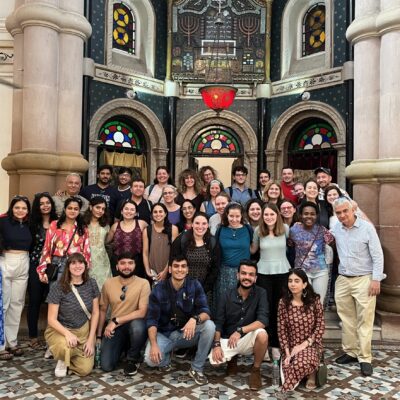
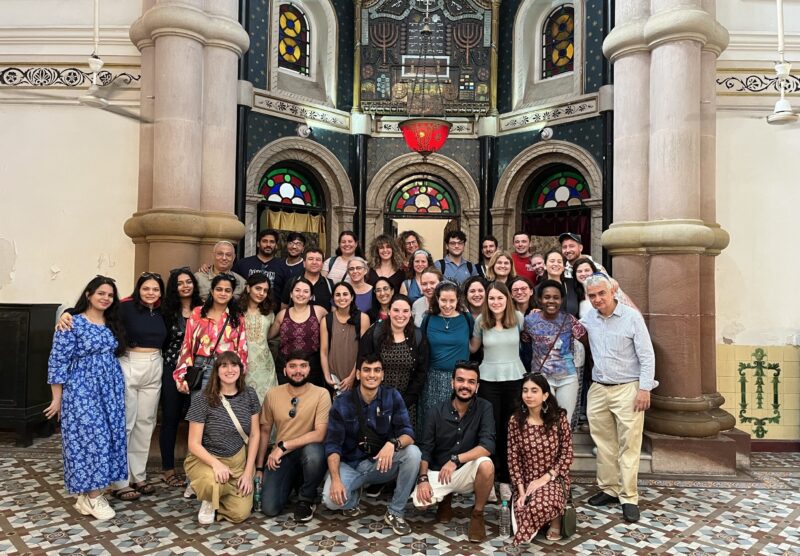
HUC rabbinic and cantorial students and Jewish educators-in-training gather for a tour of the Magen David Synagogue in Kolkata, India, as part of their trip to visit with and learn from the country's Jewish community, where JDC has worked since the 1950s.
He sent a letter to rabbis in New York to try to understand who these people were, and discovered they descended from Jews expelled from Spain in 1492. The rabbi assisted Calvo and Policar with finding housing and employment. These events mark the start of Seattle’s vibrant Sephardic community.
This tale of Jewish connectedness and responsibility resonates even more deeply today. As Jews, we are grappling with rising global antisemitism, including the horrific attacks in Sydney and Jackson, a fragile ceasefire in Israel and instability around the globe.
That is why the story of Seattle’s Sephardic community resonated so deeply for us when it was shared several months ago at the first reunion of the Weitzman-JDC Fellowship for Global Jewish Leaders, a program that offers Hebrew Union College rabbinical, cantorial and education students a unique opportunity to travel and explore the global Jewish world and integrate a sense of global Jewish responsibility into their future professional lives. This journey is grounded in the historic and current work of the American Jewish Joint Distribution Committee, a global Jewish humanitarian organization.
Over a decade ago, JDC board member and leading philanthropist Jane Weitzman had the foresight to pair HUC and JDC so that rising Jewish leaders could understand the complex world that Jews live in and the issues that confront Jews internationally. From Buenos Aires to Bucharest, from Mumbai to Dubai, the fellowship has enabled HUC students to encounter the Jewish world in all its richness and complexity. They meet the young professional in Bucharest who single-handedly refurbished his town’s synagogue; the residents at Mumbai’s Jewish old–age home who regaled us with the tunes of their youth, including a Sephardic song; and the Jewish school children with whom we played soccer in Buenos Aires.
Since the fellowship’s inception, 50 fellows and more than 150 HUC students have seen the JDC’s life-changing work; today they are impacting 200 Jewish institutions in the U.S., Canada, Israel, Australia and Austria, infusing them with the mantra of global Jewish responsibility. In both moments of crisis and calm, these young leaders take initiative to forge new paths to Jewish connection by cultivating a global sense of Jewish life and identity.
Weitzman-JDC Fellow alumnus Rabbi Michael Lewis brought a group of young adults from his congregation at Temple Emanu-El in Dallas on a JDC Entwine Insider Trip to connect with the Jewish community in Budapest. Despite the enduring legacy of the Holocaust and decades of Communist persecution, this community continues to thrive. Through cultural immersion and peer engagement, the Dallas group met other young Jews revitalizing Jewish life in Hungary and beyond, gaining a deeper appreciation for diverse Jewish identities and inspiration to respond to today’s challenges back home with innovation, pride and determination.
Shortly after the conflict began in Ukraine, countless Weitzman-JDC Fellowship alumni reached out to see how their synagogues could offer support to the local Jewish community there. Some organized collection drives and shipped items to refugees in Moldova, while others shared their experiences of visiting Ukrainian Jewish communities with their congregants, urging support and solidarity.
We have found that the more that students are able to interact with Jews around the world, the more they are able to relate to Jewish Peoplehood — not just as a theoretical discussion, but as one person gazing into the face of the other. Students develop a lasting sense of responsibility toward Jews around the world, and one that continues to impact their commitments and actions within their home communities.
That impact is urgently needed as we stand at a critical crossroads for global Jewish life. Jewish communities are facing both significant challenges and profound opportunities, especially for those encountering crisis and those who are seeking Jewish connection and meaning as part of “the Surge.”
Two core learnings from our decade of this fellowship can serve as guideposts for those seeking to strengthen Jewish life and put into action the ideal that all Jews are responsible for one another:
First, community is our call to action, and it requires a global mindset. The story of Solomon Calvo and Jacob Policar is not just a historical anecdote; it reminds us that, even across oceans, Jews have always found and supported each other. We must renew that commitment in our time, especially in moments of dire need for our people.
Second, global Jewish culture transforms Torah and Jewish life at home. Immersion in Jewish communities around the world deepens empathy, sharpens emotional intelligence, and expands understanding of Jewish identity. These global experiences bring greater depth to Jewish practice, programming, and the Torah the Fellows teach, shaping the mindset they bring to their roles and enriching the communities they serve at home.
Following such experiences, Weitzman-JDC Fellows have gone on to develop engaging curricula on tzedakah and Jewish Peoplehood. They introduce tunes unique to the communities they’ve visited into their own congregations in America, and they give sermons on the blossomings of Jewish life they’ve encountered in the most unexpected places — the synagogue behind an aquarium supply shop in Cochin, India, or the Jewish family camp in located in a Romanian town named Christian.
For Will Brockman, a third-year cantorial student and current Weitzman-JDC Fellow, his future cantorate will be informed by the Romaniote-style prayers he learned in Athens, folk melodies acquired from a Jewish choir in Budapest and the familiar Reform tunes he chanted in a synagogue in Cape Town. All these now enrich his community, linking it to the rich history and traditions of Jews across the world.
In an October 2025 sermon at HUC’s Los Angeles campus, Sarah Livschitz, a fifth-year rabbinical student from New Zealand who has traveled with and received a microgrant from JDC Entwine, said that JDC “taught me how to enact Klal Yisrael.”
“Through JDC, I have gained a better understanding of the richness of Jewish life around the world. I felt passionate about global Jewry before, but now I feel empowered to actualize that desire,” she continued, and offered the following charge: “Wherever you go next, remember that Klal Yisrael only exists as long as we continue to cultivate the connections between and within it.”
Messages like these from the pulpit counter growing isolationism, even among Jews, to divide the world up into local needs and those of people far away — people who should take care of themselves rather than rely on us. But Jewish history and recent events teach us that Jews are connected wherever they are and require each other for mutual support and kinship to build resilience and forge a stronger future.
More than a century after two strangers called out “Yehudi!” in the streets of Seattle, the call remains the same. Jewish life endures because Jews continue to recognize one another across distance, difference, and uncertainty. In this fragile moment, expansive, connected leadership is required. Our communities look to clergy and educators to answer that call, to stand in the space between distance and belonging, and to ensure that no Jew is ever left unheard.
Rabbi Madeline T. Budman serves as rabbi educator at Congregation Emanu-El in San Francisco.
Rabbi Joshua Mikutis is JDC Entwine’s director of design and Jewish learning and the rabbinic director of the Weitzman-JDC Fellowship.