WHAT YOU SHOULD KNOW
U.K. sanctions unlikely to directly affect West Bank nonprofits, but could make Israel support toxic

Wiktor Szymanowicz/Future Publishing via Getty Images
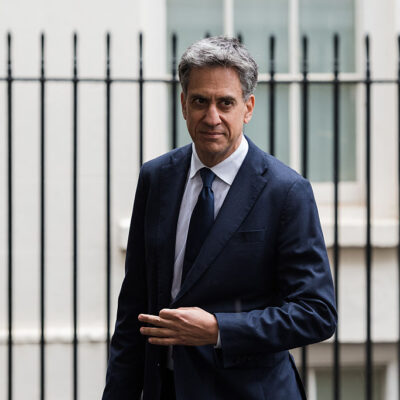
British Foreign Secretary Ed Miliband leaves 10 Downing Street after attending a weekly Cabinet meeting in London, on Sept. 8, 2026.




 Add EJP on Google
After weeks of signaling its intentions, the British government announced fresh economic restrictions on Israeli settlements in the West Bank, banning goods from settlements and imposing sanctions on “specific companies and individuals who provide services such as construction, infrastructure, financing, or real estate for settlement expansion,” accusing Israel of “ethnic cleansing” and turning a “blind eye” to extremist violence against Palestinians. France and Canada have announced similar measures.
But despite the sweeping rhetoric and Foreign Secretary Ed Miliband’s threat of using “the full force of U.K. sanctions” against companies and individuals who help expand settlements, the immediate effects of the restrictions appear to be limited.
Ahead of the announcement, Bloomberg reported that the British diplomats had privately told their American counterparts that the sanctions are “largely symbolic.”
In his announcement, Miliband noted that it will take “six to nine months” for the legislation required to be passed, leaving ample time for negotiations and compromises, particularly if a new Israeli government is elected. He also added that there will be “appropriate religious exemptions” for its sanctions.
For British, Canadian and French nonprofits that support organizations in the West Bank — both those directly connected to the settlement enterprise and more generic ones that merely benefit Israelis who live in settlements, like educational programs and social services — the practical effects of the new trade bans and economic sanctions will likely be minimal; existing laws already limit their ability to fund initiatives beyond the “Green Line” — the de facto border between Israel proper and the West Bank.
As it is, British and Canadian authorities are investigating Jewish nonprofits that support activities in the West Bank. Canada has also been steadily revoking the nonprofit status from organizations that operate in the West Bank, most notably Jewish National Fund-Canada.
Last month, the U.K.’s Charity Commission launched an investigation into British nonprofits that have transferred funds for projects in West Bank settlements, which the British government considers to be illegal.
In addition to the trade ban and sanctions against West Bank settlements, Miliband also announced that the government planned to bar British organizations and institutions from advertising real estate in West Bank settlements. This, he said, was in response to a real estate event in June at a London synagogue, which included properties in East Jerusalem and West Bank settlements.
As an investigation was already launched against the organizers of the event, who apologized for including properties beyond the Green Line, it is not clear why an additional ban is necessary.
And yet, while the sanctions and bans may have a limited concrete effect on Israeli nonprofits that operate in the West Bank, several figures involved in Diaspora philanthropy told eJewishPhilanthropy that they could have a chilling effect on foreign donations to all Israeli causes. Speaking on condition of anonymity to discuss a sensitive diplomatic issue, the sources said that these changes will make it easier for anti-Israeli organizations and individuals to lodge complaints with tax authorities in those countries and generally make support for Israeli initiatives more fraught and controversial. As a result, many would-be funders may decide that funding such projects is not worth the added hassle and social stigma associated with them, even if they are entirely in line with the law.
The backlash against the move by Israeli and most Jewish leaders has been swift. British Chief Rabbi Sir Ephraim Mirvis called it a “dark day for British Jews.” Two of the U.K.’s central Jewish communal organizations — the Board of Deputies and Jewish Leadership Council — decried the decision, accusing the Labor government of acting out of partisan politics and pressure from radical groups, even as they each condemned the issue of violence by extremist Israelis against Palestinian civilians.
The two organizations, as well as the chief rabbi, also said that the measures would be ineffectual and likely counterproductive.
“Today’s announcement is not about advancing peace or the two-state solution. The government is simply yielding to pressure from the most extreme elements of British society. They will continue to push the government to take increasingly radical action against Israel, to the detriment of peace in the Middle East and community relations in the UK,” the Jewish Leadership Council said.
The Board of Deputies noted the odd timing of the announcement, a month and a half before an Israeli national election, which could push the current government to adopt even more expansionist policies in the West Bank to appease its voters.
“Announcing such measures during an already heated Israeli election — which has the potential to lead to considerable change to the situation in the West Bank and Gaza — risks perverse consequences which go against the UK’s stated objectives. We urge both governments to avoid pursuing what appear to be party interests over national interests,” the group said.
Mirvis warned that the measures would also buoy extremist rhetoric and antisemitism.
“The measures announced amount to little more than political flag bearing for mendacious anti-Israel rhetoric and those who harbour a dangerous obsession with the Jewish State. These measures will succeed only in bolstering the very extremism they seek to target,” he said.
“Gesture politics of this kind feeds into an increasingly hostile discourse about Israel, and the cumulative effect of such punitive policies is to further embolden those, at home and abroad, who use hatred as a weapon against Jews,” Mirvis continued.
Speaking to the British Jewish News after the announcement, Miliband rejected the claim that the measures would encourage antisemitism in the United Kingdom, which has already seen a marked rise in antisemitic incidents in recent years, including a deadly attack on a Yom Kippur service last year in Manchester.
“Any person who targets British Jews because of the actions of the Israeli government is an antisemite in my view. That’s very, very important, and I couldn’t have said it more plainly,” Miliband said. “I don’t think anyone should be conflating these two sets of questions. There are British Jews going about their lives, there are the actions of the Israeli government, and then there is our relationship with Israel. I want a strong and flourishing relationship with Israel.”
Large American Jewish organizations also decried the sanctions, with the Conference of Presidents of Major American Jewish Organizations noting that they potentially put the U.K. on a collision course with the United States.
“Companies complying with these boycott measures should think carefully about the consequences,” the Conference of Presidents said in a statement. “Thirty-eight U.S. states have acted, through laws or executive action, to oppose boycotts of Israel. Companies that participate in these measures may therefore put state contracts, investments, or other business at risk. Businesses should not allow foreign governments to enlist them in economic discrimination against Israelis.”
The American Jewish Committee, which also decried violence against Palestinian civilians in the West Bank, said the trade bans and sanctions would not advance peace. “Violence by Israeli extremists in the West Bank must be condemned and those responsible must be held accountable. AJC has spoken forcefully on this issue,” the group said in a statement. “But the path to a better future for Israelis and Palestinians runs through diplomacy, dialogue, and direct negotiations, not economic isolation. European governments should focus their efforts on strengthening the conditions for meaningful engagement and a secure and prosperous future for both Israelis and Palestinians.”