WHAT YOU SHOULD KNOW
Turmoil and tut-tutting as Yesh Atid splits World Zionist Organization
SCREENSHOT
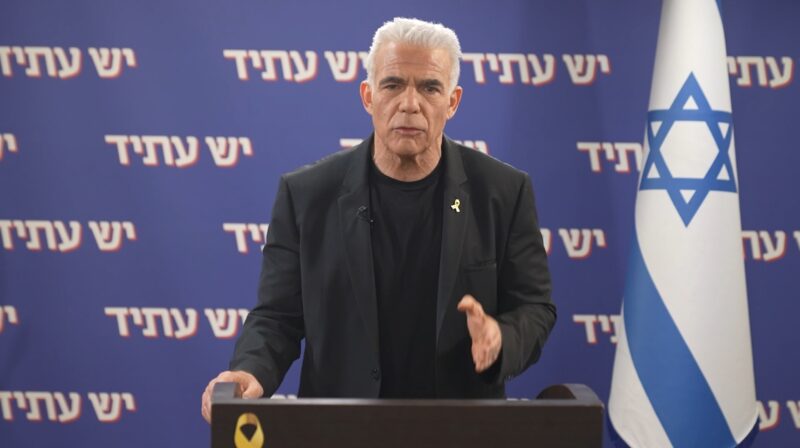
Yesh Atid leader Yair Lapid announces that his party was dropping out of the 'National Institutions' on Nov. 5, 2025.




 Add EJP on Google
The centrist Yesh Atid party’s sudden decision yesterday to drop out of the so-called “National Institutions” shocked and angered its center-left allies in the World Zionist Congress, with whom it had been working to negotiate a power-sharing agreement with the center-right parties.
In a recorded video message, Yesh Atid leader Yair Lapid described the World Zionist Organization and Keren Kayemeth LeIsrael-Jewish National Fund, which owns more than 10% of the land of Israel and controls a substantial budget to match, as irredeemably corrupt, which he said required his party to abandon them entirely. Lapid also called for the “immediate nationalization” of KKL-JNF’s land holdings and assets.
Yesh Atid, as the largest party in Israel’s opposition, had been playing a lead role in the negotiations, with representatives from the party expected to serve as chairs of KKL-JNF and the WZO, which runs educational and civil programs around the world.
“[Yesh Atid Chair Yair] Lapid is like a commander who abandons his soldiers in the field,” a political ally of Yesh Atid in the congress told eJewishPhilanthropy, speaking on condition of anonymity to discuss a sensitive matter.
Representatives from several center-left parties, who spoke to eJP on condition of anonymity, said that they were caught off guard by Lapid’s announcement, believing that the power-sharing agreement between the left and right blocs of the congress was nearing completion. In some cases, Yesh Atid allies only found out about the decision when they were asked about it by journalists.
The crux of Yesh Atid’s split with its center-left allies was not in Lapid’s diagnosis of the situation but in how he planned to address it. Speaking to eJP, Yesh Atid’s coalition allies did not dispute Lapid’s conclusion that WZO and KKL-JNF had become corrupt and excessive institutions, which often served as a mechanism for Israeli politicians to provide political allies and family members with lucrative jobs. Instead, they argued that walking away from the organizations both hampers efforts to reform them and serves only to leave control of these budgets and positions in the hands of the center-right bloc.
The unnamed political ally derided the Yesh Atid decision as an “amateur political move” and as a futile gesture. He noted that, for instance, a top official in the KKL-JNF workers’ association — which has regularly been accused of being a hotbed of cronyism and political corruption — had been arrested recently as part of a new massive corruption probe involving the Histadrut labor union. “This would have been an amazing opportunity to fix it,” the ally said. He added that KKL-JNF is in the midst of a search for a new director-general, which — as chair — Yesh Atid could have played a central role in selecting, but now won’t.
Steinhardt Foundation CEO Tova Dorfman, who serves as president of the WZO and is also a major Yesh Atid supporter, told eJP that after years of pushing for reform from within the organization, Lapid reached the conclusion that this was a lost cause.
“The price that we felt we had to pay in terms of corruption was too high,” Dorfman said.
Dorfman noted that in addition to the center-right bloc’s initial plans to nominate Israeli Prime Minister Benjamin Netanyahu’s divisive son, Yair, to a top post within the WZO, the proposed agreement would have also included a senior role for one of the sons of Shas leader Aryeh Deri. Participating in an agreement that included that kind of “nepotism” would have compromised Yesh Atid’s ability to stand against political corruption, she said, also noting the rampant fraud that was seen in this year’s World Zionist Congress elections.
“Now [Lapid] is going to try to change the system from within his political power,” Dorfman said.
In the short term, Lapid’s move throws the coalition negotiations back into turmoil. However, a source involved in them told eJP that Yesh Atid’s abdication does not fundamentally alter the balance of power between left and right, so the basic power-sharing arrangement should still hold. “In another few days, we’ll be there,” the source said.
In the long term, however, Yesh Atid’s abandonment of the National Institutions may signify the beginning of their demise, ending a nearly 130-year-old institution that gave rank-and-file Diaspora Jews direct power over the goings-on in Israel. Through the World Zionist Congress — in theory anyway — one need not be a billionaire philanthropist or the head of a national organization or religious denomination to influence significant budgets, programs and building plans in the Holy Land.
To some, this is what made these institutions anachronistic, no longer relevant or necessary after the creation of the state. To others, the institutions are what helped sustain the connection between world Jewry and the State of Israel, not through rhetoric and gestures but in practical terms of cold, hard cash and political leverage.
Though Lapid has built and maintained a strong relationship with Diaspora Jewry — until now at least — he has long eyed the National Institutions warily. As finance minister from 2013-14, Lapid first sought to nationalize KKL-JNF, and in the 2015 World Zionist Congress, Yesh Atid played a limited role in the field. This year, Yesh Atid decided to play a more active role in the National Institutions. This was driven, in part, by Dorfman, who has long supported Israel-Diaspora ties.
“This was a really painful, difficult decision,” Dorfman said.
“From being on the inside for a couple years, I can tell you, it’s not easy. We did make strides when we were sitting there, and that’s why we went back to the table. We believed in the [power-sharing agreement] but it got to the point that [we had to leave]. We couldn’t live with it,” she said. “I couldn’t argue anymore.”
Dorfman stressed that Lapid and Yesh Atid still believe that world Jewry is a “strategic asset” for the State of Israel. She also clarified that the party’s issues are with WZO and KKL-JNF, not with the other two organizations that make up the National Institutions: the Jewish Agency for Israel and the international fundraiser Keren Hayesod, which she said Lapid greatly respected, particularly in their efforts following the Oct. 7 attacks.
Regarding the future of Israel-Diaspora relations, Dorfman said that it may indeed be time for a new framework instead of the World Zionist Congress. “Israel’s almost what? Seventy-eight years old?” she said. “Maybe it’s time to think of another form of representation.”